US stocks end bumpy session relatively flat
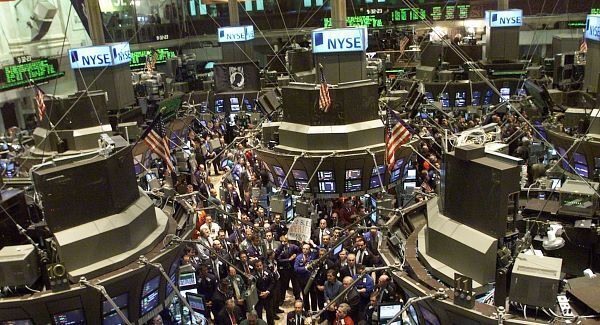
Stock prices pared earlier gains to end a choppy day relatively flat today as Wall Street remained uncertain that a 17.4 billion-dollar(€12.5 billion) lifeline for US carmakers will make a lasting difference for the beleaguered industry.
In early trading, investors cheered the government’s pledge to provide General Motors Corp and Chrysler LLC with short-term financing and sent the Dow Jones industrial average up as much as 182 points.
But stocks turned lower at midday, recovered in the afternoon, and then lost ground again in the last hour as initial enthusiasm over the bail-out waned.
The decision to provide emergency help to carry the struggling industry into the new year comes after a 14 billion-dollar(€10 billion) bail-out for the carmakers failed to make it out of the Senate last week.
The companies’ cash flows have been dwindling to a slow trickle due to the weak economy, slumping sales and the credit crunch.
The White House said it will let GM and Chrysler draw 13.4 billion dollars(€9.6 billion) in short-term financing, and another 4 billion dollars(€2.9 billion) will be added later. But it attached conditions that must be quickly met – GM and Chrysler must prove viability, defined as positive cashflow and the ability to pay back government loans, by March 31.
Ford Motor Co, meanwhile, is not asking for short-term assistance, but its chief executive predicted the aid will stabilise the broader industry.
GM chief executive Rick Wagoner said the company had much work ahead, but he was confident it could reinvent itself with the government help.
Some analysts expressed doubts.
“I think that there’s a lot of scepticism about how much real reform we’re likely to see, particularly at GM, given the parameters under which the loans have been made,” said Alan Gayle, senior investment strategist at RidgeWorth Investments.
“There is a lot of scepticism about whether GM is prepared to do what needs to be done.”
Still, the government’s move staved off, for the time being, a major bankruptcy which could have sent a debilitating blow to the economy and the labour market.
Investors have been concerned about the job market ramifications of a possible bankruptcy filing by a carmaker like GM or Chrysler LLC, which some analysts said could result in up to 3 million US job losses.
The government lost more than half a million jobs in November, and the Labor Department said yesterday that new claims for unemployment remained well above 500,000 last week. When unemployment rises, spending declines and credit deteriorates.
The White House’s action today “prevents the collapse of a very high- profile industry less than a week before Christmas,” said Phil Orlando, chief equity market strategist at Federated Investors.
“That’s not to say that these guys won’t collapse next March, but it takes it out of the headlines now, and takes the threat of an auto industry default off the table until next spring.”
GM shares jumped 83 cents, or 22.7%, to 4.49 dollars, while Ford shares added 11 cents or 3.9% to 2.95 dollars. Chrysler is not publicly traded.
According to preliminary calculations, the Dow Jones industrial average fell 25.88, or 0.30%, to 8,579.11. The Standard & Poor’s 500 index rose 2.60, or 0.29%, to 887.88, while the Nasdaq composite index rose 11.95, or 0.77%, to 1,564.32.
For the week, the Dow ended down 0.59%, while the S&P 500 finished up 0.93% and the Nasdaq up 1.53%. All of the indexes are still down more than 35% for the year.
The technology-heavy Nasdaq was lifted by big gains from Oracle Corp and Research In Motion Ltd, both of which released earnings reports after the bell yesterday.
Oracle’s profit weakened for the first time in years, but its shares rose 7% as investors bet that the company will fare better than others as the economy struggles.
BlackBerry-maker Research In Motion rallied 4.39 dollars, or 11%, to 42.83 dollars, after reporting better-than-expected revenue guidance for the fourth quarter and strong holiday sales of its new smart phones.
The Russell 2000 index of smaller companies rose 7.09, or 1.48%, to 486.26.
Advancing issues outnumbered decliners by about 2 to 1 on the New York Stock Exchange, where volume came to 2.14 billion shares.
Some analysts attributed much of the market’s choppiness today to the expiration of options contracts, as well as the routine rebalancing of stock indexes.
Earlier today, Treasury Secretary Henry Paulson said Congress should release the second 350 billion dollars from the rescue fund which it approved in October to bail out financial institutions.
Mr Paulson said tapping the fund for the auto industry basically exhausts the first half of the 700 billion-dollar total.
At the same time, he said he was confident that the Treasury Department, Federal Reserve and Federal Deposit Insurance Corp had the resources to address a significant market event if one should occur before Congress approves the use of the second half of the largest government bail-out programme in history.
Meanwhile, the industry which has already received billions in government funding – the financial sector – remains in sad shape.
This morning, Standard & Poor’s downgraded its ratings on 11 major US and European financial institutions, including Citigroup Inc, Goldman Sachs Group Inc, JPMorgan Chase & Co, and Wells Fargo & Co.
Citigroup shares sank 41 cents, or 5.5%, to 7.02 dollars. Wells Fargo slipped 29 cents to 29.36 dollars.
Yesterday, the stock market tumbled, shaken by a negative ratings outlook for industrial conglomerate and Dow component General Electric Co. A drop in oil prices also weighed on stocks, pulling down the energy sector and revealing how downbeat investors are about consumer demand.
The market’s losses on Wednesday and yesterday erased most of the Dow’s 360-point rally on Tuesday, which was sparked by the Federal Reserve’s historic interest rate cut. The central bank set its target for the rate at which banks lend to each other to a range of zero to 0.25%, the lowest level on record, and vowed to use “all available tools” to jump-start the economy.
Still, analysts believe Wall Street has entered a period of relative stability, compared with the wild swings of September, October and early November. Since their multi-year lows on November 20, the Dow is up 13.6% and the S&P 500 is up 18%.
“Even though there’s been a lot of really bad news coming out about the economy in the last few weeks, especially in unemployment numbers, the market hasn’t been reacting negatively to that,” said Richard Sparks, senior equities analyst at Schaeffer’s Investment Research.
Yields on long-term Treasurys recovered from record lows today. The yield on the benchmark 10-year Treasury note, which moves opposite its price, rose to 2.12% late today from 2.07% late yesterday. The yield on the popular three-month T-bill – whose yield has at times gone negative due to frenzied buying – rose slightly to 0.01% from zero late yesterday.
The January contract for light, sweet crude, which expired today, fell 2.35 dollars to settle at 36.22 dollars, the lowest close in nearly five years after falling at one point to 33.44 dollars.
The dollar rose against other major currencies. Gold prices fell.
Markets overseas were mostly lower. Japan’s Nikkei stock average slipped 0.91%, while Hong Kong’s Hang Seng index sank 2.39%. Britain’s FTSE 100 was down 1.01%, Germany’s DAX index fell 1.26%, and France’s CAC-40 fell 0.26%.