Wall street tumbles amid carmarker bailout worries
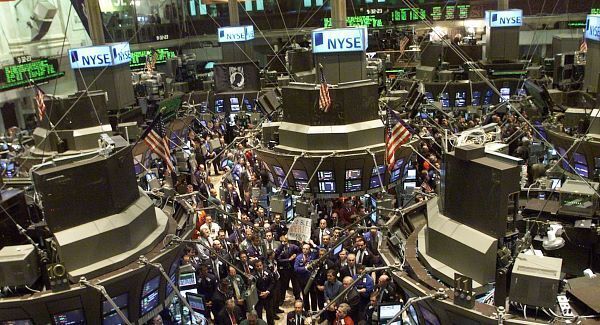
Wall Street’s anxiety about Detroit carmakers welled up today, sending stocks sharply lower in an afternoon sell-off as investors grew fearful that a bill to rescue the companies would not get through the Senate.
The retreat follows mostly moderate moves in stocks since mid-November and is a fresh reminder of investors’ fears about the US economy.
Prospects for the 14 billion dollars(€10.49 billion) in loans to cash-starved General Motors and Chrysler dimmed as opposition from both parties mounted.
Politicians opposed to the plan are arguing that any support for the car industry should carry significant concessions from autoworkers and creditors and reject tougher environmental rules imposed by House Democrats.
The House approved the plan on Wednesday on a vote of 237-170 to infuse money within days to the two struggling companies. Ford has said it does not need aid.
The heads of the three companies said that even one of them going into bankruptcy would slam an already battered economy with thousands of job losses.
Wall Street has been betting Washington would extend a lifeline to the companies and even recovered early today from a sell-off at the opening bell that followed weak readings on unemployment and the trade deficit.
But the worries about the carmakers weighed on a market that managed to trade flat for much of the session.
“What we had was a little bit of a jumping of the gun, overreaction to the auto-rescue bill,” said Jon Nadler, senior analyst at Kitco Bullion Dealers Montreal. “The Dow tried to put a good face on things, but at the end of the day, reality set in.”
The Dow Jones industrial average fell 196.33, or 2.24%, to 8,565.09.
The decline came a day after the Dow added 70 points after a surge in gold and other commodities prices gave investors reason to snap up energy and materials stocks.
The Standard & Poor’s 500 index fell 25.65, or 2.85%, to 873.59, and the Nasdaq composite index fell 57.60, or 3.68%, to close at 1,507.88.
The Russell 2000 index of smaller companies tumbled 25.19, or 5.3 %, to 451.21 as investors looked for the safety of larger companies expected to fare better in a weak economy.
Declining issues on the New York Stock Exchange outnumbered advancers by more than 3 to 1, while trading volume totalled a moderate 1.47 billion shares. Lighter trading can exacerbate the market’s swings.
“What’s going to happen in the Senate is really weighing on the market in a big way,” said Dr Robert Froehlich, chief investment strategist for DWS Investments. He contends that a failure of the car companies’ bailout would trigger a sell-off similar to what occurred when a financial sector rescue plan did not make it out of Congress on the first try.
The Dow Jones industrials tumbled 777 points on September 29 as the plan failed an initial House vote.
Wall Street remains on edge, as was clear by today’s pullback, but trading has been generally more orderly since the S&P 500 and the Dow hit multiyear lows on November 20. Even some big moves in stocks in recent weeks do not compare with the enormous swings in September and October.
One measure of unease in the market is still elevated but well off its highs. The Chicago Board Options Exchange Volatility Index, known as the VIX, is at 56. Ordinarily what is known as Wall Street’s fear gauge might be in the 20s and 30s but it had been near 90 in October.
Ed Hyland, global investment specialist for JP Morgan’s Private Bank, said investors were hoping the government’s medicine, from interest rate cuts to financial infusions in banks, would eventually help lift the economy but that it remained unclear how soon the recovery will come.
“There is still a high degree of uncertainty out there,” he said. “All you have to do is look at the Treasury market to get a gauge of how much fear there is in the overall investment community.”
In Treasurys, the yield on the three-month T-bill stood at 0.02%, unchanged from late on Wednesday. The low yield still indicates a high degree of investor unease. The yield on the benchmark 10-year Treasury note, which also moves opposite its price, fell to 2.63% from 2.69% on Wednesday.
The one-month T-bill’s yield was at 0.01%, down from 0.04% late on Wednesday. It was auctioned on Tuesday with a yield of 0%, a sign that institutional and foreign investors were so eager to preserve principal they were willing to forgo interest.
Chevron rose 1.02, or 1.3%, to 79.46 following the rise in oil, while Hess advanced 3.02, or 6.8%, to 47.71.
US automakers declined as investors worried about the prospects for a bailout. GM fell 48 cents, or 10.4%, to 4.12, while Ford fell 35 cents, or 10.8%, to 2.90. Chrysler is not publicly traded.
Financials fell amid worries about their balance sheets. US Bancorp warned it is earmarking more than 1 billion in the fourth quarter for bad loans. US Bancorp fell 2.82, or 10.2%, to 24.85. JPMorgan Chase & Co. fell 3.58, or 10.7%, to 29.94, while Wells Fargo & Co. declined 3.29, or 11.3%, to 25.90.
Consumer stocks fell after a surprise jump in weekly unemployment claims touched off fresh worries about weak consumer spending. Costco Wholesale Corp. fell 1.63, or 3%, to 52.06 after the warehouse chain’s first-quarter earnings fell short of Wall Street’s projections following a drop in sales of discretionary items.
CONNECT WITH US TODAY



Be the first to know the latest news and updates