‘Having a place like this is the fulcrum from which to build a good life’
OVERNMENT suggestions are 10-a-penny when it comes to tackling the national homelessness crisis. Not so bounteous are actions on the ground.
Talk has, however, morphed into something more tangible in a quiet Cork city suburb, where an innovative housing project is breaking new ground.
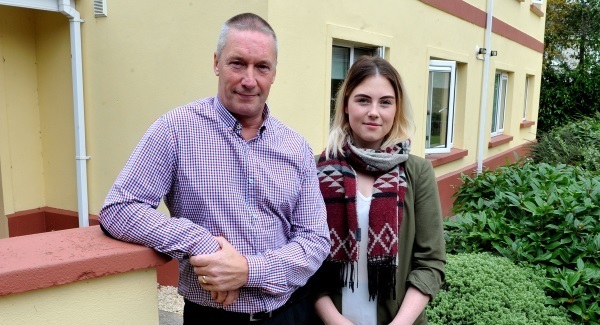
Bishopsgrove, a 39-bed, seven-house campus in Curraheen, targets young people on the cusp of homelessness and, all going well, sets them on an entirely different trajectory.
Behind electronic gates, it’s an attractive campus, leafy, dotted with picnic tables and bike stands — a cut above much of the student accommodation currently on offer.
But what really marks it out is the clientele. All of the residents are aged 18-25, who without Bishopsgrove would most likely be packing the city’s homeless hostels, or sleeping rough, or couch-surfing for as long as the goodwill lasts.
Take Matthew Moynihan, 23. A highly articulate young man, he still finds it difficult to talk of the circumstances that took him from Greystones, Co Wicklow, and a life that included boarding school education, to emergency accommodation in a St Vincent de Paul hostel in Cork.
He had issues with mental health he says, and addiction, that he couldn’t deal with himself. Anxiety levels were high. Somewhere along the way, he was sent to boarding school, “to get away from an abusive situation”, one of the “predicating factors” in his subsequent unravelling.
As time went on, his ability to cope deteriorated, as did relations with family. He wasn’t, he says, getting the help he needed and struggled “to crawl back out”. He had a breakdown in sixth year and didn’t finish his education.
He left home aged 19 and went to work in a shop in Greystones, renting a house for €350 a month. He was “smoking a bit of cannabis, drinking”. The addiction crept up on him, he says; he was, is, an alcoholic, though he no longer drinks.
Eventually, he lost his job, family issues worsened, and he moved to Cork. He says the absence of dual diagnosis services (addiction and mental health) meant he slipped through the cracks and ended up in Vincents.
Efforts to overcome addiction took him on a 12-step fellowship programme and his mentor allowed him to say at his home for the first three months of sobriety. Then it was back to Vincents, better equipped, he says, to deal with his situation.
In recognition of his efforts, the process to find him more suitable accommodation was sped up, and within months he had moved to the Foyer.
The Foyer, tucked away off a hill in Blackpool, is the forerunner to Bishopsgrove — both are owned by Cork City Council — and is in some respect its “feeder” campus. Celebrating its 10th anniversary this year, it has provided transitional accommodation to around 300 young people. Not just that, it has involved them in training courses which give them “something to put on their CVs”, says Foyer and Bishopsgrove manager, Barry Waddingham.
While the city council —Barry’s employer — is the Foyer landlord, it works in partnership with agencies such as Churchfield Community Trust, which offers training, work, and enterprise skills to the residents, with a particular focus on adult education, woodwork, painting, and horticulture. The trust also operates a Garden Café on site and allotment-style gardens where Foyer residents work. They also run a bike-repair service in tandem with the trust.
“For a young person with nothing on their CV, the courses can help get a job in a café, in retail. It makes them more employable. Which is what we want,” Barry says.
Barry came from the UK to interview for the job of setting up Ireland’s first Foyer, a French approach to youth homelessness, now widely used throughout the UK and France.
ORMERLY of the RAF, where he managed the officers’ mess, he subsequently worked with the Salvation Army Housing Association, before moving to the Foyer model. He saw the Cork job advertised through the Foyer Federation in the UK. The city council’s homeless forum had identified the need for a specific project to tackle youth homelessness.
Barry came with his pitch — “basically I lifted the best of the Foyers I had worked in in the UK” — and was given the task of setting up Ireland’s first Foyer from scratch.
A decade later, the Foyer’s success has prompted the council to invest in a what is a natural extension of the Blackpool service, but targeted at those committed to participating in third-level education, or equivalent accredited training, with the ultimate goal of employment and an end to the cycle of homelessness.
Katelyn Kelly, 21, from Glanmire originally, is among the first cohort of students at Bishopsgrove.
In care since she was seven — “when I was younger, my mum and dad couldn’t care for me, they had eight kids and problems of their own” — she moved in with a foster family in Cobh with her older sister. She still visits them at weekends.
Katelyn stayed with her foster parents until age 18, at which point the State considered her an adult, and she had to move on. She moved to a HSE residential centre, Wellsprings, for
females aged 16 to 23, where they helped hone her independent living skills — cooking, washing, cleaning. But she was still at risk of homelessness.
The Wellsprings manager had an eye to her wellbeing. “The manager knew about Bishopsgrove and told me about it. I decided I wanted to move there to be nearer college,” Katelyn says. She has just started Early Years Education, a three-year third-level course.
Matthew Moynihan is following his passion by studying radio broadcasting at Coláiste Stiofáin Naofa. He already has his own show, Voices of Ireland, on Irish Radio International.
“In a year’s time, I intend to be studying English and psychology at UCC,” he says.
Kieran Joyce, 23, joins the conversation in the comfortable kitchen-living room at the house in Bishopsgrove where this discussion took place. He had lived with his stepfather, but following the breakdown of that relationship, he entered a house share in 2014. That didn’t work out and he took to couch-surfing for a few months, eventually ending up on the streets. He was in the College of Commerce at the time, but sleeping rough and taking showers at a nearby gym.
“A security guard found me sleeping upstairs in the college and he asked me why. I told him everything. The next day staff at the college started talking to me and offering help,” Kieran says.
A staff member helped him get a place in a homeless hostel. He was grateful but felt a bit out of place, because it was “full of elderly men”.
“I was there a few months and then someone contacted me from the city council and put me in contact with Jess Feehan in Cork Foyer.
“I was assessed by another staff member for suitability and then Jess contacted me. That was just over a year ago, March 2016. I did training courses — health and safety, computers, sales. I worked in the Garden Café. Then Jess arranged for me to come here [Bishopsgrove[.”
Jess, who studied social care in Cork Institute of Technology, found herself in the Foyer as part of a third- year work placement. Then the role of project worker came up and her application was successful. These days, she is based at Bishopsgrove, supporting young people with the practicalities of applying for places on courses, budgeting, and independent living skills.
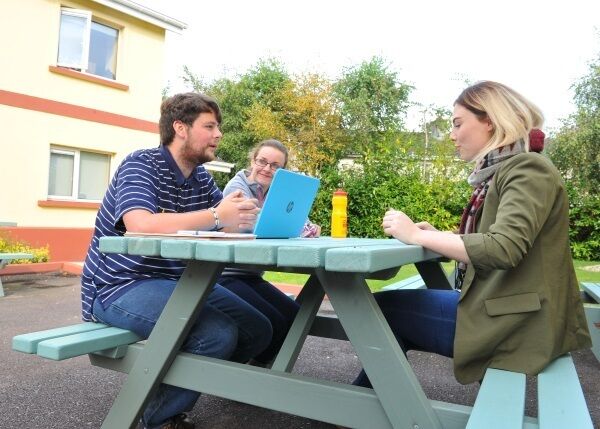
VERYONE on the Bishopsgrove campus must sign a legal agreement that lasts for the duration of college. Students pay €56 a week towards their accommodation costs.
They are required to participate in third-level education. If they drop out, they are given 28 days to find an equivalent and their social worker needs to make a convincing case that this young person is committed to living by Bishopsgrove’s rules. If education is not
resumed, rather than turf the young person back on the street, other options are
considered, such as swapping them out with someone in the Foyer who feels ready for third level.
Students are required to keep their rooms clean — there are room inspections. They’re given three written warnings if they don’t keep them up to scratch. “It’s three strikes and you’re out. But we don’t impose fines like in UCC,” Barry says.
There is a security presence on campus, but not 24-hour. There’s been no problems so far. Local residents did not object to the council’s purchase of Bishopsgrove for use as supported student accommodation, at a cost earlier this year of €2.1m.
“You’ve got to get the culture right,” Barry says.
“We met with local councillors. They were pleased the campus was managed and that they had a point of contact. If there are any issues, residents can be held accountable via the licence agreement.
“So far, we’ve had no problems, even though to a degree we don’t yet have a full staffing complement.”
An administrator will be hired later in the year to deal with rents. And a caretaker. There’s an eight-seater bus on campus, part-funded by JP McManus. It helps with social integration, Barry says. There are trips to Spike Island, Kinsale, fishing. This is a big step up. “We’ve never had anything like this at the Foyer in 10 years,” he says.
The beauty of the Bishopsgrove project — apart from its mission to prevent youth homelessness — is the amount of by-in from other agencies. It truly embodies what is repeatedly called for at national level — a multi-agency approach.
While the city council is the landlord and owns two of the houses, it has allocated units to Focus Ireland, Liberty St (which caters for young people out of home) and Tusla, the Child and Family Agency.
“The homeless services all work together to a certain degree but this is the first time all the agencies are coming together,” Barry says. “Liberty St is full of young people just finished their Leaving Cert, highly likely to end up in, for example, St Vincents or Edel House. Something had to be done.” Besides it’s more cost-effective to share the campus. “We are all trying to deal with the same problem — diverting young people out of homeless services. It’s a shared investment.”
Barry anticipates they will have a waiting list for the new student accommodation by Christmas. If any of the agencies has an empty room and nobody for it, it has to be given to another agency. It’s part of the service agreement which runs for 12 months.
“If we find one agency is not hitting the target group, the unit will be given to another housing agency.”
There’s already a waiting list at the Foyer. Barry says in previous years, 30-33 young people a year would have benefited from the service. Now it’s closer to 15 because there is nowhere to move on to, such is demand on homeless services. There are currently 22 people on the waiting list for the Foyer.
“We can’t find single accommodation anywhere,” Barry says. “The housing crisis has slowed the process of moving people on, so people are waiting longer to get in here and are taking longer to move out.” Against that backdrop, the young people in Bishopsgrove are the “lucky” ones, if the comparison is limited to other homeless situations.
Katelyn is grateful. “I’m happy here, that I have a roof over my head, that I am not at risk of homelessness.” She’s hoping her education will take her down her preferred career path, as a primary school special needs assistant. She loves children.
Kieran has just embarked on a one-year jewellery- making course in St John’s Central College on Sawmill St. The first decent piece he makes will be going to Jess, he says, because she has been his saving grace. “You bet it’s going to Jess. I’ll send it in a gold box,” he says.
Matthew says Bishopsgrove is a “great project” but a drop in the ocean considering national homelessness figures, tipping around 8,000.
He is critical of the national response but delighted with the local one.
“The advantage of having a place like this is that it’s the fulcrum from which to build a good life. Really, there’s a great level of support here, and space if you don’t need that support.
“The space is great, the wifi is great, the staff are great. There’s a great sense of communal living. We all have different stories and came here via different agencies, but there are similar themes.”
Matthew says Housing Minister Eoghan Murphy could learn from the Bishopsgrove project.
“I’d call on him to fund more of these initiatives so young adults at risk of homelessness can be supported while getting an education and reaching their potential.
“Bishopsgrove allows you to live, to live safely, to eat well, to have a bit of discretionary income, and know that there is support.”
Barry, recently invited to sit on the international Foyer Federation accreditation panel, says giving young people a place to live so they can get on with their education and lives, has been transformative.
“Their whole mindset changes to ‘I’m being looked at as a student now, not as a
homeless person’.”
CONNECT WITH US TODAY



Be the first to know the latest news and updates











