UK vote may not alter the Brexit picture
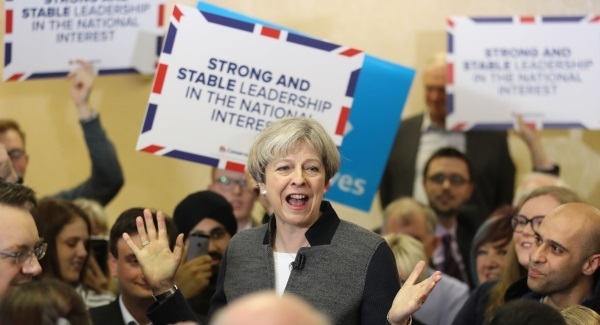

Britain’s Prime Minister, Theresa May, has moved with lightning speed to call a General Election less than two years after her predecessor David Cameron defied pundits and pollsters by securing an overall majority for the Tories in the House of Commons.
According to the conventional wisdom, the Conservative Party is on course to win a much larger majority.
It is the view of many in the financial markets that Mrs May will then have the authority to negotiate a deal with the EU that takes proper account of economic realities.
As The Economist put it: “A bigger majority would leave Mrs May free to strike sensible compromises.”
The alternative is really too hard to contemplate. We reach the March 2019 deadline with no deal in place and a breakdown in talks.
The economies of both Britain and the remaining EU 27 – and Ireland above all - face being crippled.
A new transitional regime must clearly be put in place to allow time for a new relationship to evolve.
The assumption is that with a substantial majority, the prime minister will face down the europhobes and Union Jack wavers, but what if her majority is extremely large and her parliamentary party has a much larger contingent of nationalists, many of them elected in constituencies in the North of England and the Midlands?
In 1977, Jack Lynch won a big majority only to be gradually undermined by restive and under-employed backbench TDs.
Sterling has strengthened considerably, to the relief of many in business with currency and commercial exposures.
Certainly, the prime minister is seeking her own mandate while the going appears good, hoping to secure the locks on No 10 Downing Street until 2022, by which stage she qualifies for a bus pass.
The British economy has outperformed expectations since the June 23 referendum vote, but there are signs of a downturn.
Headline retail sales have dropped by 1.4% in the first three months of 2017 and by almost 2% in the month of March alone. The mood music has altered.
Perhaps, this in turn will be followed by a more sober approach to the Brexit talks as gung-ho attitudes gradually moderate in the face of dawning economic realities.
Writing just ahead of the results of the first round of France’s presidential election, one is acutely aware of just how high the stakes now are just across the water.
The Daily Express once produced a famous headline; “Fog in Channel. Continent cut off.”
But just how cut off is mainland Europe these days? Political events in France could set off tremors across the eurozone.
Alternatively, they could have a calming effect, at least temporarily. But few would bet on stability.
Membership of the eurozone brought catastrophe to Ireland, but in recent years we have experienced stability as a result of low interest rates.
A renewed existential crisis in the zone would be accompanied by raised interest rates as question marks about peripheral countries with huge levels of borrowing — sovereign, corporate and personal — are raised.
The centrist and centre right candidates promise a degree of certainty, but are committed to reform.
A populist victory in the second round of the election could trigger meltdown in financial markets, but people should be aware that the traditional parties could score strongly in upcoming legislative elections.
All of which leaves investors rather puzzled right now.
The rolling elections have had the effect of stifling serious comment on the future of the EU, but such discussion must be had.
The French centrist candidate, Emmanuel Macron, has suggested that such a debate on the EU’s future needs to take place quickly as “Brexit imposes a calendar on us.”
He is calling for a public consultation across the union on its future and indicates that he favours establishing a separate finance ministry and budget for the eurozone.
Any such move would require deep-seated reforms within France.
Macron has been cultivating German political contacts but knows that the Germans remain reluctant to commit to any arrangement that involves pooled funding, largely at the Germans’ own expense.
In an address last week in memory of Michael Sweetman, the man who led the campaign for Irish entry into the European Community in 1972, Education and Skills Minister, Richard Bruton, warned that “the EU’s future could no longer be taken for granted .. Peoples’ faith has weakened.”
The EU’s origins lie in a desire on the part of people after World War Two to “turn swords into ploughshares.”
However, this idea had “lost traction”, in today’s world. We now had a new ‘precariat’, people living exposed lives and there is a “swing to authoritarian values”.
In his view, there are “flaws in the democratic design of the EU”. He also questioned the focus on fiscal rectitude evident in recent years. “We have spent the past five years projecting the EU as a model of austerity.”
However, technological change sweeping across the continent has altered the ground rules. One result is the ‘gig economy’ with eroded worker rights. Another is the development of “echo chambers of populism.”
In Richard Bruton’s view, there is a need for systems of solidarity and for an easing in the rules that prevent a country like Ireland from committing adequate resources to investment projects likely to address the country’s long-term needs.
It will be interesting to see whether space is allowed for such serious debate to take place, or whether events will simply gather a momentum of their own, imposing a new reality, altogether different than that envisaged by the centrist backers of the European project.
CONNECT WITH US TODAY



Be the first to know the latest news and updates











