Legs-it, more like sex-it. Who’s pulling whose leg?
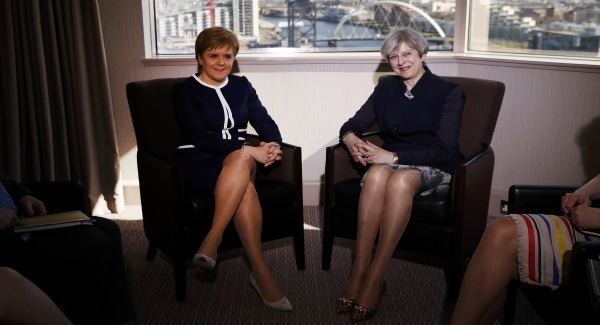
FUNNY old world. On Tuesday, there was uproar when the Daily Mail compared the legs of two of Britain’s most powerful politicians.
Beside a front-page picture of British prime minister Theresa May and Scottish first minister Nicola Sturgeon, it ran the headline: “Never mind Brexit, who won legs-it?” In the inside pages, a woman wrote an article that invited us — nay, incited us — to compare their lower limbs. Cue outrage and some choice comments. (A favourite: “Article 1950 has just been triggered”.)
It's 2017. This sexism must be consigned to history. Shame on the Daily Mail. pic.twitter.com/V3RpFSgfnO
— Jeremy Corbyn (@jeremycorbyn) March 27, 2017
The Daily Mail hit back, saying it was a bit of humour and telling dissenters to “get a life”.
Yes, the clock changed last weekend all right, but it seems we’d lost at least 100 years. Perhaps even more because on January26 last, The Guardian published a cartoon by Steve Bell that was even worse. It was intended as a modern rendering of an 18th-century sketch mocking the British royal family, but it’s clear nothing has changed.
On this occasion, the pins in question belonged to Donald Trump and Theresa May. The Donald’s were represented in bright orange; Ms May’s were fish-belly white. He was barefoot; she was sporting an exquisite pair of pointy leopard-print shoes.
Let’s not describe the position of the leaders’ legs in too much detail, other than to say Trump came out on top in an image that would be condemned as an example of the worst excesses of sexual humiliation if it were published in the Daily Mail.
Cue very little comment indeed, apart from a few angry tweets.
The Guardian riposted by saying it was satirising the “special relationship” between the US and the UK after the British PM’s visit to Washington. If you haven’t seen the offending cartoon you’ll find it on the internet but, let me warn you, it won’t improve your day.
Couldn’t resist? Well, at least now you and your churning stomach are in a better position to judge which newspaper won “sex-ist” – the scurrilous Daily Mail or the women-respecting The Guardian?
You could argue that caricatural legs have less impact than those depicting flesh and blood, but let me go out on a limb here and ask: When was the last time you saw a cartoonist resort to sexual domination in a sketch ridiculing two male leaders?
To be fair to Bell, he has a healthy disrespect for politicians of all hues, regardless of their gender, and embraces the carnal with unsettling glee. All the same, it’s interesting that the complaints were heaped on the Daily Mail — more than 300 people complained to the press standards body, Ipso — yet there was barely a whisper about The Guardian image. There are probably good reasons for that — readership numbers, a cartoon versus a photograph, a zealous respect for freedom of expression — but there is also a tendency not to call out sexism if it’s hidden in seemingly respectable places.
This week’s focus was, quite rightly, on the Daily Mail but it’s unfair to suggest the paper is the only guilty party. It is not alone in looking at women in high places and reducing them to their body parts?
If it had ended with legs, that wouldn’t be so bad; after all, it is a bit of a scoop to reveal that women actually have lower limbs.
The problem is when journalists start to write things like this: “There is no doubt that both women [May and Sturgeon] consider their pins to be the finest weapon in their physical arsenal.” The only pins I wanted were ones to stick in my eyes. Heaven help us, who would be a female politician in this day and age? And don’t be fooled, just because we’re living in ‘this day and age’ does not mean that the ideas of the sexist past are, in fact, past.
When a woman writes how May’s “famously long extremities are demurely arranged”, while Sturgeon’s more “shapely shanks” are tantalisingly crossed, you have to admit that the objectification of women is alive and well..

It’s not that I can’t take a joke, or see the humorous side when someone takes a light-hearted look at the semiotics of dress. I’m all for the interpretation of the signs and symbols of political attire; what you wear is up for discussion if you are in the public eye.
Anybody with the temerity to put themselves forward for elected office knows only too well that growing a thick skin is part of the job description. Our elected representatives are, quite rightly, subjected to all kinds of scrutiny. The message has always been, “don’t stand for election if you’re not able for the cut and thrust of politics”. But some, like Steve Bell, have taken the thrust far too literally. The sad truth is that female politicians are subjected to the worst kind of sexism — one that personalises and sexualises.
It’s all so very dull and so very dated.
Way back in the last millennium, the focus was on women’s legs too. In the early 1990s when Edith Cresson was France’s prime minister — the first and only one to-date — she made headlines for all the wrong reasons. A respected magazine printed a picture showing she had committed an unforgiveable crime against fashion — she apparently had a ladder in her tights.
But that was tame. She was nicknamed “La Pompadour” after the official chief mistress of Louis XV, and had to endure the protesting banners of farmers who said they hoped she was better in bed than in government.
She railed against the “calumnies and base deeds”.
As it happened, her term as prime minister was disastrous and short-lived. It lasted just 10 months. She went on to become a European commissioner but was forced to resign, in 1999, in a corruption scandal that involved serious financial irregularities over many years.
It goes to show that when dealing with politicians, of both genders, it makes sense to take your eye off their legs and keep it on the ball.

CONNECT WITH US TODAY



Be the first to know the latest news and updates