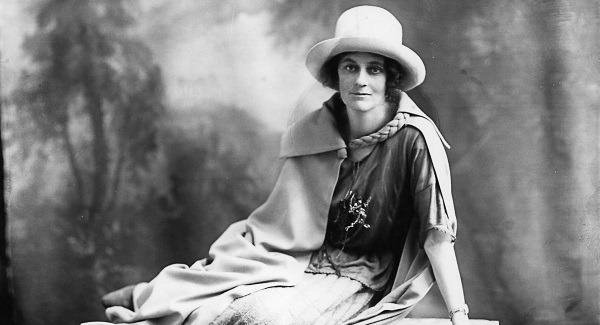
What would Constance Markievicz make of the position of women in the republic she helped win?
JAMES CONNOLLY was a feminist and he was the one who insisted that the 1916 Proclamation included women as well as men. When we read the proclamation today we can rightly ask ourselves the question: what happened to the aspired Irish Republic that “guarantees religious and civil liberty, equal rights and equal opportunities to all its citizens… cherishing all the children of the nation equally”?
Even though a great number of women played an integral role in the 1916 Rising, they never got the recognition they deserved for the part they played. This is evidenced in the reality that far too many of the women who fought alongside their fellow men were denied pensions after the War of Independence, and were not celebrated as heroes as their male counterparts were. It has taken 100 years to acknowledge and validate the role women played in 1916.
The 1916 Proclamation’s commitment to gender equality was ahead of its time.
Over the years we have demonstrated in Ireland that we are very good when it comes to producing reports but very poor when it comes to implementing the necessary changes to effect real change. Could this implementation deficit have had its genesis in 1916?

There is no single answer as to why the problem of gender inequality has been so difficult to shift, but we know that since 1916 women were treated as second class citizens in Ireland.
Married women were seen as the property of their husbands, they did not have the right to create their own domicile, and they had to retire from their public service jobs when they married. This is to name but a few of the many inequalities that have existed for women in Ireland.
It is true that since 1916 we have slowly but surely, but too often with great difficulty, made the necessary changes to address these inequalities. However, we still have some way to go yet to redress the many inequalities that still abound.
We need to work together to transform the social and cultural norms and institutions in order to once and for all eradicate inequality in our society, in particular violence against women, childhood poverty and homelessness.
Genders quotas, implemented in our recent General Election, have begun the process of redressing the gender imbalance that has always existed in Dáil Éireann. However, female members of the Dáil still only account for 22% of the overall membership. Gender quotas are like stabilisers — they can come off eventually once the balance is reached.
The disparity in female representation is also sadly evident in our second house, the Seanad.
I wonder what Constance Markievicz would say if she knew that in 35 years the graduates of National University of Ireland have not elected a woman representative to its Seanad panel? How would she react to hearing that women are still being paid less than men, for doing the same work? What would Dr Kathleen Lynn think of the statistics regarding violence against women, or Rosie Hackett of the housing crisis? Would they believe it if someone told them that 100 years from 1916 some families are forced to sleep in their cars because of the housing crisis and every night we witness people sleeping in doorways in our cities?
European Commission Statistics published in 2014 show Ireland’s gender pay gap is increasing. It was 14.4% in 2012 compared with 13.9% in 2010 and 12.6% in 2009 and 2008. The average EU gender pay gap stands at 16.1% (2014). These figures speak for themselves. While we have come a long way we are still very far from reaching gender equality in Ireland. Feminism needs to be embraced by everyone. It is not something to resist or to be afraid of. We know that more equal societies are healthier, happier and more prosperous.
In the recent General Election we saw the positive affect of the introduction of gender quotas. In order to represent our society fairly and to have a true mandate from all the people of Ireland, we need both genders in our Oireachtas.
Our Oireachtas is made of the President, the Dáil and the Seanad. Over the past 20 years we saw the very positive effect that our first two women Presidents, Mary Robinson and Mary McAleese, had on Ireland.
Both Mary Robinson and Mary McAleese were keenly aware of the symbolic significance of their position and their role as President on Irish society in general and on the women of Ireland in particular. Irish women as a consequence felt more empowered and confident as a result of having a female President. The fact that both Presidents were very different in their personalities and in the execution of their roles only enhanced their positive effect on our society. It is very heartening to have in President Michael D Higgins, a man who is a feminist and very proud to call himself a feminist.
In 2013 the people of Ireland voted to retain our second house of Government, Seanad Éireann. Since then Dr Maurice Manning has delivered an excellent report on Seanad reform.
However this report, along with 12 other reports on Seanad reform that were commissioned in the past, has not yet been implemented.
The current Seanad election is being conducted in the same way as Seanad elections of the past have always been conducted. It is elitist, it is a huge cost to the exchequer and it is not representative of all of the people of Ireland. The Manning Report needs to be implemented as a matter of priority in the new Government to address all of the above. So as we commemorate 1916, let us reconnect to that spirit of “equal rights and opportunities for all our citizens”.
If elected to Seanad Éireann next month, I will be the first woman elected to the NUI panel since 1981. Working together for true equality, education rights and mental health reform, we can make a difference.