ECB’s Mario Draghi facing an emerging-market slowdown
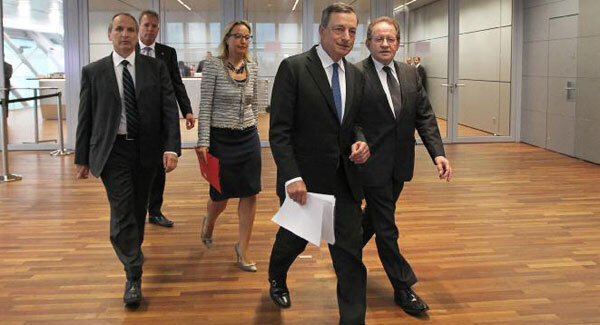
Mario Draghi can not catch a break.
ECB’s Mario Draghi facing an emerging-market slowdown

After overcoming a recession, Greece’s debt crisis and a damaged financial system, the ECB president should be celebrating a slowly improving economy.

Instead, an emerging-market slowdown is threatening the outlook and inflation that remains obstinately low.

That has put policymakers back where they were a year ago: Considering once again if they need to do more to pump up price growth.

“There’s a lack of inflation,” said Peter Dixon, an economist at Commerzbank in London.

“The global backdrop against which the eurozone economy is operating has clearly deteriorated, that is potentially one of the motivating forces behind the ECB’s desire to want to put more stimulus on the table,” he said.

As ECB officials wait for eurozone growth data this week, the slowdown in China and other emerging markets has prompted a drop in commodity prices, confounding their attempt to stoke price pressure via bond buys to the tune of €60bn a month.

That downturn overseas also carries the risk of putting the brakes on European expansion, which thus far has benefited from an uptick in real incomes and higher consumer spending.

The 19-nation economy probably expanded 0.4% in the third quarter, matching the pace in the previous three months.

Mr Draghi has all but committed to further easing by invoking the term “vigilant”, which his ECB predecessor Jean-Claude Trichet used to signal an imminent policy shift.

Having thus acknowledged that the fragile recovery is at risk of being derailed, and with inflation at zero, he will likely face a group of frustrated lawmakers when he testifies before the European Parliament on Thursday.

Mr Draghi now needs to “back up his words with actions”, said Dario Perkins, chief European economist at Lombard Street Research in London.

“The ECB will probably cut its deposit rate and expand its quantitative easing programme,” said Mr Perkins.

Last week, the European Commission cut its eurozone growth and inflation outlook for 2016, citing more challenging global conditions and a fading impetus from lower oil prices. GDP will rise 1.8%, while inflation will average 1%, it said.

The ECB aims to have inflation just below 2%.

“We are faced with a situation where the price dynamics are very weak, the macroeconomic environment is still uncertain,” Mr Draghi said in Milan last week. “We are not constrained in our ability to act.”

Industrial production data for the eurozone is scheduled for Thursday.

On Friday, seven euro-area economies, Germany, France, Italy, the Netherlands, Portugal, Slovakia and Greece, will release third-quarter GDP data in addition to numbers for the entire region.

More in this section

The Business Hub

Newsletter

News and analysis on business, money and jobs from Munster and beyond by our expert team of business writers.

Cookie Policy Privacy Policy Brand Safety FAQ Help Contact Us Terms and Conditions

© Examiner Echo Group Limited






