Going green puts firm in the black
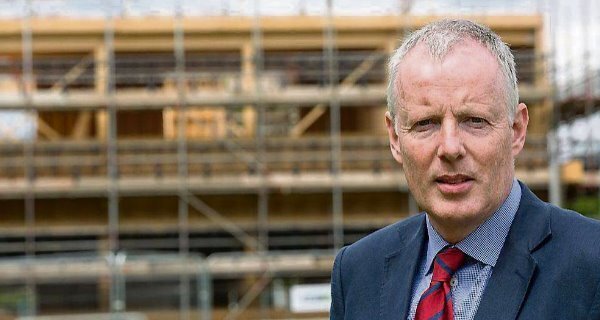
The company has engineered, manufactured, and erected the timber-frame structure for the €12.5m Norfolk Enterprise Centre, at the University of East Anglia. It has been called the UK’s greenest building because it is the first commercial building in Britain to achieve both Passivhaus and BREEAM standards, the most rigorous of environmental performance measurements.
Part of Cygnum’s role in building the 465m sq building involved processing 650m cubic of locally produced timber in order to create the frame. Winning the tender against stiff competition in the UK, one of the company’s strengths was that it had the technology and skill to process Corsican pine, a type of timber normally used for fencing.
Chief executive John Desmond says that Cygnum has been building Passivhaus, ultra-low-energy buildings in the UK since 2011 and has established itself as one of main timber-frame suppliers for these types of projects.
In rebuilding the company following the property collapse in Ireland, Cygnum has concentrated its efforts in the UK, initially focusing on Passivhaus projects, which are built to an energy efficiency standard akin to that seen in Germany.
“In supplying thisspecialist market, we have the technical engineering and design skills and the ability to provide cutting-edge solutions,” Mr Desmond says.
Set up in 1996, the company flourished during the Celtic Tiger years and, at the high point in 2007, employed a staff of 140 at its 5,000m sq facility in Macroom, building one-off houses, as well as commercial and housing developments around the country.
When the market in Ireland slumped, Cygnum had already established a tenuous foothold in the UK and an office in Suffolk and has since been working on growing this market. In the aftermath of the slump, the staff size was cut to 40. “But when the market began to recover in the UK in 2011, business began to pick up,” says Mr Desmond.
In 2011 Cygnum built its first Passivhaus project, a school in Wolverhampton. Since then, other Passivhaus projects have included a second school in Wolverhampton, others in Caerphilly and Bury Port in Wales, as well as an archive centre in Hereford.
In 2012 the demand for more mainstream housing and apartment developments, as well as commercial projects, began to grow. “We have worked on a broad range of projects throughout the UK including apartment developments, housing schemes, and supermarket buildings,” Mr Desmond says, adding that business is now fairly evenly divided between Passivhaus projects and standard timber-frame development.
Mr Desmond says that turnover grew by 75% in 2014 and that significant growth is expected this year. “We had a turnover of €7m in 2014 and are on target to grow this to €13m this year.”
The major share of the growth is in the UK, which accounts for 80% of turnover, but Cygnum is beginning to see green shoots in the Irish market. “We are working on a number of new housing developments in Cork and Limerick and are seeing further growth in both one-off houses and developments.”
Currently employing a staff of 60, Cygnum expects this to grow to 100 by the end of the year and plans to recruit graduate architects and engineers as well as factory production staff.
Macroom-based Cygnum has weathered the crash and is constructing the ‘greenest building in the UK’, writes
We had a turnover of €7m in 2014 and are on target to grow this to €13m this year