Promising signs as exports lead recovery
Things are looking up for the indigenous export sector, which is good news for the rest of us.
In the case of Ireland, it really is a case of export or die. We remain one of the most open economies in the world with total exports this year set to exceed €195bn. Much of this is accounted for by multinationals, with close to 60% of merchandise exports provided by the pharmaceutical & chemicals sector.
Moreover, the statistics can flatter to deceive. Large IT companies direct much of their activity through Ireland for tax purposes, while some of the recorded manufacturing activity of Irish-owned firms actually takes place overseas.
Increasingly, the use of contract manufacturers in low cost countries is skewing top line data, making it harder and harder for economists to get a handle on what is happening on the ground.
Nevertheless, it is clear that foreign trade has been propping up much of the economy. It is also evident that things are looking up for the indigenous export sector, which is good news for the rest of us, given its close links to the rest of the economy.
Around 175,000 people, perhaps slightly more at this stage, are employed by Enterprise Ireland companies, around 150,000 on a full-time basis.
The Irish Exporters Association represents the indigenous export sector. In its recent survey, conducted with accountants Grant Thornton, it found that just over 70% of respondents expect their business to increase in the coming year. Last year, 62% of those replying were upbeat about the year ahead.
Of course, there are bumps on the road. The IMF has warned of considerable financial and geopolitical risks to global recovery. The oil price has been falling. It could rebound within the next year. The eurozone remains mired in stagnation. ‘Black swan’ events are always possible.
No one priced in a war in Ukraine and sanctions against Russia into their predictions, this time last year. That said, the trade weather dial is pointed towards ‘fair’.
The food and drinks sector is one that has provided more of its share of positive stories as far as Irish-owned firms are concerned. The sector is well on course to beat the target of €12bn for food and drink exports set out in Harvest 2020. The coming year will be critical. Restrictions on output are due to be lifted at the end of March. Following strong harvests globally, and with pressure on demand on some countries, commodity prices have been soft. A crisis in the beef sector has pushed some farmers towards dairy. The banks are back lending to the sector, but farmers will have to tread warily during the transition.
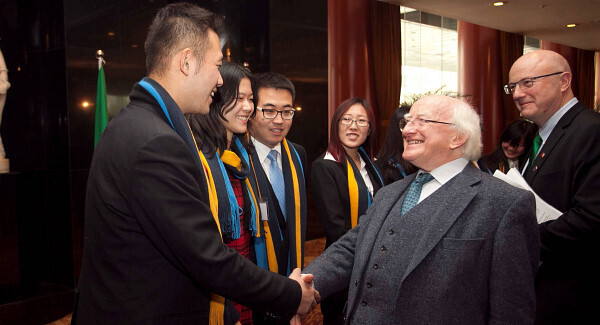
Geographically, China is emerging as a key market. The country’s president, Xi Jinping, received our first citizen, Michael D Higgins, recently in what amounted to an important signal of positive intent. A return visit to Ireland is in the pipeline. The country’s 1.3bn people have a growing appetite for dairy and meat products. Food and drink exports rose by 40% to reach €400m, last year.
Global income per head has risen from $7,000 (€5,750) in 1999 to $12,000 in 2009 paving the way for a large growth in middle income consumers, some of whom are swallowing more Irish whiskey, among other things. Jameson has accounted for 80% of growth in global consumption of over 10% in the Irish hard stuff.
Total exports of meat and livestock amounted to €3.3bn in 2013. Earlier this year, a visit from Agriculture Minister, Simon Coveney helped prise open the Japanese market for beef exporters.
The UK remains the key market for indigenous firms. In 2014, we witnessed an implosion in Tesco’s customer base. This raises important issues for suppliers, given Tesco is the largest corporate customer for Irish firms.
Enterprise Ireland has supported the creation of an Ireland-UK food hub to act as “a focal point for co-operation in innovation”. It is also offering ‘Channel Partner Development’ workshops aimed at ensuring that smaller exporters find the right ‘channel partner. Over 80% of our exporters operate through some form of partnership. Enterprise Ireland has concluded that there has been “a lack of systematic approach to partner identification” with “little initial assessment of the customer and competitive landscape in target markets”.
It concludes also that firms are not investing enough in training, marketing and promotion.
Some would appear to be getting it right. The country’s food multinationals and groups such as Glen Dimplex have shown how it can be done over a period of almost three decades.
Another interesting development was the launch at UCD of a new financial services technology centre focused on the development of ‘governance risk and compliance technology. The Dublin Web Summit, meanwhile, firmly established itself as Europe’s leading gathering for techies; while, in Cork, the Tyndall National institute continued to play a major role in promoting science and R&D.
The recent exporters association survey highlights some interesting trends.
The buoyant picture painted by official statistics is confirmed by this independent survey, which also highlights key challenges faced by firms in the medium term. Traditional markets such as the UK and US are back with a bang. In 2014, almost 80% reported a good or very good experience in the UK, with over 60% reporting positive experiences of the US. On the other hand, one third were less than enamoured with their selling activity in India and Russia, while China attracted a negative rating from one fifth of respondents.
Two thirds criticised the “overly bureaucratic decision-making” in state organisations yet somewhat perversely, support for the establishment of a state bank remains strong.
Just under one quarter reported difficulty in obtaining trade finance from the banks, yet 62% accept that access to finance, in general, has improved in the past year.
At the same time, over half had no awareness about existing state schemes, despite the efforts of organisations such as Enterprise Ireland and Bord Bia. Plenty of food for thought, so, for all those trading out of the food island and for those charged with assisting the traders.












