John Whelan: Sorry, Ms von der Leyen, but Turkish trade offers many benefits
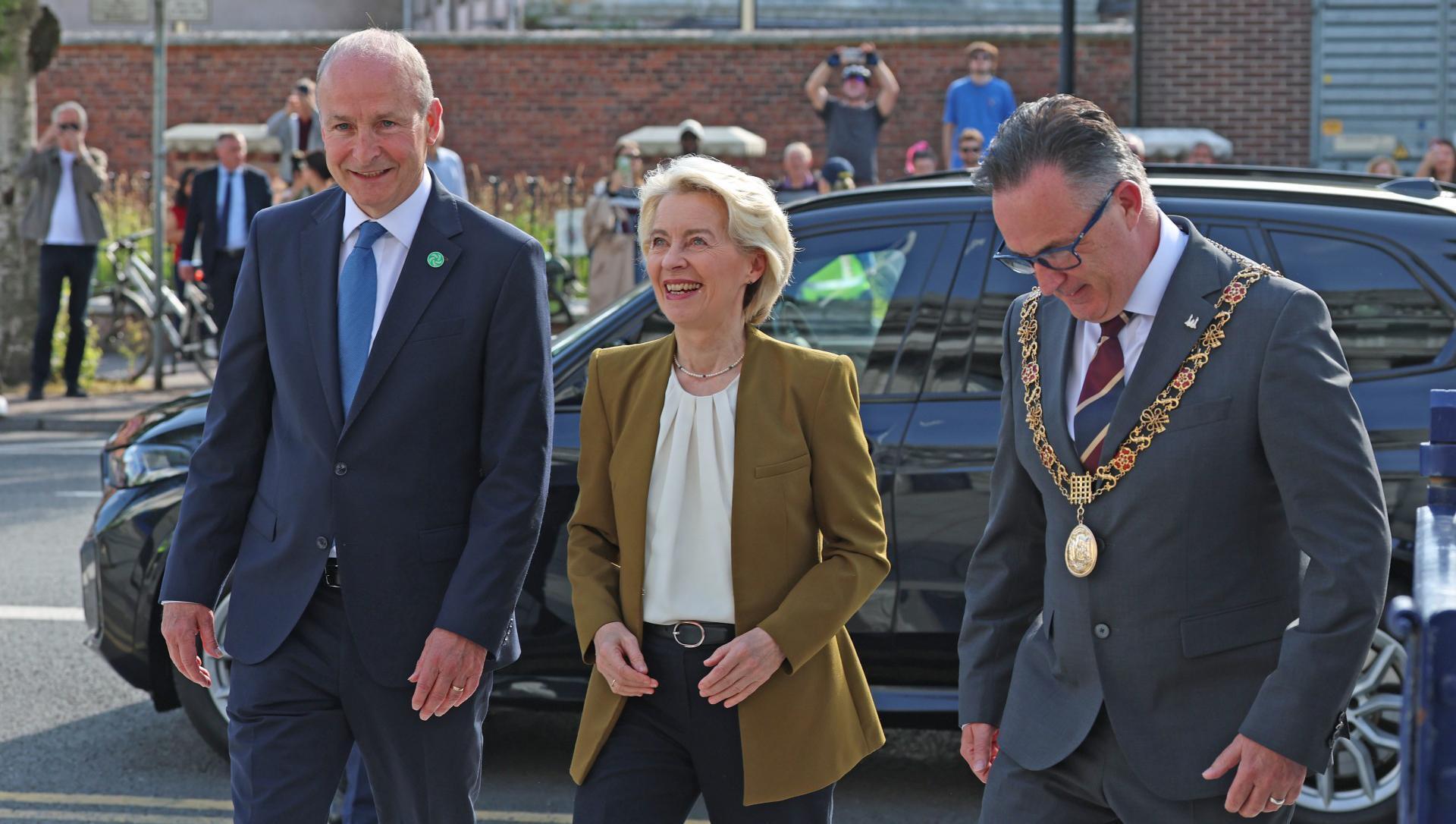
Taoiseach Micheal Martin (left) and Lord Mayor of Cork Damian Boylan, greet European Commission President Ursula von der Leyen in Cork last week. Ms Von der Leyen's comments regarding Turkey are unhelpful to trade says John Whelan. Picture: Liam McBurney/PA
Turkey is known as a meeting point, a land where East meets West, where civilizations overlap, and last week where fraying alliances created a tense atmosphere as Nato leaders jetted into Ankara.
Both the US president’s recent disparaging comments about the lack of support from Nato allies and European Commission president Ursula von der Leyen's comments some three months ago warning that Europe must be wary of the influence of “Russia, Turkey, or China” put the host country Turkey and its president in a very tight corner.

Read More

Ms Von der Leyen’s phrasing was striking not only because Turkish president Erdogan objected, but because of the company Turkey was placed in. Russia is a military adversary waging war against Ukraine. China is a systemic competitor with deep economic reach. Turkey, by contrast, is a Nato ally, an EU candidate country, and a major trade partner for Ireland and the EU.
Irish exporters have benefited from EU-Turkish customs union, since it came into force since 1995, allowing for the mostly tariff-free movement of industrial goods and processed agricultural products between both markets.
Back in 2013, as chief executive of the Irish Exporters Association to further expand trade with Turkey, I signed a memorandum of understanding (MoU) with the Turkish Exporters Assembly in Istanbul, witnessed by then Tánaiste and Minister for Foreign Affairs & Trade Eamon Gilmore, who was leading the trade mission.“Today’s milestone signing is a direct consequence of the fast-growing interest among Irish companies in deepening their engagement with Turkey, across a wide range of sectors including ICT and telecoms, financial services, engineering, clean tech, life sciences and medical technologies,” said Mr Gilmore.
The MoU had the stated aim to increase Irish exports of goods and services to Turkey from €803m in 2012 to €2bn by 2023, linking into the Turkish national ‘’strategy 2023’’ document to double bi-lateral trade by 2023.
These targets were well exceeded with exports of goods and services reaching €3.9bn in 2024. This growth was facilitated by the EU-Turkey customs union, making the flow of industrial and agricultural goods and services between the two nations highly fluid and cost-effective.
Ms Von der Leyen's destabilising comments last April throws doubt on the continuity of Ireland’s high-value exports of pharmaceuticals and medical equipment, as well as sales of telecommunications, financial services, engineering, and energy consultancy services. Ireland’s many importers depend on Turkey’s massive manufacturing sector for supplies of electronics and textiles. Turkey is also a leading supplier of wind turbines and solar panels.
Turkey-EU relations are complex. It is not a member of the EU, although EU leaders increasingly refer to Turkey as a ‘partner’, and at the Nato summit the partnership has been extended to defence and energy security, foreign and trade security, and counter-terrorism security.
However, it remains only an EU potential candidate country, despite being fundamentally tied to Europe through its customs union, Nato membership, Horizon Europe association and regulatory convergence with EU standards. This unusual pattern highlights a core problem: Turkey’s EU accession negotiations are frozen for the best part of a decade, due to the country’s democratic backsliding and concerns over the rule of law and freedoms. This causes a dilemma for the EU members such as Ireland.
The conundrum for Irish exporters and support agencies such as Enterprise Ireland, Bord Bia and IDA: should they include Turkey in their longer-term sales and investment developments, or should the strategy be to focus on other countries for long term sales growth? To date, Irish companies have invested €2bn in Turkey, inclusive of ESB international.
Prompted by the war in Ukraine, shifting global dynamics, and evolving European defence needs, the EU needs to pursue closer security cooperation with Turkey, despite European Commission president Van der Leyen’s comments. As became clear from negotiators at last week’s Nato conferenced who were pushing for deeper inclusion of Turkey in EU defence initiatives.
Exporters in Ireland and across the EU remain deeply integrated through a long-standing EU-Turkey Customs Union, with bilateral trade recently hitting a record volume of approximately €217bn. Turkey is the EU’s fifth-largest trading partner, and the EU is Turkey's largest export market. Turkey for most exporters is too important to ignore.
The EU can’t afford to maintain such ambiguity towards a country of such strategic importance.