John Whelan: AI start-ups taking lion’s share of investment funding in 2026
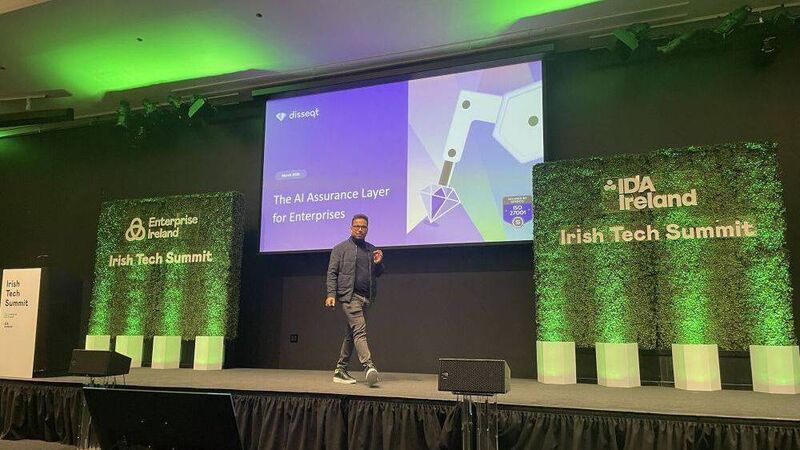
Apoorva Kumar, chief executive and co-founder of Disseqt AI.

The first quarter of 2026 was unlike any other for venture capital investment, driven by unprecedented spending on artificial intelligence (AI) by investors. Investment researchers show investors poured €260bn into 6,000 start-ups globally in the quarter, up over 150% year over year.
Nearly a quarter of Europe's startups are now AI-backed, and the growth rate is only expected to accelerate, with AI funding making up two-thirds of all VC deal value so far this year — but a handful of regions and sectors are doing most of the heavy lifting.
There are almost 11,000 AI start-ups in Europe, nearly twice as many as five years ago, according to Eurostat figures. Just last year, about 800 new companies were added amid an acceleration of funding in the space.
Total venture capital funding for Irish AI companies reached over €106m, with 2025 seeing the highest annual funding at more than €35m. The Irish Government is actively supporting this growth, with the National Digital and AI Strategy 2030 aiming to have 75% of Irish enterprises using AI, cloud, and data analytics by 2030.
However, US-based companies raised the vast bulk of global venture capital funding — $250bn (€217bn) or 83% of global venture capital in Q1 2026, according to international corporation Crunchbase Data.
Four of the five largest venture rounds ever recorded were closed in Q1, with OpenAI ($122bn) leading the charge with the biggest private tech raised ever, Anthropic ($30bn), despite pressure from US president Donald Trump to give US military "unfettered access" to its AI tools, then the Elon Musk and brother Kimbal Musk venture xAI ($20bn) to supposedly build transparency in AI systems and self-driving company Waymo ($16bn), collectively raising two third of global venture investment in the quarter.
The second-largest market globally for AI venture funding in Q1 was China, with $16.1bn (€14bn) invested. The UK followed, with $7.4bn (€6.4bn) invested. Both countries were up quarter over quarter and even more significantly year over year.
Despite the boom, securing funding is the biggest challenge for most Irish start-ups, and there is a "readiness gap" regarding technical integration between an organisation’s ambition to adopt new technologies — particularly AI and automation — and its actual ability to implement and scale, while ensuring governance.
Ireland's AI start-up ecosystem in 2026 is rapidly expanding, with standout firms such as AI governance software Dissect AI, employee benefits platform Kota, and computer vision safety specialist Protex AI, amongst a host of others.
Cyril Treacy, co-founder and chief operations officer of Disseqt AI, sees Ireland as a good place for raising seed funding, but challenging when it comes to scale-up funding. Disseqt AI has raised €1.7m in funding with venture capital funding from Sure Valley Ventures, Delta Partners and Enterprise Ireland, since its start-up last year.
But expanding further into global markets will need significant added funding, which will likely have to come from markets in the US or UK, according to Treacy.
Disseqt AI is actively targeting these markets for its next round of funding, as they provide a wider range of venture capital funds, and the valuations for early-stage companies are higher, with decisions made faster, which is important in a fast-moving market.
The UK‘s massive financial services, banking and insurance sector is also a key market for its software services platform, where, according to Mr Treacy, companies in this sector can save 30% to 40% of their labour costs through application of AI to their systems.
However, he advises financial services companies are heavily regulated and need platforms such as Disseqt AI to ensure no miss-selling of their products, which has dogged the sector. Enterprise Ireland is actively "upping its game" to make larger funds available for scaling companies in Ireland, according to Mr Treacy, driven by a new five-year strategy (2025–2029) designed to address a recognised €1bn-plus financing gap for expanding firms.
The agency is pivoting towards supporting larger, globally ambitious Irish-owned companies such as Disseqt AI, through increased direct investment and improved access to venture capital.