Ireland relies on a narrow range of activities for our tax yield
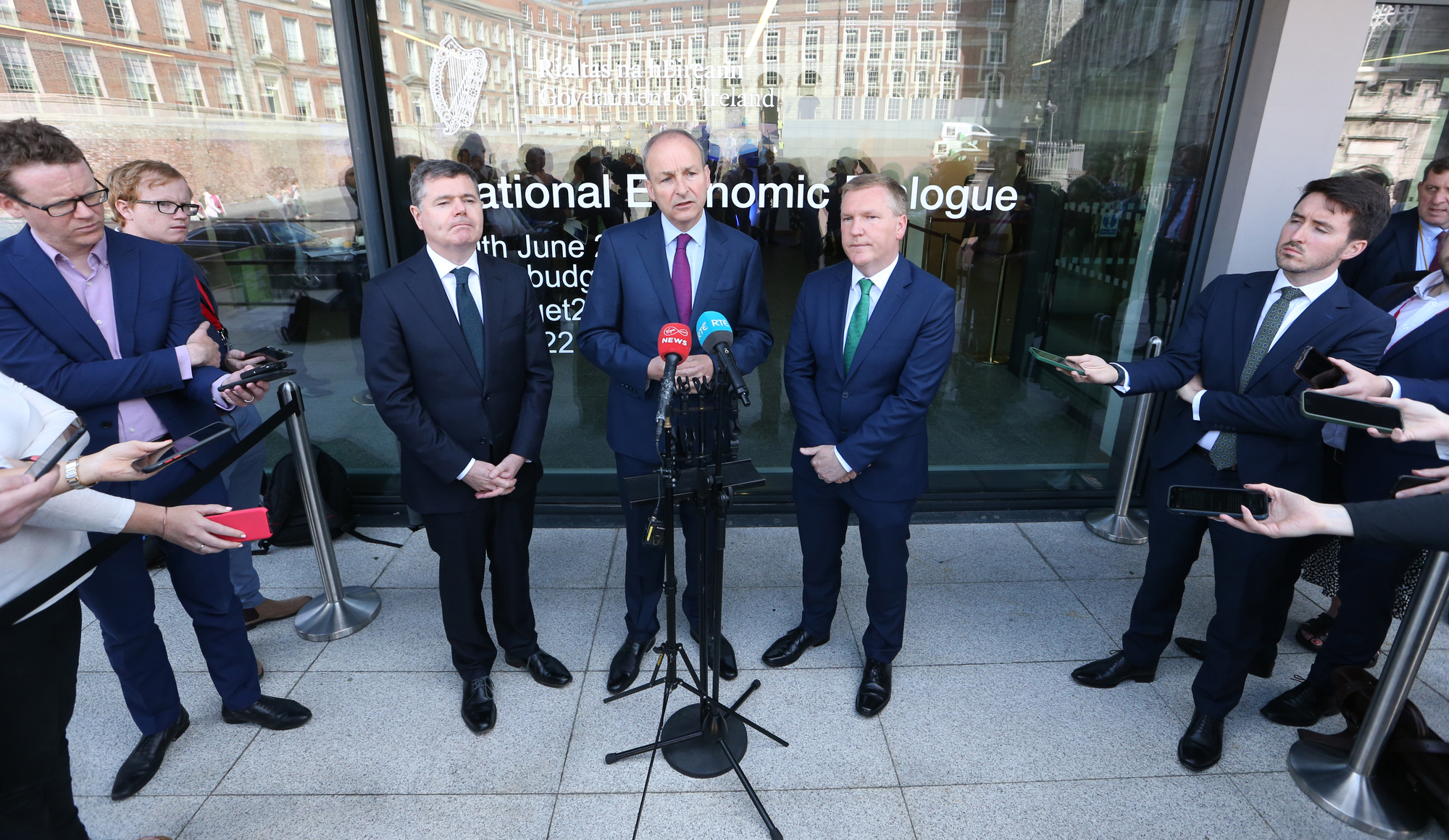
Finance Minister Paschal Donohoe, Taoiseach Micheál Martin, and Minister for Public Expenditure Michael McGrath at the National Economic Dialogue — an annual forum for government, politicians, and civil society representatives to discuss the shape of taxation and expenditure policies. Picture: Sasko Lazarov/RollingNews.ie
Between the breakdown of pay talks at the Labour Relations Commission and the restoration of wages to our top public servants, public-sector pay and conditions have dominated the news cycle.Â
No wonder Public Expenditure Minister Michael McGrath was prompted to remind attendees at the National Economic Dialogue last Monday that public-sector pay accounted for approximately one third of total Government expenditure.Â
The National Economic Dialogue has become an annual forum for government, politicians, and civil society representatives to discuss the shape of taxation and expenditure policies.
While much of the reporting from the National Economic Dialogue amounted to little more than repeating the Government’s position on the national finances, the mood among the participants who actually generate the finances for government to spend seemed, to me, to be relatively measured and positive.
In the face of rising public-sector pay and rising national debt servicing costs as interest rates increase, the first priority of taxation policy will be to secure the very buoyant tax receipts which have persisted throughout the pandemic.
Many commentators have said that our tax base is too narrow and that we rely on the contribution of too few individuals and companies to pay the national bills.
However, if we want to sustain the flow of money, it may be more useful to think in terms of the kind of activities we tax rather than on individual taxes, rates, and bands.
We tax intellectual property and corporate know-how through the corporation tax system.Â
We tax consumer spending — whether that is domestic spending by our citizens or spending by foreign citizens within the tourism sector — through the VAT system; at 23%, our standard VAT rate is one of the highest in the EU.Â
Then we rely on the incomes of well-paid individuals for the vast bulk of our income tax, USC, and PRSI receipts.
The challenge for the Government in forming the next budget is how to introduce policies which will not prejudice these three key activities, otherwise, we cannot fund the crucial housing, education, health, and retirement supports citizens need.
Perhaps one way of sustaining the corporation tax receipts, along with the earning and spending capacity of individuals, is to start thinking more about trade in services rather than trade in goods.Â
We tend to be suspicious of services in Ireland — though in international trade terms, our trade in services rivals our trade in goods.Â
Investment incentives in the areas of research and development and employment investment are, in many cases, impossible for the services industry to use.
Services rely on people participation, and we can build capacity through remote working, which promotes labour market participation. It also broadens the pool of available workers beyond our shores.Â
Just as important, remote-working facilities can serve as a recruitment and retention inducement, especially if workers are looking more closely at the cost of commuting and subsistence in the workplace as prices rise.
Revenue Commissioners, to their credit, have greatly simplified the remote-working tax situation for Ukrainian workers who have come here.Â
Simplifying remote-working administration for staff based overseas, without foregoing income tax and social welfare properly due in this country, could make a real difference in building Irish industrial capacity.
Budgetary policies recognising the contribution of service activities, rather than merely tweaking the mathematics of tax rates and bands, are needed in the next budget.
- Brian Keegan is director of public policy at Chartered Accountants Ireland