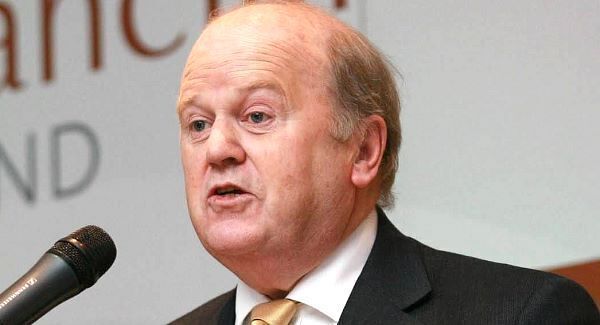
Conflicting advice leaves Noonan in dilemma

The IMF, which is owed a lot of money by Ireland, will continue to monitor progress in the economy along with the European Commission until all of that money is paid back.
It will assess the economic and financial progress that is being made and will continue to issue policy advice. Some might have believed that once we exited the troika programme external surveillance would cease.
Nothing could be further from the truth and I believe we should welcome it rather than criticise it.
The reality is that the IMF, in particular, wants to be repaid the loans that it gave Ireland and has a strong vested interest in ensuring that Irish policymakers remain on track and do not get carried away by political considerations as is their wont.
Given how often we have failed to manage ourselves properly, external influence is good. The first surveillance exercise since exiting the troika deal was carried out at the end of April and was reported on this week.
It is broadly positive, but does pose a strong policy dilemma for a Government that is facing an election in 2016 at the latest, and which is getting lots of conflicting advice at the moment from Ibec to the OECD and many more besides.
The IMF is clearly impressed with the “steadfast” manner in which the Irish Government has stuck with the terms and conditions of the troika programme, as it should be.
It is enthusiastic about the manner in which the economy is returning to growth after an exceptionally severe banking crisis and most especially the broadening of the economic recovery.
While many in Ireland may not agree with this prognosis, the facts are pretty clear — most economic indicators are moving in a positive direction and 2014 does look like being the best year since 2007.
But the IMF did warn about the dangers and risks that are still lurking out there. Credit is still too weak in the economy, long-term unemployment is still a particular problem, the fiscal deficit and sovereign debt levels are still too high and the banks need to speed up debt resolution.
While these views are widely accepted, other aspects of the IMF’s utterances are more controversial.
For a start it is forecasting GDP growth of just 1.7% this year, which is substantially lower than recent bullish forecasts from the ESRI, Ibec and the relatively cautious Department of Finance.
In fact on the same day that the IMF was saying this, Ibec was suggesting economic data is not currently capturing the real magnitude of economic growth.
Secondly, the IMF is arguing strongly that the minister for finance should stick with the fiscal commitments made in 2011 out to 2015, which in effect means that €2bn should be taken out of the economy in Budget 2015.
Again IBEC argued this week that tax cuts would now be very appropriate if not essential for the continued health of the economy.
This is consistent with some, but not all recent comments from Mr Noonan that the next two budgets would see targeted tax cuts.
Furthermore, the ESRI has suggested that the fiscal targets could be achieved this year without any further budget adjustment.
This is clearly predicated on its stronger growth forecast, while the IMF’s view, which is shared by the OECD, is predicated on substantially weaker growth.
For the neutral observer it is all quite confusing, but it is clear that domestic political considerations will drive the rhetoric from Government ahead of May 23, and then we will see.