The Islands of Ireland: The miracle of Beginish
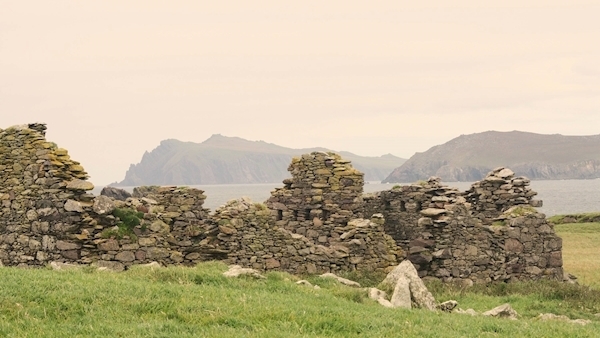
Overshadowed by its giant neighbours it may be, but the smallest of the main Blasket islands, Beginish, is no less impressive in its own right.
Surrounded by often raging seas, its several storm beaches attest to its wild location. And yet it is the nearest of the Blasket Islands to the mainland, lying about 2km from the nearest departure point at Coumeenoole Beach.
Its most immediate neighbour is the famous Great Blasket, whose forbidding hulk rises out of the ocean like some biblical behemoth. Beyond are the trio of Inishtearaght, Inishnabro, and Inishvickillane.
Beyond these, and reminiscent of the Skelligs because of its pyramidal shape, is the truly remote Inishtearaght. This is not the end of the Blaskets however, and a close scrutiny of an Ordnance Survey map reveals two other very small islands: Oileán Bui, Oileán na nÓg, and three islets: Illaunbaun, Illauncanknock, and Illaunasharragh.
Beginish is one of two islands of this name in Ireland. The other is southeast across Dingle Bay at Valentia Island. It was a roll of the dice whether a place was named Beginish (small island) or Inishbeg (also small island) and of which there are many examples around the country.
Beginish is mightily difficult to get to, as there is no pier and landing by RIB can be difficult. It is encircled by a palisade of rocks so daunting that they even have their own names: Sliggery Rock, Fosth’s Rock, Cock Rock, Barnagh Beg and Theogh Rock. However, hardy sea kayakers can give it a shot without too much bother. It is a lovely island to have a stroll around and at beach level there a number of impressive arches created by the sea.
At the end of the summer, the island attracts huge numbers of visitors — grey seals — enticed by the lack of human interference where they breed in huge numbers. On the beach opposite Beginish on the Great Blasket, Trá Bán, there are often so many seals covering the beach that it easier to see seal than sand. The land on Beginish was of sufficient quality to be used by the Great Blasket Islanders for grazing. In fact, the ruin on the island was once a dairy which was all the more remarkable for having been run without a water supply. That had to be brought in by barrel from the mainland or the great Blasket.

All of the other Blaskets bar Inishtearaght have archaeological sites so it is odd that the low-lying Beginish was passed over for the erection of some monument or other. Some ships of the doomed Spanish Armada sailed past the Blaskets in 1588 including the galleon San Juan captained by admiral of the fleet Juan Martinez de Recalde. In a prodigious feat of seamanship the captain guided his 1,000 tonne ship in a storm past Beginish and on up the coast.
Writer Niall Fallon described the manoeuvre as “little short of miraculous”. Martinez de Recalde somehow “threaded a delicate course between rocks, islands and reefs” to lead his ship to safety. The admiral later engaged English forces in battle and though wounded was able to return to Spain but later succumbed to his wounds. The rest of the Armada was torn to pieces by Mother Nature and the English.
The scholar Robin Flower who spent some time on the Great Blasket wrote of the incident: “In sight of this wrecking sea one came to realise that only very desperate or very brave men could have dared the passage of the reefs. But the men of the Armada were very brave indeed.”
Fishing rights and ownership rights of wrecks in among the Blasket Islands were keenly contested among the islanders and the mainlanders and were even a matter of life and death. Author Gerald Hayes relates an encounter in 1818 between a boat from Gorta Dubha near Ballyferriter and a boat from Dunquin which was plundering the spoils from a sunken ship beside Beginish.
The Gorta Dubha men overpowered the locals but overloaded their own vessels with the booty and their boats sank. Twenty men drowned to the indifference of the Dunquin men. A long period of hostility between the villages transpired not mended till a marriage settled matters.
How to get there: No ferry. Enquire at Dingle pier.
Other: The Armada in Ireland, Niall Fallon, Wesleyan; The Blasket Islandman, Gerald Hayes, The Collins Press
CONNECT WITH US TODAY



Be the first to know the latest news and updates