Watch: Blue Origin rocket explodes during test in latest setback for Jeff Bezos-owned company
Nasa’s plans to build a lunar base and return humans to the moon in the next two years were thrown into jeopardy after a New Glenn rocket from Jeff Bezos’s Blue Origin company exploded during a test in Florida.
A massive fireball engulfed and destroyed the launchpad at the Kennedy Space Centre seconds after the start of the scheduled “hotfire” test at 9pm ET, and an orange sky was visible in Fort Pierce, 185km (115 miles) to the south.
It is the type of rocket that Blue Origin intends to use to launch landers to the moon for Nasa, including the landers that will take astronauts to the lunar surface.
Mr Bezos, the Blue Origin founder, tweeted that all his company’s employees were accounted for, safe and uninjured, but lamented a “very rough day”.
On Tuesday, Nasa announced that Blue Origin had won the contract to launch the first of three planned missions this year to begin construction of its $20bn moon base.
It is also in competition with Elon Musk’s SpaceX to provide a lunar lander for the Artemis IV mission planned for 2028 that will see astronauts land on the moon for the first time since 1972.
Jared Isaacman, the Nasa administrator, posted to X that a full evaluation of that timeline would be conducted after the explosion, which Blue Origin described as “an anomaly”.
“Spaceflight is unforgiving, and developing new heavy-lift launch capability is extraordinarily difficult,” he wrote.
“We will work with our partners to support a thorough investigation of this anomaly, assess near-term mission impacts, and get back to launching rockets.
“We will provide information on any impacts to the Artemis and Moon Base programs as it becomes available.” Mr Bezos, in his tweet, said: “It’s too early to know the root cause, but we’re already working to find it. Very rough day, but we’ll rebuild whatever needs rebuilding and get back to flying. It’s worth it.”
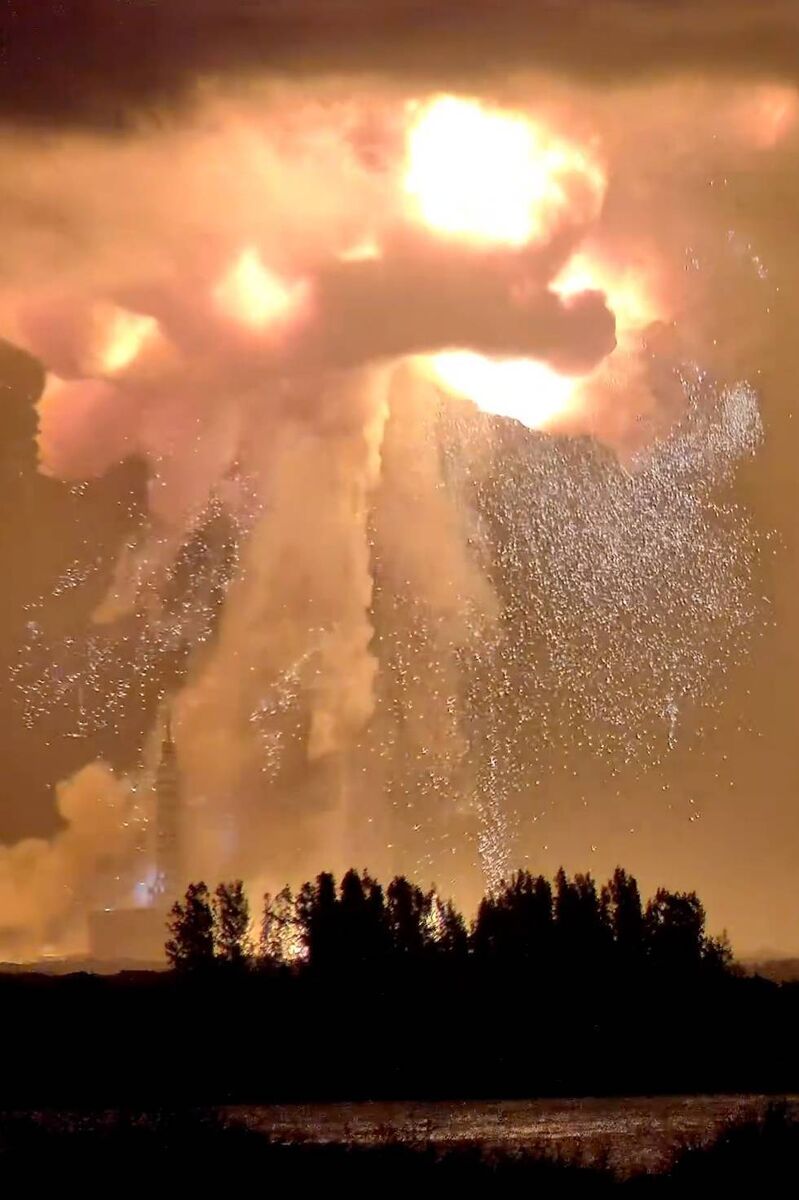
Shockwaves from the explosion were felt along the stretch of Florida’s Atlantic Ocean seaboard known as the Space Coast, and residents in South Carolina, hundreds of miles north reported seeing a glow in the sky.
A livestream posted by NSF, an aerospace news organisation, captured the fiery plume. Homes shook in nearby Cape Canaveral and Cocoa Beach around 9pm, with residents turning to social media to ask what happened. Cape Canaveral Space Force Station’s Launch Complex 36 is visible from the beach, and the internet quickly filled with photos of the orange fireball.
Emergency officials said there was no threat due to fumes or other potential hazards. Flames were still burning at the launchpad more than two hours after the explosion.
Blue Origin has endured a sequence of setbacks as it vies with SpaceX for Nasa contracts for the Artemis program. A payload from the third flight of New Glenn ended up in the wrong orbit during a flight last month, and the rocket was temporarily grounded by the Federal Aviation Administration (FAA).
Thursday’s test was the first static fire test – one in which the rocket remains on the launchpad – since the FAA cleared it to return to flight last week. The FAA did not immediately respond to a request for comment regarding whether Thursday’s explosion will trigger another investigation.
Blue Origin and SpaceX have both built large new facilities in or close to the Cape Canaveral space centre to support crewed and cargo missions in partnership with Nasa.
Artemis III, planned for 2027, is scheduled to test Blue Origin’s Blue Moon lander, and SpaceX’s Starship Human Landing System (HLS), to determine which will ferry the Artemis IV crew from Orion capsule to the lunar surface.
Mr Musk was quick to offer his take on Thursday’s Blue Origin explosion.
“Most unfortunate,” he said in a discussion on X, which he owns. “Rockets are hard.” Bezos also has a vested interest in space tourism. Last April, the company made headlines as it sent an all-female, star-studded crew into space. Gayle King and Katy Perry were on board the flight.
CONNECT WITH US TODAY



Be the first to know the latest news and updates