Explained: Who was Ismail Haniyeh, the Hamas political chief killed in Iran?
A protege of Hamas founder Sheikh Ahmad Yassin, Haniyeh was a key figure in the group’s international diplomacy
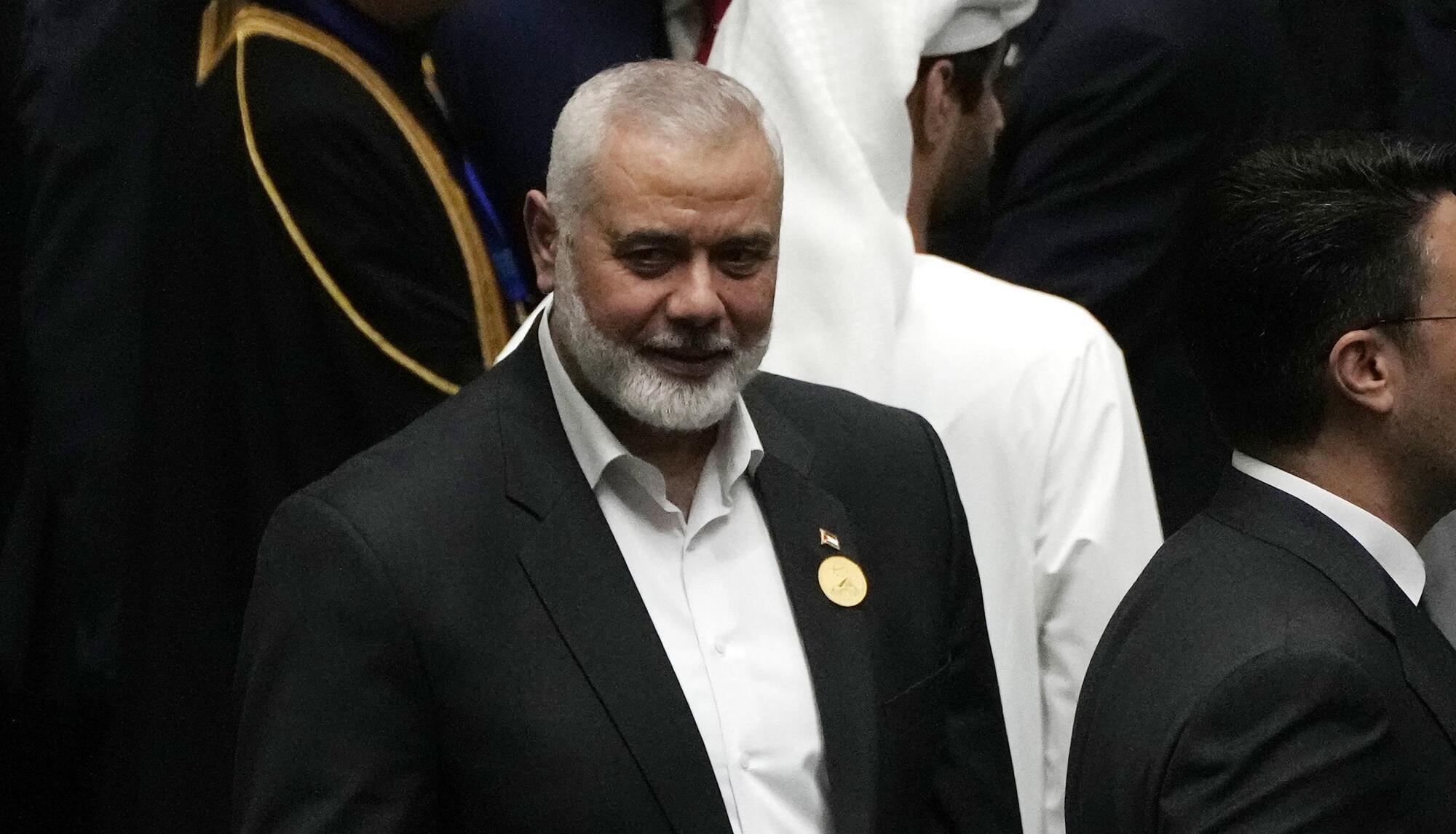
Hamas chief Ismail Haniyeh arriving at the Iranian parliament to attend the swearing-in ceremony of newly-elected President Masoud Pezeshkian, in Tehran, Iran, Tuesday, July 30, 2024. Picture: AP Photo/Vahid Salemi.

Hamas chief Ismail Haniyeh arriving at the Iranian parliament to attend the swearing-in ceremony of newly-elected President Masoud Pezeshkian, in Tehran, Iran, Tuesday, July 30, 2024. Picture: AP Photo/Vahid Salemi.

Hamas has described the killing of its political chief, Ismail Haniyeh, as a grave escalation that will not go unanswered. His assassination in Iran will be perceived as a serious blow to efforts to secure a ceasefire in Gaza, as talks mediated by the US, Qatar and Egypt stagger forward after months of negotiations.

Haniyeh had long served as the head of Hamas’ politburo, and was seen as a moderate figure within the movement, one whose role had become vital in sustained diplomatic efforts to secure a ceasefire.

Hamas leader Ismail Haniyeh killed in raid on Iran residence, says Palestinian group Read more He was elected as the head of the political wing in 2017, before leaving Gaza for exile in Qatar two years later. From exile he became the face of the Palestinian group’s international diplomacy, shuttling between Turkey, Iran and Qatar, joining a group of Hamas leaders sheltering in Doha and unable to return to Gaza. Even so, Haniyeh was seen as a key line of communication with hardline figures like Yahya Sinwar in Gaza.

Arab diplomats and officials had viewed him as relatively pragmatic compared with other more militant voices, inside Gaza and he was described by some experts as leading the political battle for Hamas with regional governments in the Middle East.

Haniyeh’s allies and even former rivals stepped in to condemn the assassination on Wednesday, amid fears that his death during a visit to Tehran could provoke a broader response.

Palestinian president Mahmoud Abbas called the killing “a cowardly act and a serious escalation.” 

The Turkish foreign ministry called the assassination “heinous.” 

Hamas chief Ismail Haniyeh speaks during a press briefing after his meeting with Iranian Foreign Minister Hossein Amirabdollahian in Tehran, Iran, March 26, 2024. Picture: AP Photo/Vahid Salemi

Haniyeh was born in 1963 in Gaza’s Shati refugee camp. While at university in Gaza, he joined a political group that was a precursor to Hamas, becoming active in local politics and at protests.

He joined Hamas when it was created in the first Palestinian intifada in 1987 and was arrested and imprisoned on a number of occasions by Israel. He was exiled in 1992 with other Hamas leaders, but returned to Gaza a year later.

Haniyeh became a protege of Hamas’ founder Sheikh Ahmad Yassin and by 2003 he was a trusted aide to him, photographed in Yassin’s Gaza home holding a phone to the almost completely paralysed Hamas founder’s ear so he could take part in a conversation. Yassin was assassinated by Israel in 2004.

Haniyeh was an early advocate of the group’s political agenda and in 2006, he became Palestinian prime minister after Hamas won the most seats in Palestinian parliamentary elections. He was dismissed by Abbas in 2007 after Israel withdrew from Gaza and Hamas took control.

During the decade in which Haniyeh was Hamas’ top leader in Gaza, Israel accused his leadership team of helping to divert humanitarian aid to the group’s military wing, an accusation Hamas denied.

In 2007, Haniyeh was instrumental in the freeing of BBC correspondent Alan Johnston, who was kidnapped in Gaza and held for 16 weeks by a local Islamist group.

He ruled Gaza until 2017, when he was elected head of Hamas’ political bureau. Haniyeh had a major role in building up Hamas’ fighting capacity, partly by nurturing relations with Iran. In 2022, Haniyeh told Al Jazeera that Hamas had received $70m in military help from Iran.

When he left Gaza in 2017, Haniyeh was succeeded by Sinwar, a hardliner who spent more than two decades in Israeli prisons and whom Haniyeh had welcomed back to Gaza in 2011 after a prisoner exchange.

Sinwar is said by experts to be the last word on major decisions by the group. When during recent talks Sinwar decided to cut off communications, negotiations stalled. “This pretty effectively underlined who is calling the shots,” one European diplomatic source told the Guardian.

In this photo released by the Iranian Presidency Office, President Masoud Pezeshkian, right, meets Hamas chief Ismail Haniyeh, at the President's office in Tehran, Iran, Tuesday, July 30, 2024. Picture: Iranian Presidency Office via AP

Since 2017, Haniyeh has been described as the political and diplomatic front of Hamas. He has been engaged in building diplomatic relations with other powers across the Middle East.

Israel regards the entire Hamas leadership as terrorists, and has accused Haniyeh and others leaders outside Gaza of continuing to “pull the strings of the Hamas terror organisation”.

In 2018, the US state department designated Haniyeh a terrorist, saying he had been a “proponent of armed struggle, including against civilians” and that Hamas activities had been responsible for an “estimated 17 American lives killed in terrorist attacks”.

Three of Haniyeh’s sons – Hazem, Amir and Mohammad – were killed in Gaza on 10 April when an Israeli airstrike struck the car they were in. Haniyeh also lost four of his grandchildren, three girls and a boy, in the attack, Hamas said.

At the time, the Hamas leader said the attack would not change the group’s demands for a permanent ceasefire and return of displaced Palestinians from their homes in ongoing negotiations mediated by Doha and Washington.

“All our people and all the families of Gaza have paid a heavy price in blood, and I am one of them,” Haniyeh said.

- The Guardian

More in this section

Cookie Policy Privacy Policy Brand Safety FAQ Help Contact Us Terms and Conditions

© Examiner Echo Group Limited