US and Britain strike Yemen in reprisal for Houthi attacks on shipping
Witnesses confirmed explosions at military bases near airports in the capital Sanaa and Yemen's third city Taiz
US and Britain strike Yemen in reprisal for Houthi attacks on shipping

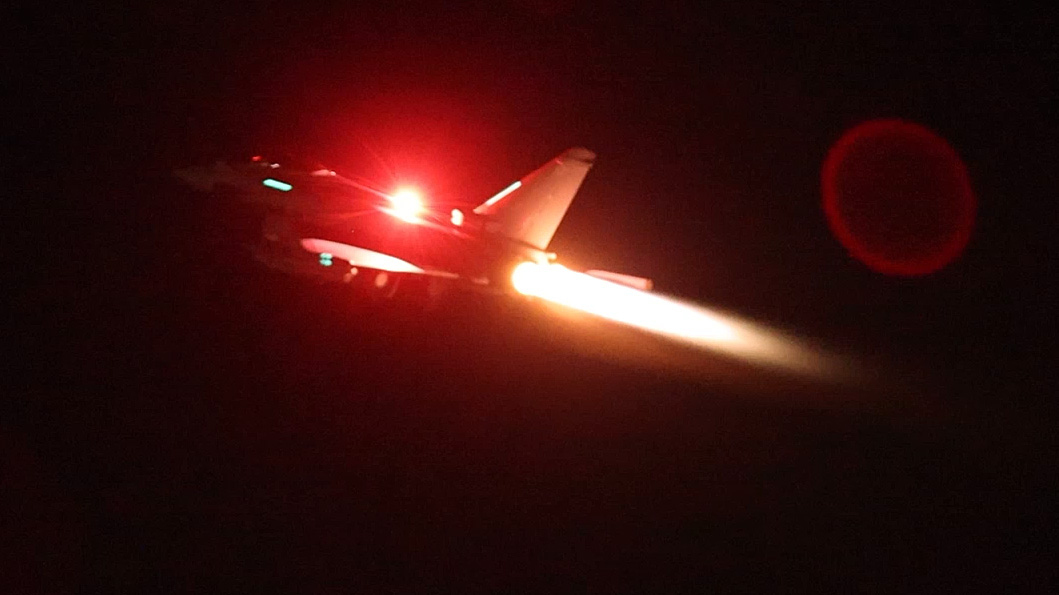
One of four RAF Typhoon aircraft taking off from RAF Akrotiri in Cyprus to join the US-led coalition conducting air strikes against military targets in Yemen. Houthi attacks in the Red Sea have increased by 500% between November and December. Picture: Sgt Lee Goddard/MOD/Crown

US and British warplanes, ships and submarines launched dozens of air strikes across Yemen overnight in retaliation against Houthi forces for months of attacks on Red Sea shipping that the Iran-backed fighters cast as a response to the war in Gaza.

Witnesses confirmed explosions at military bases near airports in the capital Sanaa and Yemen's third city Taiz, a naval base at Yemen's main Red Sea port Hodeidah and military sites in the coastal Hajjah governorate.


"These targeted strikes are a clear message that the United States and our partners will not tolerate attacks on our personnel or allow hostile actors to imperil freedom of navigation," US president Joe Biden said.

The Houthis, who have controlled most of Yemen for nearly a decade, said five of their fighters had been killed in a total of 73 airstrikes. They vowed to retaliate and continue their attacks on shipping, which they say are intended to support Palestinians against Israel.

One of four RAF Typhoon aircraft taking off from RAF Akrotiri in Cyprus to join the US-led coalition conducting air strikes against military targets in Yemen. Houthi attacks in the Red Sea have increased by 500% between November and December. Picture: Sgt Lee Goddard/MOD/Crown

Shortly after 1500 GMT, the UK Maritime Trade Operations information hub said it had received reports of a missile landing in the sea around 500 metres (1,600 feet) from a ship about 90 nautical miles southeast of the Yemeni port of Aden. Three small boats were also reported to have neared the vessel.

The shipping security firm Ambrey identified it as a Panama-flagged tanker.

In Yemen, crowds gathered in cities. Drone footage on the Houthis' al-Masirah TV showed hundreds of thousands of people in Sanaa carrying Palestinian and Yemeni flags and chanting slogans denouncing Israel and the United States.

"We saw a large fire from where the attack took place. It was half an hour of terror," said Kheloud, a Sanaa resident who awoke to loud explosions from the direction of the airport. 

By mid-afternoon, crowds had gathered in central Sanaa and other cities. Drone footage on the Houthis' al-Masirah TV showed hundreds of thousands of people carrying Palestinian and Yemeni flags, chanting slogans denouncing Israel and the United States in a response to a speaker on a giant screen.

A man holds up a Palestinian flag during a demonstration in which worshippers show their support of Palestinians and condemning the US and British militaries strike against Iranian-backed Houthis in Yemen, after Friday prayer in Tehran, Iran. Picture: AP Photo/Vahid Salemi

"Your strikes on Yemen are terrorism," said Mohammed Ali al-Houthi, a member of the Houthi Supreme Political Council, "The United States is the Devil."

The commander of US air operations in the Middle East, Air Force Lieutenant-General Alex Grynkewich, said 60 targets at 16 locations had been hit using more than 100 precision-guided munitions.

A US official said the targets had been chosen to weaken the Houthis' ability to attack: "We were going after very specific capability in very specific locations with precision munitions."

In a poor country only just emerging from nearly a decade of war that brought millions to the brink of famine, people fearing an extended new conflict queued at petrol stations.

"There is a lot of worry that the fuel shortages will repeat themselves and food supplies will be scarce," said Ali Ahmad, 52. 

"We are rushing to fuel our car and we bought flour and rice in case of any emergency because we are expecting the Houthis to respond and an escalation to take place."

In Hodeidah, a resident who gave only his first name, Mahmoud, said troops were spreading through the streets and military vehicles were leaving barracks with security escorts.

PRICE OF OIL JUMPS 

The price of oil rose sharply on concern that supplies could be disrupted, with Brent crude up $2 (€1.82) on Friday.

Commercial ship tracking data showed at least four oil tankers diverting from the Red Sea.

INTERTANKO, an oil tanker industry body, sent a note to members saying the US-led Combined Maritime Forces had advised ships to "stay well away from Bab al-Mandab", the mouth of the Red Sea where 15% of global seaborne trade passes.

The strikes follow months of raids by Houthi fighters, who have boarded ships they claimed were Israeli or heading for Israel.

Sea Viper missiles are fired in the Red Sea. U.S. and British militaries are bombing more than a dozen sites used by the Iranian-backed Houthis in Yemen, in a massive retaliatory strike using warship-launched Tomahawk missiles.(Picture: UK Ministry of Defence via AP)

The strikes follow months of raids by Houthi fighters, who have boarded ships they claimed were Israeli or heading for Israel.

The United States and some of its allies deployed a naval task force to the area in December, and recent days saw increasing escalation. US helicopters sank three Houthi boats on New Year's Eve, killing fighters attempting to board a ship. On Tuesday, the United States and Britain shot down 21 missiles and drones in what they called the biggest attack yet.

However, not all major US allies chose to back the strikes.

The Netherlands, Australia, Canada and Bahrain provided logistical and intelligence support, while Germany, Denmark, New Zealand and South Korea signed a joint statement defending the attacks and warning of further action.

But Italy, Spain and France chose not to sign or participate, fearing a wider escalation.

Egypt, which controls the Suez Canal linking the Red Sea to the Mediterranean, expressed deep concern.

A senior US official accused Iran of providing the Houthis with military capabilities and intelligence to carry out their attacks.

Iran, which supports armed groups around the Middle East including both the Houthis and the Hamas militants that control Gaza, condemned the US and British attacks.

Iran-backed armed groups have increased attacks on US targets in several countries since Hamas militants attacked Israel on October 7, killing 1,200 people and precipitating the war in Gaza, which has so far killed more than 23,000.

Within hours of the air strikes, the US Treasury Department issued sanctions targeting four oil tankers and two firms whose shipments it said were helping to finance the Houthis and Iran's Quds Force.

FEARS OF ESCALATION

Houthi attacks have forced commercial ships to take a longer,costlier route around Africa, creating fears of a new bout of inflation and supply chain disruption.

Carmaker Tesla said delays to parts shipments from Asia due to Red Sea unrest had forced it to shut its factory in Germany for two weeks, the first big manufacturer to make such an announcement.

One of four RAF Typhoon aircraft returning to RAF Akrotiri in Cyprus after joining the US-led coalition conducting air strikes against military targets in Yemen. Houthi attacks in the Red Sea have increased 500% between November and December. Picture: Sgt Lee Goddard/MOD/Crown Copyright/PA Wire 

Washington has had to weigh its determination to keep the shipping lane open against the risk of spreading unrest in a region on edge over the Gaza war.

It is unclear whether the strikes will in fact deter further attacks on shipping, said Tobias Borck, a Middle East security expert at Britain's Royal United Services Institute.

The Houthis wanted to portray themselves as champions of the Palestinian cause and foes of the West but were mainly concerned about retaining power.

"Is this the hill they want to die on?" said Mr Borck, "They were doing well, they have been able to survive the last eight years, have expanded their power, but now they are inviting air strikes from the world's most powerful military."

But Farea Al-Muslimi, a Yemen expert at Chatham House think tank, noted that years of air strikes by Saudi Arabia had previously caused huge suffering to Yemenis while doing little to deter Houthi attacks: "Clearly it didn't work."

Saudi Arabia, which has sought for nearly a decade to oust the Houthis in a war that is now in a delicate stage of peace negotiations, called for restraint.

More in this section

Cookie Policy Privacy Policy Brand Safety FAQ Help Contact Us Terms and Conditions

© Examiner Echo Group Limited