US, Japan and South Korea open summit to bolster Pacific security
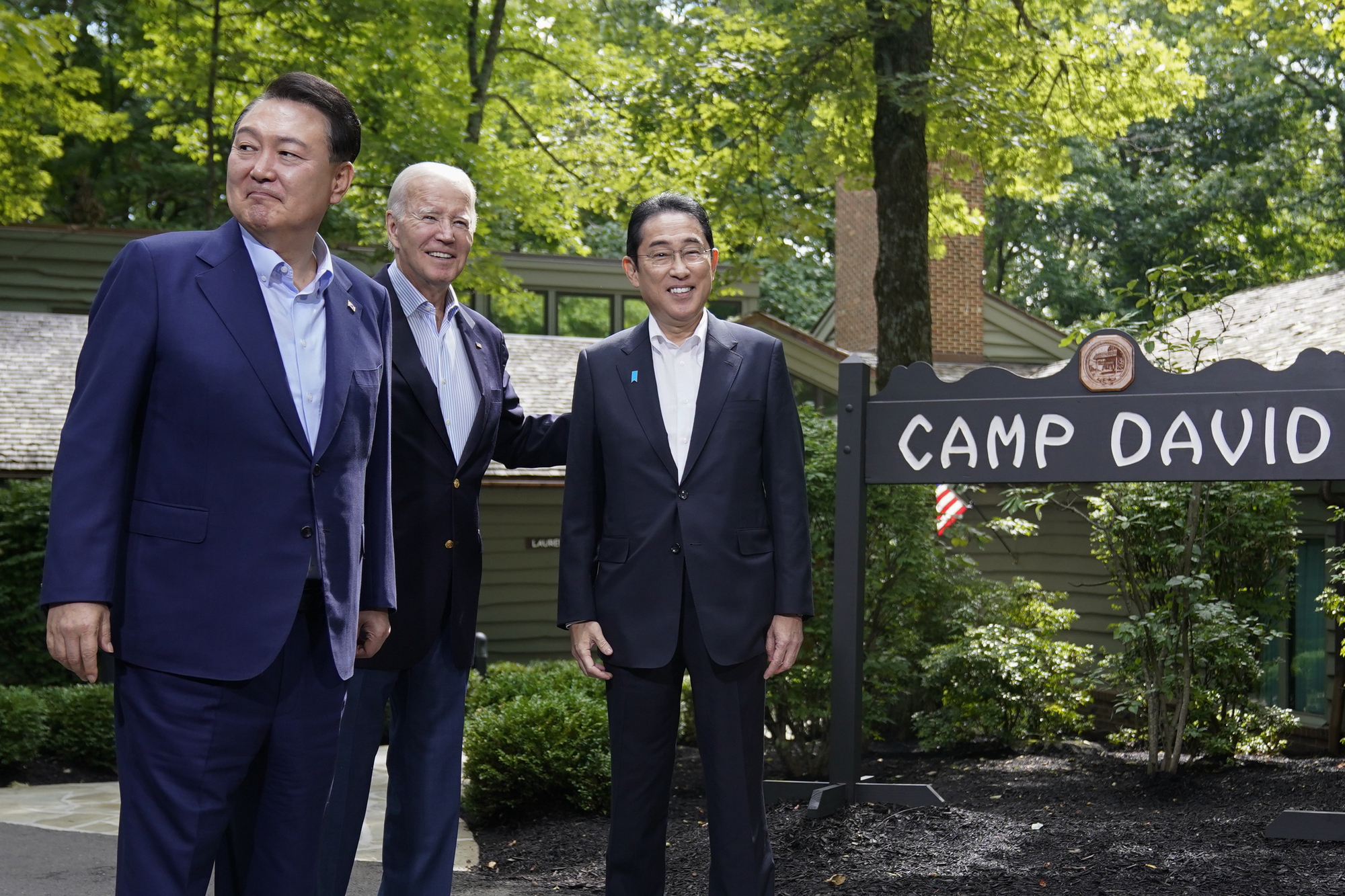
US President Joe Biden opened a historic summit with Japan and South Korea at Camp David on Friday, focused on strengthening security and economic ties at a time of increasing concerns about North Korea’s persistent nuclear threats and China’s provocations in the Pacific.
“Our countries are stronger and the world will be safer as we stand together, and I know this is a belief that all three share,” Mr Biden said at the start of the meeting with South Korean President Yoon Suk Yeol and Japanese prime minister Fumio Kishida at the presidential retreat in Maryland in the US.
Addressing the men at what he called the first standalone summit of the three nations, Mr Biden said: “I want to thank you both for your political courage that brought you here.”
Mr Yoon said as they appeared before reporters that “today will be remembered as a historic day, where we established a firm institutional basis and commitments to the trilateral partnership”.

And Mr Kishida said before the private talks that “the fact that we, the three leaders, have got together in this way, I believe means that we are indeed making a new history as of today. The international community is at a turning point in history”.
The US, Japan and South Korea have agreed to a new security pledge committing the three countries to consult with each other in the event of a security crisis or threat in the Pacific.
Details about the new “duty to consult” commitment emerged as the summit got under way.
Before the three-way talks, Mr Biden separately met Mr Yoon and then Mr Kishida. The visitors’ remarks were translated into English as they spoke to reporters.
The agreement is one of several joint efforts that they were expected to announce at the day-long summit.
“Suffice it to say, this is a big deal,” Mr Biden’s national security adviser Jake Sullivan told reporters on Friday shortly before the start of the summit.
“It is a historic event, and it sets the conditions for a more peaceful and prosperous Indo-Pacific, and a stronger and more secure United States of America.”
Even before the summit began, it drew harsh public criticism from the Chinese government.
“The international community has its own judgment as to who is creating contradictions and increasing tensions,” Chinese foreign ministry spokesman Wang Wenbin told reporters on Friday.
“Attempts to form various exclusive groups and cliques and to bring bloc confrontation into the Asia-Pacific region are unpopular and will definitely spark vigilance and opposition in the countries of the region,” Mr Wang said.
But Mr Sullivan said: “It’s explicitly not a Nato for the Pacific.
“This partnership is not against anyone, it is for something. It is for a vision of the Indo-Pacific that is free, open, secure and prosperous.”
The “duty to consult” pledge is intended to acknowledge that the three countries share “fundamentally interlinked security environments” and that a threat to one of the nations is “a threat to all”, according to a senior Biden administration official.
The summit is the first Mr Biden has held during his presidency at Camp David.
The three leaders are also expected to detail in their summit communique plans to invest in technology for a three-way crisis hotline and offer an update on progress the countries have made on sharing early-warning data on missile launches by North Korea.

CONNECT WITH US TODAY



Be the first to know the latest news and updates