Paris police station attack: 'It's like the Charlie Hebdo affair isn't over'
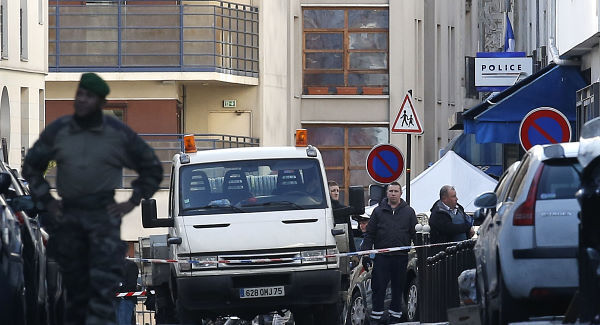
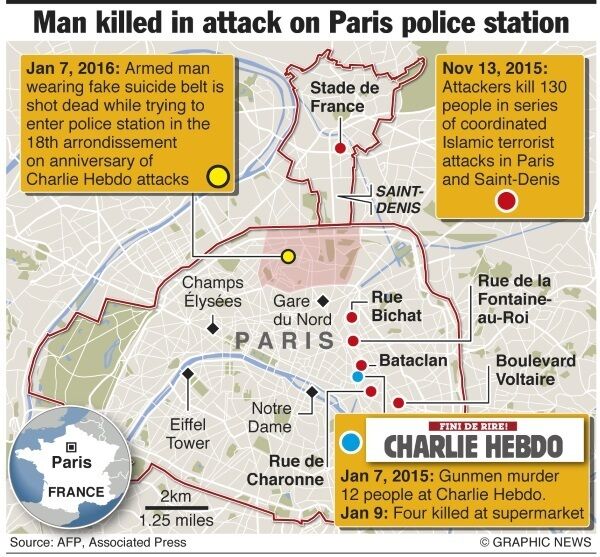
Officers have shot and killed a knife-wielding man wearing a fake explosive vest outside a police station in northern Paris, French officials said.
The incident occurred a year to the day since an attack on the French satirical newspaper Charlie Hebdo launched a bloody year in the French capital.
France has been under a state of emergency since a series of attacks claimed by the Islamic State group killed 130 people in Paris on November 13, and tensions increased this week as the anniversary of the January attacks approached. Soldiers were posted in front of schools and security forces were even more present than usual amid a series of tributes to the dead.
Officials said the man shot dead wore a fake explosive vest and threatened officers at the entrance of a police station minutes after French president Francois Hollande, speaking in a different location, paid respects to officers fallen in the line of duty.
Pierre-Henry Brandet, the Interior Ministry spokesman, said the man at the police station is believed to have cried out “Allahu akbar”, Arabic for “God is great”. He has not been identified, and Mr Brandet said that police do not believe anyone else was involved.

Alexis Mukenge, who saw the shooting from inside another building, told the network iTele that police told the man, “Stop. Move back”, adding that officers fired twice and the man immediately dropped to the ground.
The Goutte d’Or neighbourhood in Paris’ 18th arrondissement was locked down, as were two metro lines running through the area, although they later reopened.
Police expanded their security cordon about an hour after the attack, swiftly and roughly clearing out hundreds who had gathered at a subway station and along nearby streets. Shops were ordered shuttered along neighbouring streets, and shop owners hastily rolled down metal shutters.
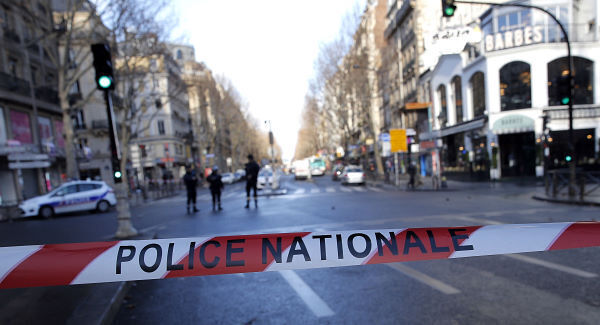
Neighbourhood resident Nora Borrias was unable to get home because of the barricades. Shaken by the incident, she said “it’s like the Charlie Hebdo affair isn’t over”.
Mr Hollande had said earlier that what he called a “terrorist threat” would continue to weigh on France. The government has announced new measures extending police powers to allow officers to use their weapons to “neutralize someone who has just committed one or several murders and is likely to repeat these crimes.”
On January 7 2015, two French-born brothers killed 11 people at the building where Charlie Hebdo operated, as well as a Muslim policeman outside. Over the next two days, an accomplice shot a policewoman to death and then stormed a kosher supermarket, killing four hostages. A total of 17 people died, as did all three gunmen.
Mr Hollande especially called for better surveillance of “radicalised” citizens who have joined Islamic State or other militant groups in Syria and Iraq when they return to France.
“We must be able to force these people – and only these people – to fulfil certain obligations and if necessary to put them under house arrest... because they are dangerous,” he said.
Hollande said officers die in the line of duty “so that we can live free”.
Following the January attacks, the government announced it planned to give police better equipment and hire more intelligence agents.
France has been on high alert ever since, and was struck again November 13 by extremists in attacks that killed 130 people at a concert hall and in bars and restaurants.
Survivors of the January attacks, meanwhile, are continuing to speak out.
Cartoonist Laurent Sourisseau, the editor-in-chief of Charlie Hebdo, who is known as Riss, told France Inter radio “security is a new expense for the newspaper budget”.
“This past year we’ve had to invest nearly two million euros to secure our office, which is an enormous sum,” he said. “We have to spend hundreds of thousands on surveillance of our offices, which wasn’t previously in Charlie’s budget, but we had an obligation so that employees feel safe and can work safely.”
After the attacks, people around the world embraced the expression “Je suis Charlie” to express solidarity with the slain journalists, targeted for the paper’s caricatures of the Prophet Muhammad.
“It’s a phrase that was used during the march as a sign of emotion or resistance to terrorism,” Charlie Hebdo cartoonist Corinne Rey – known as Coco - told France Inter radio.
“And little by little, I realised that ’I am Charlie’ was misused for so many things. And now I don’t really know what it means.”
CONNECT WITH US TODAY



Be the first to know the latest news and updates