Bodies of drowned passengers recovered from capsized ship
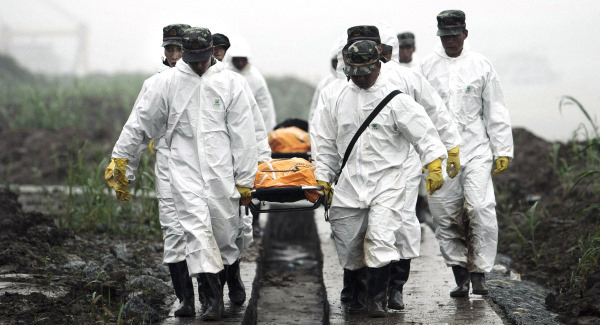
Rescuers in China have cut into the upside-down hull of a river cruise ship and pulled out 39 drowned passengers.
This brings the death toll to 65 since the Eastern Star capsized in the Yangtze River with more than 450 people aboard.
Chinese state broadcaster CCTV said rescuers had stabilised the ship with the help of a crane so that it does not sink and planned to cut into at least one other part of the hull in hopes of finding more survivors of Monday night's capsizing during a heavy storm.
So far, authorities say at least 14 people survived, some by jumping from the ship during the early moments and swimming or drifting ashore.
Three survivors were pulled by divers from air pockets inside the overturned hull today after rescuers heard yells for help coming from inside.
The sudden overturning of the Eastern Star is on track to become the country's deadliest maritime disaster in seven decades, and Chinese authorities have launched a high-profile response while tightly controlling media coverage.
Premier Li Keqiang, the country's number two political leader, travelled to the disaster site in the Hubei province county of Jianli where he urged "all-out" 24-7 efforts.
But the vast majority of those on board remain missing. Many were elderly tourists, reportedly aged between 50 and 80 years old, taking in the scenic vistas of the Yangtze on a cruise from Nanjing to the south-western city of Chongqing.
Records from a maritime agency show the capsized ship was cited for safety violations two years ago.
Authorities in Nanjing held the ship and five other Yangtze cruise vessels after it found them violating standards during a safety inspection campaign in 2013, according to a report on the city's Maritime Safety website. It did not specify the Eastern Star's violations.
The shallow-draft boat, which was not designed to withstand as heavy winds as an ocean-going vessel can, overturned in what Chinese weather authorities have called a cyclone with winds up to 80 mph (130 kph).
"The river ships tend to have a lower standard on wind-resistance and wave-resistance than ocean ships," Zhong Shoudao, president of the Chongqing Boat Design Institute, said.
"Under the special circumstance of cyclone, the pressure on the one side of the boat went beyond the standard it was designed for, resulting in the overturning of the boat.
"The boat had lifejackets and lifeboats, but due to the sudden capsizing, there was not enough time for people to put on lifejackets or for the signals to be sent out," Mr Zhong said.
More than 200 divers worked in shifts virtually around the clock as part of a last-ditch attempt to find survivors, the last of which was found on Tuesday afternoon.
Transport Ministry spokesman Xu Chengguang said divers would search the ship for as long as possible.
"Until all hope is lost and more accurate information becomes available, we will not give up on our final efforts, although I know that our colleagues at the scene are facing a great many difficulties," Mr Xu said.
The rescue and salvage efforts are being run from a massive barge tethered a few miles upstream of the wreckage.
Reached through a watery wasteland of flooded crops and trees torn in half by high winds, it was a bustle of activity, as rescuers, paramilitary troops and army and navy specialists arrived and left by smaller boat.
The survivors included the ship's captain and chief engineer, both of whom have been taken into police custody.
Some relatives have questioned whether everything was done to ensure the safety of the passengers and have demanded help from officials in Nanjing and Shanghai in unruly scenes that have drawn a heavy police response.
The Eastern Star was 251 feet (76.5 metres) long and 36 feet (11 metres) wide, and could carry a maximum of 534 people.
It is owned by the Chongqing Eastern Shipping Corporation, which focuses on tourism routes in the popular Three Gorges river canyon region.
China's deadliest maritime disaster in recent decades was when the Dashun ferry caught fire and capsized off Shandong province in November 1999, killing about 280.
With 65 dead and more than 370 people still missing, the Eastern Star disaster could become China's deadliest since the sinking of the SS Kiangya off Shanghai in 1948, which is believed to have killed anywhere from 2,750 to nearly 4,000 people.