Paris shooting: Brothers 'radicalised by cleric' and were on US no-fly list
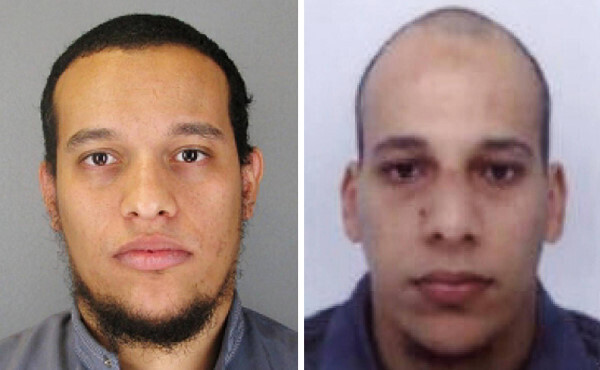
The manhunt for the two brothers wanted over Wednesday's attack on a satirical magazine office in Paris is into its third day.
Thousands of police officers are combing an area of forest north of the French capital looking for Said and Cherif Kouachi.
The brothers believed to have massacred 12 people in Paris were poverty-stricken orphans set on the path to terrorism by a radical preacher.
Cherif Kouachi, 32, was a pizza delivery man and would-be rapper before he was reportedly persuaded by extremist cleric Farid Benyettou to abandon his life and book a flight to wage “holy war” in Syria.
Raised in care homes in Rennes after his French Algerian parents died, he returned to Paris with his brother where, angry at the war in Iraq, he became radicalised.
He told a French documentary in 2005 how that happened, explaining that “Farid told me that (holy) texts prove the benefits of suicide attacks. It’s written in the texts that it’s good to die as a martyr.”
Soon won over, he became part of a shadowy organisation known as “Buttes Chaumont” said to be led by Benyettou. It funnelled Muslim men from the working class 19th arrondissement of Paris to the battlefields of Iraq.
His training sessions consisted of jogging round a Paris park to get in shape and learning how a Kalashnikov automatic rifle works by studying a sketch.
At his subsequent trial in 2008 he was described a reluctant holy warrior who was relieved when he was stopped by French counter-espionage officials from taking his flight out to the Middle East.
Journalists who covered his court case recall a skinny young man who appeared very nervous to be in court.
And a video filmed in 2004 shows a young man who seems a far cry from a terrorist capable of gunning down a dozen people in cold blood.
Lanky, wearing a baseball cap backwards and chunky watch, he belts out rap lyrics and breaks into a dance surrounded by friends.
In the documentary he was described as a “fan of rap music more inclined to hang out with pretty young girls than to attend the mosque”.
But all that is said to have changed after he met Benyettou. Following his trial he was sentenced to 18 months in prison and jail seems to have hardened his attitude.
His former lawyer Vincent Ollivier told Le Parisien newspaper that Cherif became closed off and unresponsive while locked up. He said he wondered whether the stint behind bars transformed his client into a ticking time bomb.
French interior minister Bernard Cazeneuve, however, warned that Cherif had been described by fellow would-be jihadists as “violently anti-Semitic”.
After he was released from prison he kept a low profile locally and worked in a supermarket’s fish section in the Paris suburbs for six months beginning in 2009.
But he soon came under the attention of the authorities.
In 2010, he was arrested as part of an alleged plot to free an Islamic militant sentenced to life in prison for bombing a Paris train line in 1995. Kouachi was ultimately released with no charges brought.
Much less has become public about the older brother, Said, 34, but Mr Cazeneuve said the jobless resident of the city of Reims was also known to authorities.
Never prosecuted, he was said to be “on the periphery” of the illegal activities his younger sibling was involved in.
A senior US counter-terrorism official said both brothers had been put on the US no fly list which includes known or suspected terrorists. Another official said Said had travelled to Yemen.
In Reims Said was a regular at a prayer room on the ground floor of a block of flats, according to the local imam, Abdul-Hamid al-Khalifa.
He wore traditional North Africa clothes to prayers and didn’t mix much – if at all – with other worshippers.
“Typically, he’d come late to prayers and leave right when they were done,” the imam said.
It was Said who unwittingly set the French police on their trail after he left his identity card in a stolen Citroen later abandoned.


CONNECT WITH US TODAY



Be the first to know the latest news and updates