Hong Kong protest crowds thin as both sides agree to talks
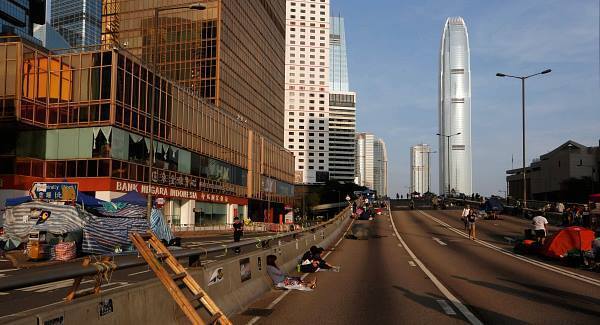
The crowds of protesters who filled Hong Kong’s streets thinned dramatically today after student leaders and the territory’s government agreed to hold talks to discuss protesters’ demands regarding electoral reforms.

Hong Kong protest crowds thin as both sides agree to talks

The crowds of protesters who filled Hong Kong’s streets thinned dramatically today after student leaders and the territory’s government agreed to hold talks to discuss protesters’ demands regarding electoral reforms.

Just a couple of days after tens of thousands of demonstrators filled the city’s streets, only a few dozen students – who have formed the core of the protest movement – remained on some stretches of occupied highway and traffic, once again disrupting traffic.

One young protester sleepily brushed his teeth as rush-hour began, spitting into a storm drain along the blockaded six-lane highway that cuts through the heart of Hong Kong’s business district. Nearby, a sleeping protester leaned back in a nylon chair, his mouth open and his glasses askew.

Despite their dwindling numbers, student leaders insisted the movement is far from defeated, and vowed to walk away from negotiations if the police used force to clear away the remaining demonstrators.

“It’s up to the government now. This is the first step, but the pressure has to continue,” said Alex Chow.

Earlier crackdowns have backfired on the government. When police fired tear gas and pepper spray on unarmed demonstrators on September 28, it caused an upsurge in support for protesters and brought tens of thousands of Hong Kong residents into the streets.

The protesters are demanding a wider say in the inaugural 2017 elections for Hong Kong’s top official, known as the chief executive, than China’s central government is prepared to give them.

Beijing, which controls Hong Kong but allows far more liberty here than on the mainland, insists candidates must be screened by a committee of mostly pro-Beijing tycoons and other elites, raising fears of communist leaders’ tightening grip.

Late yesterday, Lau Kong-wah, the territory’s under-secretary of constitutional affairs, said the government and students had agreed on terms for talks, saying the two sides would enter discussions on an equal footing.

Lester Shum, a leader of the Hong Kong Federation of Students, confirmed the agreement, but said they had not discussed or reached a consensus on the agenda. A date for the talks had not been set.

Yesterday, Chief Executive Leung Chun-ying, who has rejected the protesters’ calls for him to resign, said in a TV address that the government would seek “a sincere dialogue on political reform”.

At the same time, he urged the end to the blockade of the streets and issued veiled warnings that the authorities would eventually need to “restore social order”.

“I hope that the protesters gathering on the roads, especially students and young people, could think this over: While fighting for a better future and democracy for Hong Kong by way of civil disobedience, should you also consider the prolonged disruption caused to the general public by the Occupy Central movement?,” he said, referring to one of the protest group’s names.

Primary schools in districts that were affected by the protests reopened today, a day after high school classes resumed. Civil servants returned to work after protesters cleared the area outside the city government headquarters, a focal point of the demonstrations which began on September 26. But the city’s legislature, located in the same complex, postponed two meetings today.

Crowds also thinned markedly at two other protest sites. But traffic slowed to a crawl as drivers jammed nearby roads in the crowded city to divert around the occupation zones.

More in this section

Cookie Policy Privacy Policy Brand Safety FAQ Help Contact Us Terms and Conditions

© Examiner Echo Group Limited










