Tornado survivors' search nears end
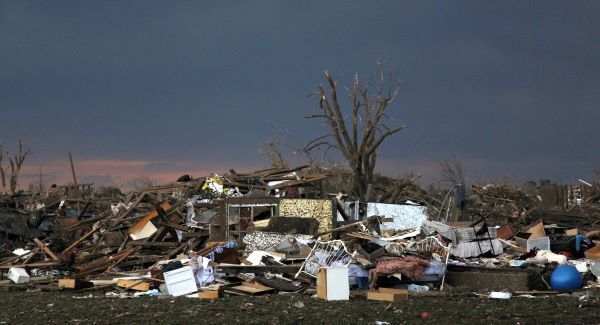
Rescue workers neared the end of the search for survivors and the dead in the Oklahoma City suburb where a mammoth tornado destroyed countless homes, cleared areas down to bare earth and claimed 24 lives, including nine children.
Scientists concluded the storm was a rare and extraordinarily powerful type of twister known as an EF5, ranking it at the top of the enhanced Fujita scale used to measure tornado strength.
Those twisters are capable of lifting reinforced buildings off the ground, hurling cars like missiles and stripping trees free of bark.
After nearly 24 hours of searching, Moore’s fire chief said he was confident there were no more bodies or survivors in the rubble.
“I’m 98% sure we’re good,” Gary Bird said at a news conference with the state governor, who had just completed an aerial tour of the disaster zone.
Authorities were so focused on the search effort that they had yet to establish the full scope of damage along the storm’s long, ruinous path.
They did not know how many homes were gone or how many families had been displaced. Emergency crews had trouble navigating devastated neighbourhoods because there were no street signs left.
Some rescuers used smartphones or GPS devices to guide them through areas with no recognisable landmarks.
The death toll was revised downward from 51 after the state medical examiner said some victims may have been counted twice in the confusion. More than 200 people were treated at hospitals.
By last night, every damaged home in Moore had been searched at least once, Mr Bird said. His goal was to conduct three searches of each building just to be certain there were no more bodies or survivors.
The fire chief was hopeful that could be completed before nightfall but efforts were being hampered by heavy rain.
Crews also continued a brick-by-brick search of the rubble of a school that was blown apart with many children inside.
No additional survivors or bodies have been found since Monday night, Mr Bird said.
Survivors emerged with harrowing accounts of the storm’s wrath, which many endured as they shielded loved ones.
Chelsie McCumber grabbed her two-year-old son Ethan wrapped him in jackets and covered him with a mattress before they squeezed into a coat closet at their house. She sang to her son when he complained it was getting hot inside the small space.
“Time just kind of stood still” in the closet, she recalled. “I was kind of holding my breath thinking this isn’t the worst of it. I didn’t think that was it. I kept waiting for it to get worse.”
“When I got out, it was worse than I thought.”
Oklahoma governor Mary Fallin lamented the loss of life, especially of the nine children, but she praised the town’s resilience.
“We will rebuild, and we will regain our strength,” she said.
From the air, large stretches of the town could be seen where every home had been cut to pieces. Some homes were sucked off their concrete slabs. A pond was filled with piles of wood and an overturned trailer.
Also visible were large patches of red earth where the tornado scoured the land down to the soil. Some tree trunks were still standing, but the winds ripped away their leaves, limbs and bark.
In revising its estimate of the storm’s power, the National Weather Service said the tornado, which was on the ground for 40 minutes, was a top-of-the-scale EF5 twister with winds of at least 200mph.
The agency upgraded the tornado from an EF4 based on reports from a damage-assessment team, said spokeswoman Keli Pirtle. Monday’s twister was at least half a mile wide, and the first EF5 tornado of 2013.
Other search-and-rescue teams focused their efforts at Plaza Towers Elementary School, where the storm ripped off the roof, knocked down walls and destroyed the playground as pupils and teachers huddled in hallways and bathrooms.
Seven of the nine dead children were killed at the school, but several were pulled alive from under a collapsed wall and other heaps of mangled debris. Rescue workers passed the survivors down a human chain of parents and neighbourhood volunteers.
Plaza Towers and another school in Oklahoma City that was not as severely damaged did not have reinforced storm shelters or safe rooms, said Albert Ashwood, director of the Oklahoma Department of Emergency Management.
More than 100 schools across the state had safe rooms, he said, but added that a shelter would not necessarily have saved more lives at Plaza Towers.
Officials were still trying to account for a handful of children not found at the school who may have gone home early with their parents, Mr Bird said.
President Barack Obama pledged to provide government help and mourned the death of young children who were killed while “trying to take shelter in the safest place they knew – their school”.
Moore has been one of the fastest-growing suburbs of Oklahoma City, attracting middle-income families and young couples looking for stable schools and affordable housing. Many residents commute to jobs in Oklahoma City or to nearby Tinker Air Force Base.
CONNECT WITH US TODAY



Be the first to know the latest news and updates