Cameron points to 'growing' evidence of chemical weapons in Syria
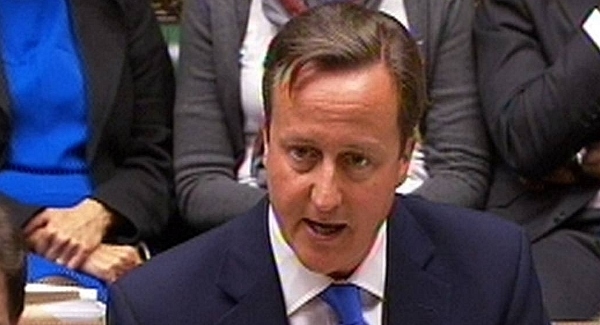
There is "limited but growing evidence" that chemical weapons have been used in Syria's civil war, British Prime Minister David Cameron said today.
Cameron said he agreed with US President Barack Obama that the issue was a "red line", but said it was unlikely that it would lead to British troops on the ground in Syria.
Speaking on BBC Breakfast, Mr Cameron said: "It is very disturbing what we are seeing. It's limited evidence but there's growing evidence that we have seen too of the use of chemical weapons, probably by the regime.
"It is extremely serious, this is a war crime, and we should take it very seriously."
Mr Cameron said they were trying not to make the mistake of "rushing into print" and were working to consider and verify the evidence with Britain's allies.
"But this is extremely serious, and I think what President Obama said was absolutely right - that this should form for the international community a red line for us to do more.
"I have always been keen for us to do more. We are working with the opposition, we want our allies and partners to do more with us to shape that opposition to make sure we are supporting people with good motives who want a good outcome, to put pressure on that regime so we can bring it to an end."
Asked if there could be troops on the ground in Syria, Mr Cameron said: "I don't want to see that and I don't think that is likely to happen, but I think we can step up the pressure on the regime, work with our partners, work with the opposition in order to bring about the right outcome.
"But we need to go on gathering this evidence and also to send a very clear warning to the Syrian regime about these appalling actions."
He said intervention was already under way through measures such as trade embargoes, sanctions and travel bans.
"The question is how do we step up the pressure and, in my view, what we need to do - and we're doing some of this already - is shape that opposition, work with them, train them, mentor them, help them, so that we put the pressure on the regime and so what we can bring this to an end.
"It is extremely difficult though, and extremely frustrating."
Mr Cameron's comments today reinforce a clear determination from both Britain and the United States that - after the experience of Iraq - they should not be drawn into precipitate action on the basis of intelligence which could turn out to be faulty.
Both London and Washington have called on Bashar al-Assad to allow United Nations inspectors to carry out a full investigation to establish what had happened.
Last night the White House said the US intelligence community had assessed with "varying degrees of confidence" that chemical weapons had been used by the regime on a "small scale".
The weapons are believed to include the deadly nerve agent sarin.
It is understood that samples smuggled out of Syria were analysed by the Defence Science and Technology Laboratory at Porton Down in Wiltshire.
In a letter to senior US senators, White House legislative director Miguel Rodriguez said they needed to build on the evidence - which included "physiological samples" - in order to establish "credible and corroborated facts".
He said the "chain of custody" of the weapons remained unclear, although it was "very likely" that their use "originated" with the regime.
"Our intelligence community does assess with varying degrees of confidence that the Syrian regime has used chemical weapons on a small scale in Syria, specifically the chemical agent sarin," he said.
"However, precisely because the President takes this issue so seriously, we have an obligation to fully investigate any evidence of chemical weapons use within Syria.
"Given the stakes involved, and what we have learned from our own recent experience, intelligence assessments alone are not sufficient - only credible and corroborated facts that provide us with some degree of certainty will guide our decision-making and strengthen our leadership of the international community."
There was, however, impatience among some US politicians, who have been pressing the President to take a tougher line on Syria.
Senior Republican Senator John McCain - one of the recipients of the White House letter - said it was now "pretty obvious" that the President's "red line" had been crossed.
"Now I hope the administration will consider what we have been recommending now for over two years of this bloodletting and massacre, and that is to provide a safe area for the opposition to operate, to establish a no-fly zone and provide weapons to people in the resistance who we trust," he said.
British Labour Party leader Ed Miliband said the development "would necessitate some kind of action" but urged caution.
"Of course it's an appalling thing if chemical weapons are being used and it will necessitate some kind of action. The question is what action is possible and that's what the international community has got to work on," he told BBC Breakfast.
Britain has to look at "what we can safely do as a country", he said.
"We need to be cautious. It is deeply worrying what we see in Syria and this news this morning.
"We need a proper UN investigation of what is actually going on.
"And then the most important thing for the international community, which frankly so far it has failed to do, is to show some unity.
"At the moment we have Russia on one side, other countries like Britain on another. We have got to have some unity in the international community and then we've got to see what action is possible."

CONNECT WITH US TODAY



Be the first to know the latest news and updates