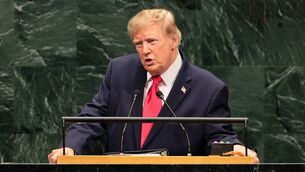
Sarkozy hits out at America's stance on Libya

French President Nicolas Sarkozy has criticised the low US profile in the international campaign in Libya, saying that France and Britain are carrying most of the burden.

Sarkozy hits out at America's stance on Libya

French President Nicolas Sarkozy has criticised the low US profile in the international campaign in Libya, saying that France and Britain are carrying most of the burden.

He said they would continue the campaign until Libyan leader Muammar Gaddafi leaves.

While other European leaders pushed for some kind of political solution in Libya, the French leader strongly defended the Nato-led military operation – and Nato itself.

He rejected comments by US Defence Minister Robert Gates that the alliance’s future could be in doubt because of European reluctance to exercise military might.

“I wouldn’t say that the bulk of the work in Libya is being done by our American friends,” Sarkozy told reporters in Brussels at a European Union summit.

“The French and English and their allies are doing the work.”

The United States has insisted on a backseat role in Libya. It led the initial coalition airstrikes in March, but in April withdrew US forces from the direct combat role, limiting them to battlefield surveillance, aerial refuelling and other support roles.

Seven Nato members are now participating in air strikes: Britain, France, Belgium, Canada, Norway, Denmark and Italy. But, as Gates said, most of Nato’s 28 members, including Germany, have refused to join the strike mission in Libya.

Sarkozy would not give a timeline for an eventual end to the three-month-old air campaign, saying that would play into Gaddafi’s hands and “I don’t think that would be constructive.”

“Things are progressing. I would have liked them to progress more quickly, but they are progressing,” he said. “We must continue until Mr Gaddafi leaves.”

There has been mounting frustration in European capitals over the rising costs of Nato’s military campaign at a time of severe financial austerity, and over the alliance’s failure to deal a knockout blow to Gaddafi’s forces, despite an overwhelming advantage in firepower.

After Sarkozy and British Prime Minister David Cameron briefed the other EU leaders on the Libya campaign, other EU leaders were keen to stress political solutions.

“(Our) nations have saved thousands and thousands of people and saved from destruction cities and villages. We expect that it will all end soon and we are pushing for political mediation which will deliver a final solution,” Italian Prime Minister Silvio Berlusconi said in Brussels.

EU President Herman Van Rompuy said: “We will keep up the military pressure as long as Gaddafi stays. We are also preparing with international partners the post-Gaddafi democratic transition.”

The EU has repeatedly condemned Gaddafi’s government, saying there can be no impunity for crimes against humanity and urging his followers to distance themselves from such crimes. The bloc has also imposed sanctions on Libyan leaders and frozen the assets of government companies.

The war has sparked accusations that EU nations participating in Nato’s aerial onslaught – Britain, France, Belgium, Italy, and Denmark – have overstepped the UN resolution, which authorised only the protection of Libyan civilians, the imposition of an arms embargo and the setting up of a no-fly zone.

The US defence secretary, in his comments earlier this month, said not enough Nato members are pitching in and that the Libya campaign illustrates his concerns about Europe’s lack of appetite for defence.

Sarkozy called Gates’ comments “unfair,” “not very nice,” and the result of “a bit of bitterness.” Gates “is about to retire, and visibly that didn’t make him happy.”

More in this section

Cookie Policy Privacy Policy Brand Safety FAQ Help Contact Us Terms and Conditions

© Examiner Echo Group Limited