'Force' urged in Ivory Coast power row
A leading ally of the man widely recognised as Ivory Coast’s new president said today that incumbent Laurent Gbagbo is using stalling tactics to stay in power and urged the international community to intervene with “legitimate force” to remove him.
Meanwhile, Gbagbo supporters who were called on to remove Alassane Ouattara from the Golf Hotel on New Year’s morning failed to materialise as United Nations Bangladeshi riot police guarded the hotel’s entrance in full crowd-control gear.
Mr Ouattara’s Prime Minister, Guillaume Soro, told the Associated Press today that Mr Gbagbo would only leave power by force and that the international community would have to intervene to protect democracy in Africa. He dismissed Mr Gbagbo’s offer to invite an international investigation into the country as a delay tactic.
“It was this same type of distracting proposition that he used to hold on for five years without an election,” Mr Soro said. “Enough is enough. Mr Gbagbo must leave power.”
Nigerian President Goodluck Jonathan, who also holds the rotating presidency of Ecowas, the Economic Community of West African States, is due in Abidjan on Monday to negotiate Mr Gbagbo’s departure. Ecowas threatened to use military force to remove Mr Gbagbo if he does not leave freely, but failed to persuade him to go into exile when its first delegation came to Ivory Coast on Monday.
The UN has said the volatile West African nation once divided in two faces a real risk of return to civil war, but Mr Soro said this war has already begun.
“In any country that records more than 200 dead in five days, as the UN has certified, it’s war. When a country experiences a massive population flight of the population – more than 20,000 Ivorians who leave their country to seek refuge in a country like Liberia – it’s war,” he said.
Human rights groups accuse Mr Gbagbo’s security forces of abducting and killing political opponents, though Gbagbo allies deny the allegations and say some of the victims were security forces killed by protesters. The UN has confirmed at least 173 deaths.
Mr Gbagbo gave an address on state television late yesterday in which he accused the international community of mounting a coup d’etat to oust him and said Ivorians were being subjected to international hostility.
“No-one has the right to call on foreign armies to invade his country,” he said. “Our greatest duty to our country is to defend it from foreign attack.”
The United Nations had been invited by all parties to certify the results of the November 28 presidential run-off vote. The UN declared Mr Ouattara the winner, endorsing the announcement by the country’s electoral commission. But Mr Gbagbo has refused to step aside now for more than a month, defying international condemnation and growing calls for his ouster.
The European Union said late yesterday that it had approved sanctions on 59 more people, in addition to 19 already sanctioned last week including Mr Gbagbo and his wife. Mr Gbagbo and about 30 of his allies also face US travel sanctions, though such measures have typically failed to reverse illegal power grabs in Africa in the past.
West African leaders have said they are prepared to use military force to push Mr Gbagbo out, but are giving negotiations more time for now. For many, the credibility of the international community is at stake if it is unable to ensure that Mr Ouattara takes power.
“I refuse to admit that they (Ecowas) are not capable of organising the intervention that they themselves decided upon,” Mr Soro said.
Mr Gbagbo points to Ivory Coast’s constitutional council, which declared him president after throwing out more than half a million votes from Ouattara strongholds. The council invalidated election results in those areas, citing violence and intimidation directed at Gbagbo supporters. The top UN envoy in Ivory Coast has disputed that assessment.
“All dictators are alike and all dictators will not negotiate their departure - they are made to leave,” Mr Soro said.
Mr Soro was appointed prime minister under Mr Ouattara’s government, which has been holed up in the Golf Hotel under UN protection despite its widespread international recognition. Mr Soro, a former rebel leader from the north, served in a coalition government with Mr Gbagbo but is now aligned with Mr Ouattara.
Meanwhile, a pro-Gbagbo youth leader had encouraged his supporters to seize the Golf Hotel, saying that Mr Ouattara and Mr Soro had until today to “pack up their bags” and leave. The building is being guarded by some 800 UN peacekeepers and hundreds of rebels loyal to Mr Ouattara. But the group did not turn up at the hotel today.
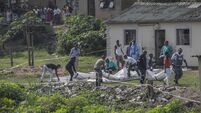
Human rights groups have warned that security forces loyal to Mr Gbagbo have been abducting political opponents in recent weeks. The United Nations, citing witness reports, believes up to 80 bodies may be inside one building nestled among shacks in a pro-Gbagbo neighbourhood on the outskirts of Abidjan.
Investigators have tried to go there several times, and even made it as far as the building’s front door before truckloads of men with guns arrived and forced them to leave. A second mass burial site is believed to be located near Gagnoa in the interior of the country, the UN said. Mr Gbagbo’s government has repeatedly denied the existence of mass graves.
“Denying access to alleged mass grave sites and places where the victims’ mortal remains are allegedly deposited constitutes a clear violation of international human rights and humanitarian law,” UN High Commissioner for Human Rights Navi Pillay said.
Mr Pillay also warned that those committing human rights violations at the direction of others could also be held accountable.
Ivory Coast was divided into a rebel-controlled north and a loyalist south by a 2002-03 civil war, and the long-delayed presidential election was intended to help reunify the nation. However, tensions over the outcome have sparked violence including several attacks on UN peacekeepers.
Ivory Coast, the world’s top cocoa producer, was officially reunited in a 2007 peace deal. However, Mr Ouattara still draws his support from the northern half of the country, where residents feel they are often treated as foreigners within their own country by southerners.
Colonel Mohammed Yerima, director of defence information for the Nigerian military, said defence chiefs from the 15-nation regional bloc Ecowas met yesterday to begin discussing what sort of assault they would use if those talks failed. But his comments appeared to suggest no such attack was imminent, as he said the plans would only be presented to Ecowas leaders in Mali in mid-January.