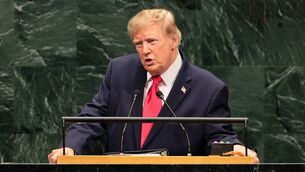
Obama warns nuclear summit of terror risk
US President Barack Obama welcomed leaders of 47 countries to a Washington summit on nuclear security today and delivered a stark warning about the dangers of nuclear weapons falling into the wrong hands.
In an opening address to assembled leaders, President Obama noted the risk of nations going to war with nuclear weapons had decreased while “the risk of a nuclear attack has gone up” – a reference to the threat of terrorists obtaining nuclear materials.
President Obama’s efforts to persuade global leaders to join him in “locking down” all nuclear materials within four years were boosted by China’s agreement to work with the US on possible sanctions against Iran and Ukraine’s decision to get rid of highly enriched uranium.
His meeting with Chinese President Hu Jintao was the last of the summit warm-up sessions.
White House national security aide Jeff Bader said Iran was a major topic of discussion at the 90-minute session.
“They’re prepared to work with us,” Mr Bader said, interpreting that willingness as “another sign of international unity on this issue”.
The upbeat assessment reflected a recent warming of US-Chinese diplomatic ties, though the meeting produced no clear breakthrough and Chinese spokesman Ma Zhaoxu did not mention sanctions in a statement about the meeting.
Mr Ma said China hopes all parties will step up diplomatic efforts and seek ways to resolve the Iranian nuclear issue through negotiations.
“China and the US share the same overall goal on the Iranian nuclear issue,” the Chinese statement said.
In Beijing on Tuesday, Chinese Foreign Ministry spokeswoman Jiang Yu said: “China always believes that dialogue and negotiation are the best way out for the issue. Pressure and sanctions cannot fundamentally solve it.”
But she added that China supports a “dual-track strategy” combining diplomacy with the possibility of international sanctions against Iran.
In Tehran, Iran expressed doubts that China would back the US push for new sanctions.
Foreign Ministry spokesman Ramin Mehmanparast said he did not think Mr Hu was signalling that with his comments.
Tehran doesn’t “consider the statement as approval of the US stance and unfair actions,” he told reporters. “Our interpretation is different.”
The US already has the robust backing of Great Britain, France and Germany in adopting further sanctions against Iran. Russia, too, has shown a willingness to join the sanctions effort, which would secure the required clean sweep of permanent members the United Nations Security Council.
Brazil and Turkey, which both hold non-permanent seats on the UN Security Council, are studying an alternative proposal to deal with Iran’s controversial nuclear programme, said Brazilian Foreign Minister Celso Amorim.
While the US worries about Iran, Turkey has its own concerns about Israel’s nuclear programme.
Israeli Prime Minister Benjamin Netanyahu opted not to attend President Obama’s summit and insiders said he had expected Turkey and Egypt to use the conference as a platform to challenge him over his country’s widely assumed nuclear arsenal, which the Jewish state never has acknowledged.
Iran’s UN Ambassador Mohammad Khazee on Monday declared Obama’s new nuclear policy, which excludes Iran from a US pledge not to use nuclear weapons against countries that do not have them, an act of “state terrorism” because it threatens nations with weapons of mass destruction.
Meanwhile, the Ukrainians, who gave a major boost to arms control in 1994 when they agreed to surrender the nuclear weapons they inherited in the collapse of the Soviet Union, agreed to get rid of their weapons-grade fuel by 2012.
Some details are yet to be worked out, including how and where the nuclear fuel will be disposed of, said White House press secretary Robert Gibbs. The material could be sent to the US or Russia, but he declined to specify the amount, other than to say it was enough to make several nuclear weapons.
The focus of the summit is tons of plutonium and highly enriched uranium feared to be insufficiently protected from international criminal gangs and terrorist organisations.
A new report from a Harvard non-proliferation expert, for example, found that Pakistan’s small but growing stockpile faces “immense” threats and is the world’s least secure from theft or attack.
However, Pakistan Prime Minister Yusuf Raza Gilani said his country’s nuclear weapons were well-guarded.
Delegates at the summit, including UK Foreign Secretary David Miliband, are expected to sign a joint declaration to guide future work toward locking away and cleansing the globe of materials potentially accessible to terrorists.

CONNECT WITH US TODAY



Be the first to know the latest news and updates