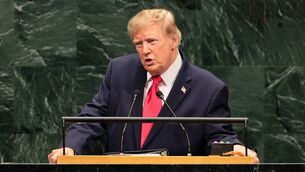
Barroso call isolates Bush on climate
European Commission President Jose Manuel Barroso said the G8 nations must reach agreement among themselves on climate change measures and avoid taking the approach that “I will do nothing unless you do it first,” which he called a “vicious circle".
However, US President George Bush says developing nations must take equal measures to make any deal work, and has shown little enthusiasm for setting goals without them.
G8 leaders are joined on Wednesday by Chinese President Hu Jintao and Indian Prime Minister Manmohan Singh when the summit is expected to focus on global warming.
China and India say it is up to the heavily polluting developed world to take the lead in the fight against global warming.
“If we agree, then we are in a much better position to discuss with our Chinese and Indian partners and others,” Mr Barroso said.
Because of their huge populations and fast-rising economies, China and India are major emitters of greenhouse gases that are blamed for global warming.
China has said it is ready to discuss setting medium- and long-term goals for reducing greenhouse gas emissions and is open to negotiating targets.
However, Beijing has not changed its view that the main responsibility still lies with developed countries. India has vowed to keep its emissions below those of developed countries, but is also looking for them to set the pace.
Japan, this year’s G8 host, has cast the summit’s spotlight on climate change and is supporting its US ally in pushing for wider international talks.
“There should be a shared sense of crisis on climate change, and based on that the G8 leaders would agree on the need for total participation from all the major economies,” said Japanese Foreign Ministry spokesman Kazuo Kodama.
G8 environment ministers said in May there was a “strong political will” to reach an agreement at the summit to cut emissions by 50% by 2050, but that a consensus had not been reached on midterm targets for 2020.
Because of dissent within the G8 itself, it was unclear whether the leaders would be able to go much further this week than their ministers did in May.
The G8 – which groups the United States, Russia, France, Italy, Germany, Canada, Britain and Japan – accounts for about 40% of global carbon dioxide emissions today, according to the environmental group Greenpeace.
More than other G8 leaders, President Bush has insisted on holding China and India to the same emission-reduction standards as nations that developed earlier.
“I’ve always advocated that there needs to be a common understanding and that starts with a goal. And I also am realistic enough to tell you that if China and India don’t share that same aspiration, that we’re not going to solve the problem,” President Bush said at a pre-summit news conference yesterday.
Advocacy groups say the G8 focus on Chinese and Indian participation is a shield for their own failure to unite behind specific interim targets.
“Finger-pointing at China and India is a poor excuse for G8 inaction,” Antonio Hill, a spokesman for Oxfam International, said in a statement. “People living in poverty already suffer terrible consequences from the profligate emissions of rich countries.”
China’s projected annual increase in emissions is greater than the total now produced each year by either Britain or Germany, according to a report by economists from the University of California at Berkeley and the University of California at San Diego.
The UN launched negotiations late last year on a new climate change pact to take over when the first phase of the Kyoto Protocol – which the US hasn’t ratified – expires at the end of 2012.
Negotiators face a deadline of December next year, when 190 nations are to meet in Copenhagen, Denmark.

CONNECT WITH US TODAY



Be the first to know the latest news and updates