UN chief meets Burma leader over cyclone aid
UN chief Ban Ki-moon met the leader of Burma’s ruling junta today, hoping to persuade him into allowing full international access to 2.5 million cyclone survivors.
Mr Ban arrived in the remote capital of Naypyitaw after a flight from Rangoon, 400km to the south. He witnessed some of the cyclone’s devastation during a carefully choreographed tour yesterday.
The contents of the talks between the UN chief and the most powerful man in the country, Senior General Than Shwe, were not immediately known.
Highest on Mr Ban’s agenda was urging Mr Than Shwe, who had earlier refused to take his calls from New York, to allow an unimpeded influx of foreign aid and experts to reach survivors, most of them women and children, at growing risk of starvation, disease and exposure to monsoon rains.
By the military government’s count, some 78,000 people were killed by Cyclone Nargis on May 2-3 and another 56,000 are unaccounted for.
Pro-democracy activists had urged Mr Ban to also bring up the fate of opposition leader Aung San Suu Kyi, whose latest period of detention expires on Monday. A string of UN envoys have in the past failed to spring the democracy leader from house arrest, confronting a junta which has proved virtually impervious to outside pressure.
The 76-year-old Mr Than Shwe – reclusive, superstitious and known as “the bulldog” for his stubbornness – has held virtually unassailable power since 1992.
As Mr Ban’s visit proceeded, the regime appeared to ease some of its restrictions on foreigners.
France-based Doctors Without Borders said it now had some foreign staffers working in four areas of the hard-hit Irrawaddy Delta, which had previously been virtually off limits to non-Burmese relief workers.
A second French cargo plane loaded with 40 tons of relief supplies was due to land in Rangoon today, while Canada said it would lend its biggest military aircraft, a C-17 cargo lifter, to deliver UN World Food Programme helicopters to Burma.
The regime had earlier allowed the UN agency to bring in 10 helicopters to fly emergency aid to stranded victims.
Mr Ban’s first-hand look at the devastation wrought by the storm left the Secretary-General shaken yesterday, even though the areas to which he was taken were far from the worst-hit.
“I’m very upset by what I’ve seen,” he told reporters after a walk through a makeshift relief camp where 500 people huddled in blue tents at Kyondah village in Dedaye township, about 45 miles (75km) south-west of Rangoon, Burma’s largest city.
Burma’s military regime has been eager to show it has the relief effort under control despite spurning the help of foreign disaster experts, and has trotted out officials to give statistics-laden lectures to make the point.
However, the UN says up to 2.5 million cyclone survivors face hunger, homelessness and potential outbreaks of deadly diseases, especially in the lower-lying areas of the Irrawaddy Delta close to the sea. It estimates that aid has reached only about 25% of them.
The places Mr Ban visited – the Kyondah Relief Camp and the town of Mawlamyinegyun, an aid distribution point – seemed well-organised.
However, the destruction in the areas around them was relatively mild compared with that further south-west in the townships of Labutta and Bogalay. Officials gave no explanation of why Mr Ban was not taken to those areas, where the preponderance of dead and missing are reported.
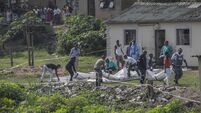
The International Red Cross said that rivers and ponds in Bogalay remained full of bodies, and that many people in remote areas had received no aid.
UN officials travelling with Mr Ban said they were discussing with Chinese authorities whether he could tour the earthquake zone in Sichuan directly after leaving Burma. The officials requested anonymity, citing protocol.
The trip, which has not been finalised, would give Mr Ban the chance to compare the two countries’ responses and urge China – Burma’s biggest ally – to put its weight behind opening the flow of aid workers.
As Mr Ban began his visit, foreign aid agencies stressed the need to quickly reach survivors suffering from disease, hunger and lack of shelter.
“In 30-plus years of humanitarian emergency work this is by far – by far – the largest case of emergency need we’ve ever seen,” said Lionel Rosenblatt, president of US-based Refugees International.
Rangoon residents did not seem optimistic that Mr Ban’s visit would make a difference.
“Don’t just talk. You must take action,” said Eain Daw Bar Tha, abbot of a Buddhist monastery on the outskirts of the city. “The UN must directly help the people with helicopters to bring food, clothes and clean water to the really damaged places.”
At the United Nations in New York, France pushed for a UN resolution authorising the delivery of aid to survivors “by all means necessary” if pressure from Mr Ban and Burma’s neighbours does not open the aid pipeline quickly.