Burma blocks UN emergency airlift for cyclone victims
Burma’s isolationist government blocked United Nations efforts today to airlift urgently needed food aid to survivors of a cyclone which may have killed more than 100,000 people, UN officials said.
Paul Risley, a spokesman for the UN World Food Programme in Bangkok, said three flights were waiting to leave Dubai, Bangladesh and Thailand with about 50 tons (45 tonnes) of high-energy biscuits. A fourth shipment aboard a scheduled Thai Airways cargo flight was likely to carry some biscuits later today.
He said that WFP was in “constant touch” with the military junta to obtain flight clearance for the first major airlift of international aid. A handful of smaller shipments from neighbouring countries arrived earlier in the week.
Earlier, a statement from WFP in Washington indicated approval for the airlift had been given, saying the planes were scheduled to land in Rangoon early today.
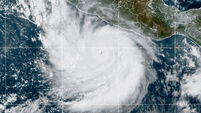
Burma’s state media said Cyclone Nargis has killed at least 22,980 people and left 42,119 missing, but a top US diplomat said yesterday more than 100,000 may have died.
Burma’s generals, traditionally paranoid about foreign influence, issued an appeal for international assistance after the storm struck on Saturday. They have since dragged their feet on issuing visas to relief staffers even as survivors faced hunger, disease and flooding in the hardest-hit Irrawaddy delta.
“We are in constant discussion with them in Rangoon, and we expect to receive clearance,” Mr Risley said.
“It is enough of a challenge that visas are being held up for bringing in experienced international relief workers, but it is specially frustrating that critically needed food aid is being held up,” he said.
Burma’s state television today showed Prime Minister Lt Gen Thein Sein distributing food packages to the sick and injured in the delta and soldiers dropping food over villages. The date of the distributions was not given.
Indian navy vessels and planes from Japan, Thailand, Singapore, Laos and Bangladesh arrived in recent days with medicine, candles, instant noodles, raincoats and other relief supplies, the television said.
State radio said “unscrupulous elements” in Rangoon were spreading rumours of an impending earthquake, a second cyclone and looting in the country’s largest city. Residents say some looting has occurred at markets and stores.
It appeared the regime was trying both to calm the population and stop any gatherings that might turn into political agitation against the widely detested military rule.
Although most Rangoon residents were preoccupied trying to restore their lives, activists using the cover of an almost-total power outage have scribbled fresh graffiti on overpasses.
The graffiti include “X” marks – a symbol for voting “no” in a referendum on Saturday on a new, military-backed constitution. Voting has been postponed until May 24 in Rangoon, some outlying areas and parts of the delta due to the storm’s destruction.
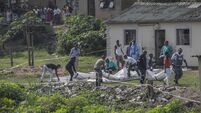
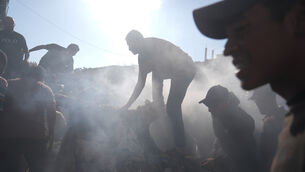
Entire villages in the Irrawaddy delta were still submerged from the storm, and bloated corpses could be seen stuck in the mangroves. Some survivors stripped clothes off the dead. People wailed as they described the horror of the torrent swept ashore by the cyclone.
“I don’t know what happened to my wife and young children,” said Phan Maung, 55, who held on to a coconut tree until the water level dropped. By then his family was gone.
A spokesman for the UN Children’s Fund said its staff in Burma reported seeing many people huddled in roughly built shelters, and children who lost their parents.
“There’s widespread devastation. Buildings and health centres are flattened and bloated dead animals are floating around, which is an alarm for spreading disease. These are massive and horrific scenes,” Patrick McCormick said at Unicef offices in New York.
Shari Villarosa, who heads the US Embassy in Rangoon, said the number of dead could eventually exceed 100,000 because safe food and water were scarce and unsanitary conditions widespread.
A few shops reopened in the delta, but they were quickly overwhelmed by desperate people, said Mr Risley, quoting his agency’s workers in the area.
“Fistfights are breaking out,” he said.
A Rangoon resident who returned from the delta area said people were drinking coconut water because there was no safe drinking water. He said many people were on boats using blankets as sails.
UN officials estimated that one million people were left homeless in Burma.
Some aid workers said heavily flooded areas were accessible only by boat, with helicopters with relief supplies unable to find dry spots to land.
“Basically the entire lower delta region is under water,” said Richard Horsey, the Thailand-based spokesman for the UN Office for the Co-ordination of Humanitarian Aid.
CONNECT WITH US TODAY



Be the first to know the latest news and updates