Rescuers search for survivors of building collapse
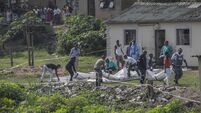
Rescuers aided by bright spotlights worked into the night tonight, searching for survivors and clearing rubble from the collapse of an eight-storey building that killed at least 15 people, the latest tragedy to mar the annual gathering of millions of Muslims in Islam’s holiest city.
The Interior Ministry said 15 people were killed and 39 were injured in the collapse of Lulu’at al-Khair, a multi-purpose building that housed a number of shops and restaurants and was rented out as a hostel during pilgrimages.
It was situated just 60 metres from the Grand Mosque, a focal point of the annual hajj pilgrimage.
Later, Saad al-Toujeri, head of the kingdom’s civil defence forces, said 18 bodies had been removed and 58 injured people had been taken to nearby hospitals.
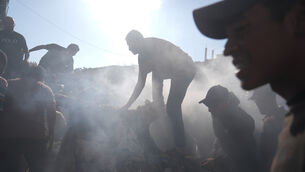
Cranes and bulldozers removed large slabs of concrete, and jackhammers broke up smaller pieces to aid in the clearing of debris.
Al-Toujeri, who was supervising rescue operations, said rescuers had lowered cameras and microphones into the rubble in attempts to find survivors.
About 1,000 rescue workers, medics and police scrambled over and around the collapsed building, working methodically but urgently.
A special unit of the country’s anti-terrorism force maintained security, keeping curious bystanders behind a red-and-white police ribbon and patrolling the scene.
Six massive generators supported spotlights atop long poles.
“Fortunately the building was almost empty when it collapsed, because most of residents were in the holy shrine at that time,” civil defence Maj Gen Alwani, who did not provide his first name, told government-run Al-Ekhbariya television.
“Most of the casualties were from the passers-by near the building.”
The dead and injured were believed to have come from a number of countries, including Egypt, Tunisia, the United Arab Emirates and Indonesia.
Another government official, who did not identify himself, told the network that the 40-year-old building’s foundations were cracked and weak.
Talha al-Nizi, a Tunisian guide for pilgrims, said his group had just finished midday prayers and returned to their hotel adjacent to Lulu’at al-Khair about 1.10pm (10.10am Irish Time).
“As I moved to step into my hotel, the whole building collapsed in front of my eyes. The whole street was full of dust,” said al-Nizi, who used his mobile phone to capture video and still images of the collapse.
Qassim Bashir, an Indian who works at a hospital in Jiddah, the nearest large city, said hundreds of doctors and other medics had been brought in to assist the rescue and recovery efforts.
He said he pulled out four dead bodies himself that were in “very bad shape” and that he could hear moaning and crying from inside.
“I think those who are trapped inside are more than those who have been pulled out,” he said.
The wounded were being taken to hospitals in Mecca and Jiddah, about 40 miles east of Mecca.
The courtyard of the Grand Mosque encloses the Kaaba, a large cubic stone structure that Muslims face during their five daily prayers.
The Prophet Mohammed was born in Mecca, and the Grand Mosque is central to the Muslim faith and the hajj. Daily prayers are also conducted in the mosque’s marble-paved yard, which can hold thousands.
Islam’s five pillars demand that followers profess there is one God and Mohammed is His prophet, pray five times daily, give alms, fast daily during the holy month of Ramadan and – if financially able – travel to Mecca at least once in their lifetime.
The number of pilgrims to Mecca has increased elevenfold over the past 15 years. During that time, the Saudi government spent billions of dollars to improve accommodations, transportation and medical facilities for the “guests of Allah.”
The massive gathering has been hit with tragedies frequently in recent years.
The worst hajj-related tragedy occurred in 1990 when 1,426 pilgrims were killed in a stampede in an overcrowded pedestrian tunnel leading to holy sites in Mecca.
In 2004, on the final day of the ceremonies, 251 people were trampled to death when the crowd panicked during the ritual stoning of the devil. Three years earlier, 35 hajj pilgrims were killed in stampede the same ceremony.
In 1998, about 180 pilgrims were trampled to death when panic erupted after several of them fell off an overpass during the ritual. Four years earlier, in 1994, some 270 pilgrims killed in a stampede during the stoning ritual.
During an anti-US demonstration staged by Iranians in 1987, some 402 people, mostly pilgrims from Iran, were killed and 649 were wounded in the crash of a Pakistani jetliner carrying hajj pilgrims Jiddah to Riyadh, the Saudi capital.

CONNECT WITH US TODAY



Be the first to know the latest news and updates