Katrina: Evacuation disrupted by arson, gunfire

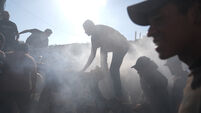
Fights and rubbish fires broke out, rescue helicopters were shot at and anger mounted across New Orleans today, as National Guardsmen in armoured vehicles poured in to help restore order across this increasingly desperate and lawless city.

Katrina: Evacuation disrupted by arson, gunfire

Fights and rubbish fires broke out, rescue helicopters were shot at and anger mounted across New Orleans today, as National Guardsmen in armoured vehicles poured in to help restore order across this increasingly desperate and lawless city.

“We are out here like pure animals. We don’t have help,” the Rev Issac Clark, 68, said outside the New Orleans Convention Centre, where corpses lay in the open and evacuees complained that they were dropped off and given nothing.

The nearby state of Texas, which is putting up 25,000 people at the Houston Astrodome stadium, has agreed to take accommodate an additional 25,000 Louisiana refugees in San Antonio, Texas Gov Rick Perry’s office said today. The details have not yet been decided.

An additional 10,000 National Guardsman from across the country were ordered into the hurricane-ravaged Gulf Coast to shore up security, rescue and relief operations in Katrina’s wake as looting, shootings, gunfire and carjackings spread and food and water ran out.

But some Federal Emergency Management rescue operations were suspended in areas where gunfire has broken out, Homeland Security spokesman Russ Knocke said in Washington.

“In areas where our employees have been determined to potentially be in danger, we have pulled back,” he said.

“Hospitals are trying to evacuate,” said Coast Guard Lt Cmdr Cheri Ben-Iesan, spokesman at the city emergency operations centre. “At every one of them, there are reports that as the helicopters come in people are shooting at them. There are people just taking pot-shots at police and at helicopters, telling them: ‘You better come get my family’.”

Police Capt Ernie Demmo said a National Guard military policeman was shot in the leg as the two scuffled for the MP’s rifle. The man was arrested.

“These are good people. These are just scared people,” Demmo said.

The Superdome, where some 25,000 people were being evacuated by bus to the Houston Astrodome, descended into chaos.

Huge crowds, hoping to finally escape the stifling confines of the stadium, jammed the main concourse outside the dome, spilling out over the ramp to the Hyatt hotel next door – a seething sea of tense, unhappy, people packed shoulder-to-shoulder up to the barricades where heavily armed National Guardsmen stood.

Fights broke out. A fire erupted in a rubbish chute inside the dome, but a National Guard commander said it did not affect the evacuation. After a traffic jam kept buses from arriving at the Superdome for nearly four hours, a near riot broke out in the scramble to get on the buses that finally did show up.

Outside the Convention Centre, the pavements were packed with people without food, water or medical care, and with no sign of law enforcement.

Thousands of storm refugees had been assembling outside for days, waiting for buses that did not come.

At least seven bodies were scattered outside, and hungry, desperate people who were tired of waiting broke through the steel doors to a food service entrance and began pushing out pallets of water and juice and whatever else they could find.

An old man in a chaise lounge lay dead in a grassy median as hungry babies wailed around him.

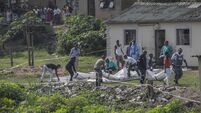
Around the corner, an elderly woman lay dead in her wheelchair, covered up by a blanket, and another body lay beside her wrapped in a sheet.

“I don’t treat my dog like that,” 47-year-old Daniel Edwards said as he pointed at the woman in the wheelchair. ”I buried my dog.” He added: “You can do everything for other countries but you can’t do nothing for your own people. You can go overseas with the military but you can’t get them down here.”

Just above the convention centre on Interstate 10, commercial buses were lined up, going nowhere.

The street outside the centre, above the floodwaters, smelled of urine and faeces, and was choked with dirty nappies, old bottles and garbage.

“They’ve been teasing us with buses for four days,” Edwards said.

People chanted, “Help, help!” as reporters and photographers walked through. The crowd got angry when journalists tried to photograph one of the bodies, and covered it over with a blanket. A woman, screaming, went on the front steps of the convention centre and led the crowd in reciting the 23rd Psalm.

John Murray, 52, said: “It’s like they’re punishing us.”

The first of hundreds of busloads of people evacuated from the Superdome arrived early today at their new temporary home – another sports arena, the Houston Astrodome, 350 miles away.

But the ambulance service in charge of taking the sick and injured from the Superdome suspended flights after a shot was reported fired at a military helicopter. Richard Zuschlag, chief of Acadian Ambulance, said it had become too dangerous for his pilots.

The military, which was overseeing the removal of the able-bodied by buses, continued the ground evacuation without interruption, said National Guard Lt Col Pete Schneider.

The government had no immediate confirmation of whether a military helicopter was fired on.

In Texas, the governor’s office said Texas has agreed to take in an additional 25,000 refugees from Katrina and plans to house them in San Antonio, though exactly where has not been determined.

Yesterday, Mayor Ray Nagin offered the most startling estimate yet of the magnitude of the disaster: Asked how many people died in New Orleans, he said: “Minimum, hundreds. Most likely, thousands.” The death toll has already reached at least 121 in Mississippi.

If the estimate proves correct, it would make Katrina the worst natural disaster in the US since at least the 1906 San Francisco earthquake and fire, which was blamed for anywhere from about 500 to 6,000 deaths. Katrina would also be the nation’s deadliest hurricane since 1900, when a storm in Galveston, Texas, killed between 6,000 and 12,000 people.

Nagin called for a total evacuation of New Orleans, saying the city had become uninhabitable for the 50,000 to 100,000 who remained behind after the city of nearly a half-million people was ordered cleared out over the weekend, before Katrina blasted the Gulf Coast with 145mph winds.

The mayor said that it will be two or three months before the city is functioning again and that people would not be allowed back into their homes for at least a month or two.

“We need an effort of 9-11 proportions,” former New Orleans Mayor Marc Morial, now president of the civil rights group Urban League, said on NBC’s Today show. “So many of the people who did not evacuate, could not evacuate for whatever reason. They are people who are African-American mostly but not completely, and people who were of little or limited economic means. They are the folks, we’ve got to get them out of there.”

“A great American city is fighting for its life,” he added. “We must rebuild New Orleans, the city that gave us jazz, and music, and multiculturalism.”

With New Orleans sinking deeper into desperation, Nagin ordered virtually the entire police force to abandon search-and-rescue efforts Wednesday and stop the increasingly brazen thieves.

“They are starting to get closer to heavily populated areas – hotels, hospitals, and we’re going to stop it right now,” Nagin said.

In a sign of growing lawlessness, Tenet HealthCare asked authorities last night to help evacuate a fully functioning hospital in Gretna after a supply truck carrying food, water and medical supplies was held up at gunpoint.

The floodwaters streamed into the city’s streets from two levee breaks near Lake Pontchartrain a day after New Orleans thought it had escaped catastrophic damage from Katrina. The floodwaters covered 80% of the city, in some areas 20 feet deep, in a reddish-brown soup of sewage, petrol and rubbish.

The Army Corps of Engineers said it planned to use heavy-duty Chinook helicopters to drop 15,000-pound bags of sand and stone into a 150-metre gap in the failed floodwall.

But the agency said it was having trouble getting the sandbags and dozens of 15-foot highway barriers to the site because the city’s waterways were blocked by loose barges, boats and large debris.

Lt Gov Mitch Landrieu toured the stricken areas and said rescued people begged him to pass information to their families. His pocket was full of scraps of paper on which he had scribbled down their phone numbers.

When he got a working phone in the early hours of this morning, he contacted a woman whose father had been rescued and told her: “Your daddy’s alive, and he said to tell you he loves you.”

“She just started crying. She said: ‘I thought he was dead,”’ he said.

More in this section

Cookie Policy Privacy Policy Brand Safety FAQ Help Contact Us Terms and Conditions

© Examiner Echo Group Limited