Co-pilot of crash plane questioned
The co-pilot of the Air France passenger jet that crashed and burned at Canada’s busiest airport will be interviewed today as investigators try to piece together why the plane skidded off the runway and burst into flames after landing in a ravine.
Real Levasseur, leading the investigation of by Canada’s Transportation Safety Board, said the captain of Flight 358 was still in hospital with injuries to his back. He said he would not be questioned by the team until doctors were satisfied he is in suitable mental health to talk about Tuesday’s crash – in which all 309 people on board escaped with their lives.
“I will not be talking to him until he is capable of talking to us,” Levasseur said.
The flight attendants – widely praised for having moved the passengers off the burning aircraft within two minutes – were to be debriefed in the coming days, he said.
A dozen passengers remain hospitalised, some with broken bones, but none apparently with life-threatening injuries.
Levasseur said the air crew did not declare an emergency to air traffic controllers as the Airbus A340 approached the runway at 160 mph in heavy rains and lightning. It then skidded some 200 metres off east-west runway at 95 mph, he said.
He said preliminary evidence suggests there was nothing wrong with the aircraft, but that still needed to be confirmed. The flight data and voice recorders – the so-called black boxes – were recovered yesterday and sent to TSB headquarters in Quebec.
Officials hope the recorders will provide clues to what caused the aircraf to skid off a runway on Tuesday at Pearson International Airport on the outskirts of Toronto.
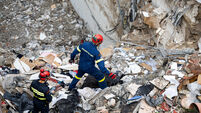
All 309 passengers and crew escaped alive in an evacuation that took less than two minutes. Air France said 22 people were injured, while airport officials said 43 were hurt. The wreckage of the jet was torn into three pieces and remained off the side of Highway 401, where many of the passengers had wandered after escaping the wreckage.
Brian Lackey, vice president of operations for the Greater Toronto Airport Authority, said yesterday the jet had enough fuel to divert to Montreal or another airport where the weather was better, but “that’s the pilot’s decision.”
The airport was under a “red alert,” which indicates potential for lightning and forces ground staff to remain indoors, but does not prevent planes from landing or taking off.
Levasseur said the decision to land during a “red alert” would be investigated.
He emphasised that wind shear likely wasn’t a factor in the crash – as has been speculated – because that usually would only affect aircraft in flight. He also doubted lightning played a role.
Airport Fire Chief Mike Figliola said three-quarters of the passengers and crew managed to escape in the 52 seconds it took for emergency crews to arrive. “The crew did a great job, they’re trained to get the people off,” Figliola said.
At Air France headquarters in Roissy, France, airline chairman Jean-Cyril Spinetta also praised the flight crew. “I don’t know if we should speak of a miracle ... but above all the professionalism of the crew,” Spinetta said.
He said the co-pilot, who was in charge of the landing, had 10,700 hours of flying time, and the 57-year-old pilot had 15,000 hours.
CONNECT WITH US TODAY



Be the first to know the latest news and updates