Violent protests follow Togo election result
At least three soldiers were killed in violent protests that broke out after the son of Togo’s late dictator was declared the winner of presidential elections, officials said today.
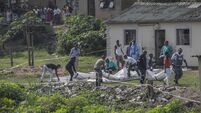
Clashes pitting riot police against opposition party supporters angered by Tuesday’s announcement of Faure Gnassingbe’s victory continued into today, with young men throwing flaming petrol bombs at police. More than 100 people were reported wounded. It wasn’t immediately clear if there were any civilian deaths.
Three soldiers have so far died in the battles engulfing the capital, Lome, Interior Minister Folly Bazi Katari told reporters. He also reported heavy looting and said rock-throwing crowds had damaged some foreign embassies.
“Those responsible for these actions will be severely punished,” he said. “This is not political protest any more, but robbery and destruction.”
By late Tuesday, more than 100 wounded in the day’s clashes had been admitted to Lome’s main hospital, said Abram Morel, a medical co-ordinator for the International Committee of the Red Cross. They included several gunshot victims and people who’d been beaten by protesters and security forces, he said.
The military had named Gnassingbe as Togo’s new president shortly after the February 5 death of a heart attack of his father, Gnassingbe Eyadema, whose 38-year-rule had made him Africa’s longest-ruling dictator.
Amid heavy international pressure, the 39-year old son agreed to give up power and allow for elections, held on Sunday amid violence and charges by the opposition that the ruling party was stealing the vote.
Authorities announced on Tuesday Gnassingbe won with 60% of the vote. His main opponent – Bob Akitani, in hiding since Sunday’s balloting – took 38% of the vote.
Gilchrist Olympio, leader of Akitani’s party, called for new elections and said it was very unlikely his party would follow through on an earlier pledge to join a national unity government.
Olympio told the French-language La Croix newspaper in comments reported today he would have to consult colleagues before giving a definitive answer, “but I can tell you already, it’s 90% (sure) that we won’t accept joining this government.”
“The election we just had is a joke,” Olympio told La Croix. “There was massive fraud so it’s difficult for a serious political party to recognise such a result.”
Olympio and Gnassingbe had agreed on Monday in nearby Nigeria that whoever won would form a government of national unity. Nigeria, which brokered the unity government deal now in question, was among the West African nations that had intervened to ensure a democratic succession in Togo and now do not want to see their efforts destroyed by violence.
In Washington, US State Department spokesman Adam Ereli said on Tuesday the proposal of a unity government “is an initiative that we support because we believe … that an inclusive government focused on national reconciliation would be a positive development.”
He said the US, together with the African Union and the Economic Community of West African States, or ECOWAS, would try to get a unity government functioning “as a way of healing the divisions in Togo and as a means of promoting a political way forward.”
Ereli called on the government and opposition to commit “themselves to a peaceful way forward.”
A spokeswoman for the 15-nation ECOWAS declared on Tuesday that the elections had been fair, saying votes uncounted amid Sunday’s violence in Lome weren’t enough to cause concern.
“The polls satisfy the criteria of credibility and international standards,” said Adrienne Diop, spokeswoman for the regional body, which had 127 observers in Togo.
Protesters raged across the capital immediately after the results were announced, blocking roads with stacks of tires and setting them ablaze. Within minutes, fires burned across the capital, darkening the horizon.
Throughout the afternoon, police and soldiers shot tear gas and grenades to scatter mobs of young men throwing stones and waving machetes and nail-studded clubs.
Gnassingbe had campaigned on a platform of national unity, promising to bring together the country’s political parties, long divided by distrust and suspicion under Eyadema.
Despite his efforts to escape his father’s legacy, many fear Gnassingbe is only a pawn of his father’s political machine, which has left the country in economic shambles.
CONNECT WITH US TODAY



Be the first to know the latest news and updates