60 dead as suicide bombers target holy cities
Car bombs tore through a Najaf funeral procession and Karbala’s main bus station, killing at least 60 people and wounding more than 120 in the two Shiite holy cities.
And in Baghdad, gunmen launched a massive ambush, murdering three election officials, in their campaign to disrupt next month’s parliamentary ballot.
Yesterday’s deadly strikes highlighted the apparent ability of the rebels to launch attacks almost at will, despite confident assessments by US military commanders that they had regained the initiative after last month’s campaign against militants in Fallujah.
In the Baghdad attack, dozens of guerrillas – unmasked and apparently unafraid to show their faces – ran rampant over Haifa Street, a main downtown thoroughfare. They dragged the three election workers from a car, lay them on the street in the middle of morning traffic and shot them at point-blank range.
The bombings in Najaf and Karbala, which Shiite officials suspected were co-ordinated, were the deadliest attacks since July. They were a bloody reminder that the Shiite heartland in the south – not just the Sunni regions of central and northern Iraq – is vulnerable to the mainly Sunni rebels aiming to wreck the vote.
Shiites, who make up around 60% of Iraq’s population, have been strong supporters of the election, which they expect will reverse the long-time domination of Iraq by the Sunni Arab minority. The uprising is believed to include many Sunnis who have lost prestige and privilege since Saddam Hussein’s fall.
The persistent violence has already raised questions over whether residents of central and northern Iraq will be able to vote. If attacks scare away voters in the south as well, it would further undermine the first national ballot since Saddam was ousted.
In a message passed on by lawyers who visited him in his cell last week, Saddam denounced the elections as an American plot.
“President Saddam recommended to the Iraqi people to be careful of this election, which will lead to dividing the Iraqi people and their land,” Ziad al-Khasawneh, who heads Saddam’s legal team, said in Jordan. An Iraqi member of the team met Saddam in detention on Thursday.
Saddam said the elections “aimed at splitting Iraq into sectarian and religious divisions and weakening the (Arab) nation”, said Bushra Khalil, another member of the defence team.
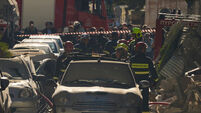
The bombings in Najaf and Karbala, predominantly Shiite cities 45 miles from each other south of Baghdad, came just over an hour apart. The first was a suicide blast that ripped through minibuses parked at the entrance of to Karbala’s main bus station, followed by a car bomb in a central Najaf square crowded with people watching a funeral procession attended by the city police chief and provincial governor.
The Najaf car bomb detonated in central Maidan Square where a large crowd of people had gathered for the funeral procession of a tribal sheik – about 100 yards from where governor Adnan al-Zurufi and police chief Ghalib al-Jazaari were standing. They were unhurt.
Hospital officials said 47 people were killed and at least 90 others wounded in the blast, which went off about 400 yards from the Imam Ali Shrine, the holiest Shiite site in Iraq
“A car bomb exploded near us,” al-Zurufi said. “I saw about 10 people killed.” Al-Jazaari believed he and al-Zurufi were the targets of the attack.
The blast sheered facades off nearby buildings and brought down part of a two-floor building. Dozens of local men clambered over the rubble, digging for survivors.
The Karbala blast destroyed about 10 passenger minibuses and set ablaze five cars outside the crowded Bab Baghdad bus station. Hospital officials said 13 people were killed and 33 injured.
It was Karbala’s second bombing in a week. On Wednesday, a bomb exploded at the city’s gold-domed Imam Hussein Shrine, killing eight people and wounding 40 in an apparent attempt to kill a top aide to Iraq’s most powerful Shiite cleric, Grand Ayatollah Ali al-Sistani.
An official with the leading Shiite political party, the Supreme Council for the Islamic Revolution, said the two bombings Sunday were “no doubt” linked.
“These operations aim at driving the Shiites away from the political process and toward acts of revenge to undermine the national unity,” Jalal Eddin al-Sagheer said.
“The whole issue has to do with elections.”
Grand Ayatollah Mohammed Said al-Hakim, one of Najaf’s top four Shiite clerics along with al-Sistani, denounced the bombings, saying they aimed to “create a disturbance in security and incite sectarian sedition” and that God will ”avenge and compensate” the victims.