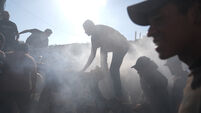
City buries its dead after train disaster
Rescuers choking on fumes finally extinguished fires on the freight train that crashed and exploded in a fireball in northeastern Iran yesterday killing more than 300 people and devastating five villages.
Neyshabur city buried its governor and residents scanned lists of the dead for friends and relatives believed killed.
Bulldozers and cranes were used to sift through the debris of villages and train wreckage 20 miles east of Neyshabur, and emergency workers collected human remains torn by a blast so powerful it devastated five villages, collapsing mud homes.
Burning freight cars from the derailment were put out shortly before dawn today, with firefighters persisting through the night despite freezing temperatures and fumes. The explosion left a crater about 50 feet deep.
In Neyshabur, stunned residents came out for the funeral of their governor, Mojtaba Farahmand-Nekou, who was among several city officials at the scene, including the fire chief, who were killed when the train cars exploded hours after the derailment.
More than 20,000 mourners, all wearing black, looked on as the body, wrapped in the red, white and green Iranian flag was driven through the city.
Shops and offices closed for three days of mourning. Survivors looked through lists of the dead posted outside hospitals and clinics.
Alireza Babaie, who was in his 70s, was looking for the name of a friend who was coming to visit him from the provincial capital, Mashhad.
“His family said he was on his way, and he should have reached here by now. I don’t know where he is, and I hope to God he is not among the dead,” said Babaie, who was in his 70s.
Hassan Rasouli, governor of Iran’s northeastern Khorasan province, told reporters 309 bodies had been recovered by midday today. He said 460 people had been injured.
The explosion happened hours after runaway train cars carrying fuel, industrial chemicals and cotton derailed, overturned and caught fire. The blast was so large that windows in homes as far as six miles away were shattered.
In an apparent indication of the explosion’s force, Iranian seismologists recorded a 3.6-magnitude tremor in the area at the moment of the blast.
“The entire area around me shook,” said Hussein Hassani, who saw the blast from several miles away. “It felt like a strong earthquake, but because the buildings didn’t collapse (where I was) I knew it wasn’t. Smoke could be seen for hours.”
Authorities were investigating what caused the 51 cars to roll out of the Abu Muslim train station.
Firefighters had extinguished 90% of the fire when the cars exploded, Mohammad Maqdouri, head of the local emergency operations headquarters, told Teheran television.
Of those injured 80% were hurt when their homes collapsed, and the rest were either burned or hurt from the force of the explosion, said Syed Majid Taqizadeh, head of the 22 Bahman hospital.
Most of the injured were from the village of Hashemabad, Taqizadeh said. Other victims were found in Dehnow, Abdolabad and other nearby villages.