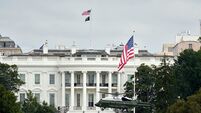
America goes to the polls
Halfway through a presidential term buffeted by terrorism and an improbable tangle in Congress, Americans were voting today in elections that offered both parties a chance to gain control of Congress.
Republicans and Democrats each had at least an outside chance of taking clean control of both houses of Congress.
But the prospect of more of the same – the Republicans holding the House of Representatives, Democrats commanding the Senate and President George Bush navigating the two – was also very much in play.
Anxiety was found high and low heading into a day certain only to bring surprises.
Aboard Bush’s plane on a four-state final swing yesterday, the expectations were buoyant but tinged with nervousness. On the ground in Missouri, a Democratic senator would not venture far beyond: “I just feel something out there.”
The suspense was left for voters to settle in elections that also will reshape power in governors' offices across the country and help determine whether Bush and his Democratic opposition can build a record to run on in 2004.
Bush, his popularity high but his ability to translate that into votes for his party unproven, campaigned in the Midwest and South to close out a vigorous campaign for Republican candidates. He implored Americans to return Senate control to his party and end the obstructionism he blamed on Democrats.
“That’s what I’m looking for – some allies,” Bush told Missouri Republicans before a windup evening rally in Dallas, Texas, and his return to Washington today.
Democrats fought to motivate voter turnout, calculating that apathy would work against them, in a district by district drive to reclaim control of the House and protect their whisker-thin hold on the Senate.
At stake today: all 435 House seats, several dozen of which were hotly competitive 34 Senate seats, of which six to eight looked like tossups and 36 governorships.
Voters also were choosing state legislatures, now split almost evenly between the parties, and deciding more than 200 ballot initiatives in 40 states.
The first national campaign in the age of terror ended as many campaigns do - hanging on local concerns and personalities, with debate over pocketbook issues and domestic matters drowning out the few disagreements over national security and even the prospect of a war with Iraq.
Democrats needed a gain of seven seats to win control of the House. Polls indicated that would be tough, but conceivable. The Republicans now control the House, 223-208, with one Democratic-leaning independent and three vacancies.
In the Senate, Republicans and Democrats each hold 49 seats and there are two independents – one a reliable Democratic vote.
With memories still fresh of the 2000 Florida balloting fiasco, and more than 200 counties trying new voting equipment, the suspense was not just over winners and losers but whether counters would be able to tell the difference.
Federal observers were dispatched by the hundreds to polling places in 14 states in the most ambitious monitoring of the nation’s ballot boxes since the 1960s civil rights era. Florida was getting the most attention.
The president’s party normally loses ground in midterm elections, although Democrats managed to add to their numbers in 1998 even when President Bill Clinton was in the throes of the Monica Lewinsky scandal.
White House spokesman Ari Fleischer gingerly predicted Bush, too, would see his party gain a bit. “The president is heartened by the fact that he appears likely to have broken the historical trend against incumbents in their first terms,” Fleischer said aboard Air Force One.
So far, that is not fact. Fleischer noted the many races were close and cautioned, “There’s no telling how they’re going to break, especially in the Senate.”
Both parties struggled to reach voters who were making their decisions based on factors other than war, terrorism or even the economy.
“It’s getting harder in the world to vote straight Republican or Democrat,” said Susan Carlson, 47, a Montana travel assistant. “We’re not just a Republican-Democratic society anymore. The issues aren’t so black and white.”
Carlson is a Republican who cast an absentee ballot for Democratic Senator Max Baucus because he “has truly shown himself to be bipartisan.”
But there were clear party distinctions in the campaign, among them a fight over whether to make last year’s Republican tax cuts permanent or let them expire after 10 years, and bitter arguments over Bush’s judicial nominations that Senate Democrats blocked because they said the nominees were too conservative.
Democrats put their hopes in a large turnout of traditional constituencies, among them blacks and union members.
“If we get the vote out, we’ll win this election,” Democratic gubernatorial candidate Bill McBride said in Florida, where he appeared to be trailing Governor Jeb Bush, the president’s brother.