Church grenade attacker may be among dead - police

Police in Pakistan were today trying to identify a body that they believe could be the attacker who launched the grenade attack on an Islamabad church, killing five people and injuring more than 45, including five Britons.

Police in Pakistan were today trying to identify a body that they believe could be the attacker who launched the grenade attack on an Islamabad church, killing five people and injuring more than 45, including five Britons.

At least one young man dressed in black hurled grenades into a Protestant church packed with Sunday worshippers, killing five people, including an American mother and daughter, in an attack clearly aimed at Pakistan’s foreign community.

No group claimed responsibility, but suspicion fell on Islamic extremists. More than 45 people, most of them foreigners, were injured, police and hospitals said. One body remained unidentified last night and officials said it could be the attacker.

British aid worker Nic Parham, 36, told PA News the attacker ran through the centre of the church.

‘‘He had a belt on with what looked as though it could have been homemade grenades,’’ Parham said. ‘‘I seem to remember about four or five explosions in total.’’

US president George Bush condemned the attack, which took place in the guarded diplomatic quarter in the heart of Pakistan’s capital about 400 yards from the US embassy compound.

And Foreign Secretary Jack Straw said the attack was aimed at undermining Pakistan’s pro-US president at a time when he was trying to quell Islamic fundamentalism following the Taliban’s fall in neighbouring Afghanistan.

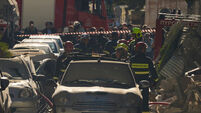
Dozens of police and soldiers rushed to the Protestant International Church after attack which occurred during the Sunday sermon.

Survivors spoke of deafening blasts, choking smoke and the pandemonium as terrified parents screamed for their children and stunned worshippers dived beneath chairs and behind cement pillars as bits of flesh were hurled through the air.

Parishioners sobbed and called out: ‘‘Brother! Brother!’’ as they tried to find friends and family amid the chaos.

Parents groped to find their way downstairs, where the children were attending Sunday School. Other parishioners feared touching the wounded, because unexploded grenades lay near their bodies.

Witnesses gave conflicting reports on the number of attackers, ranging variously from one to three. Last night Sunday, senior police superintendent Nasir Khan Durrani said authorities believed only one attacker was involved.

Durrani said the assailant may have died in the attack.

‘‘There was blood, blood, blood, intestines lying on the floor,’’ said Elisabeth Mundhenk, 54, of Hamburg, Germany as she awaited treatment for shrapnel wounds at a hospital. ‘‘It was horrific. There was a horrible smell and we could barely breathe.’’

Mark Robinson of San Clemente, California, who was being treated at a clinic for a minor leg injury, described ‘‘total pandemonium’’.

‘‘Everyone panicked,’’ Robinson said. ‘‘I saw one woman on the steps with a piece of shrapnel in her carotid artery. She bled to death right there.’’

The US embassy identified the dead Americans as Barbara Green and her daughter Kristen Wormsley, a pupil at the American School in Islamabad.

Green and her husband, Milton, worked at the US embassy - she in administration and he in the computer division. A son, whose name was not released, was slightly injured.

The other dead included one Afghan, one Pakistani and the one unidentified, Pakistani officials said.

Ten Americans were among the 45 injured, along with 12 Pakistanis, five Iranians, one Iraqi, one Ethiopian and one German, police said. The government said the injured also included Sri Lankans, Afghans, Swiss, the five Britons, Australians and Canadians.

Six or seven were in serious condition, District Judge Tariq Mehmood Khan said.

President Pervez Musharraf condemned the attack as a ‘‘ghastly act of terrorism’’ and pledged to find the culprits. Musharraf abandoned support for the Afghan Taliban after the September 11 attacks and backed the US-led war on terrorism.

On January 12, Musharraf announced a major crackdown on Islamic fundamentalists - who had been supported for years by Pakistani governments - and banned five extremist movements. More than 2,000 people were arrested, although many have since been released.

It had been long expected that religious extremists would strike back with dramatic attacks against foreigners, Western interests or government facilities in Pakistan.

The kidnap-killing of Wall Street Journal correspondent Daniel Pearl was seen as part of an extremist campaign to embarrass the government and undercut its support in the West. Four people, including British-born militant Ahmed Omar Saeed Sheikh, have been arrested in connection with the case.

‘‘This is part of a continuing effort by dissident extremist terrorists to try to destabilise President Musharraf’s government and the support which he enjoys from around the world, including the Western nations,’’ Mr Straw said.

‘‘It is a serious outrage, particularly because it took place within what we thought was the well-protected diplomatic enclave.’’

x

More in this section

Cookie Policy Privacy Policy Brand Safety FAQ Help Contact Us Terms and Conditions

© Examiner Echo Group Limited