PARIS ATTCKS: Vladimir Putin and Barack Obama edge closer owing to common threat of Islamic State
After weeks of accusing Moscow of propping up Syrian president, Bashar Assad, by bombing US-backed rebels, Obama changed his tune this week, praising Putin as a “constructive partner” in a nascent diplomatic effort to resolve Syria’s civil war.
Putin, too, has issued conciliatory signals, softening his tone about the US and calling for the US and Russia to “stand together” against the extremist threat.
Speaking on the sidelines of a summit in the Philippines, Obama even raised the prospect of military co-ordination with Russia, a possibility that has seemed remote since the US cut off military ties last year, over Moscow’s actions in Ukraine.
“If we get a better understanding with Russia about the process for bringing an end to the Syrian civil war,” he said, “that obviously opens up more opportunities for co-ordination with respect to ISIL.”
He was using an alternative acronym for the extremist group.
Obama suggested that Russia may be reorienting its military campaign in Syria toward IS targets, following the downing of a Russian jet in Egypt, a step the president said “we very much want to see.”
The Islamic State group has claimed responsibility for the October 31 crash that killed 224, and Putin has vowed to hunt down those responsible and to punish them.
For Putin, the terror attacks in Paris marked a watershed moment in relations with the West.
At a summit this week in Turkey, Putin huddled amicably with Obama and other Western leaders, whose changing attitudes reflect that the US and its allies need Russia’s help to confront an extremist threat now striking at the heart of Europe.
In a sign of an emerging Russia-West axis, French president, Francois Hollande, announced he would travel to Washington next week, and Moscow two days later, to discuss stepping up co-operation against IS.
Forging an alliance with the West to fight IS would offer Putin a chance to raise Russia’s global clout and prestige, and to repair relations that were shattered by the Ukraine crisis.
“The West may find it hard to discuss a degree of Russia’s responsibility for what happened in Ukraine, or the legitimacy of its presence in Syria, at a moment when the IS has reached all the way to the Eiffel Tower,” Gleb Pavlovsky, a political strategist who used to work for the Kremlin, said on Ekho Moskvy radio.
Yet, while the Kremlin is clearly hopeful that co-operation against IS will push Ukraine to the sidelines, both the US and Russia have rejected any link between Syria and Ukraine.
A White House official said no matter what happens in Syria, the US won’t lift crippling economic sanctions against Russia, until it fulfills its obligations under a Ukraine peace deal reached in February.
Because Obama has suspended formal US-Russia military ties, co-ordination in the fight can only go so far, even if Moscow sharpens its focus on IS.
In recent days, Russia has begun focusing some of its strikes on IS, but the vast majority have targeted moderate rebels fighting Assad, said an official who wasn’t authorised to comment publicly and requested anonymity.
Putin’s high-intensity air campaign makes him a major player in the Syrian conflict, and Russia’s influence over its ally, Assad, gives it a key role in diplomatic efforts to negotiate a political solution.
Obama said that for weeks, Russia has played a helpful role in talks in Vienna, which US Secretary of State John Kerry says could produce a ceasefire within weeks.
Though distrustful of Russia’s government after years of skirmishes, Obama has sought to compartmentalise the various conflicts in which the former Cold War foes inevitably cross paths.
Despite its quarrels over Syria and Ukraine, the US worked with Russia to secure the nuclear deal with Iran, after which Obama thanked Putin for his “important role” in formulating the accord.
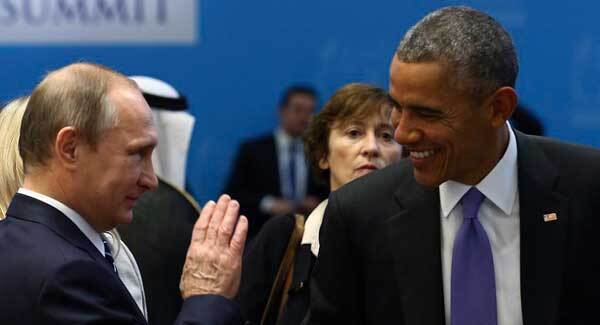
Obama’s interactions with Putin at the Group of 20 summit this week were notably devoid of the grim-faced exchanges they’ve had in the past.
Instead, the two were spotted leaning in close at a coffee table and, in another run-in, grinning broadly as they casually chatted.
And Putin, who has rarely missed a chance to mock the US, avoided outright gloating as he spoke to reporters at the meeting in Turkey.
Instead, he deployed even-mannered restraint when asked to assess the efficiency of the US-led coalition’s air war against IS, which has thus far fallen woefully short of Obama’s goal of defeating the extremist group.
“It’s not the right moment to judge who is better and who is worse,” Putin said. “Now, it’s necessary to look forward and pool efforts to fight the common threat.”

CONNECT WITH US TODAY



Be the first to know the latest news and updates