No 'food police' on duty in Sport Ireland kitchen
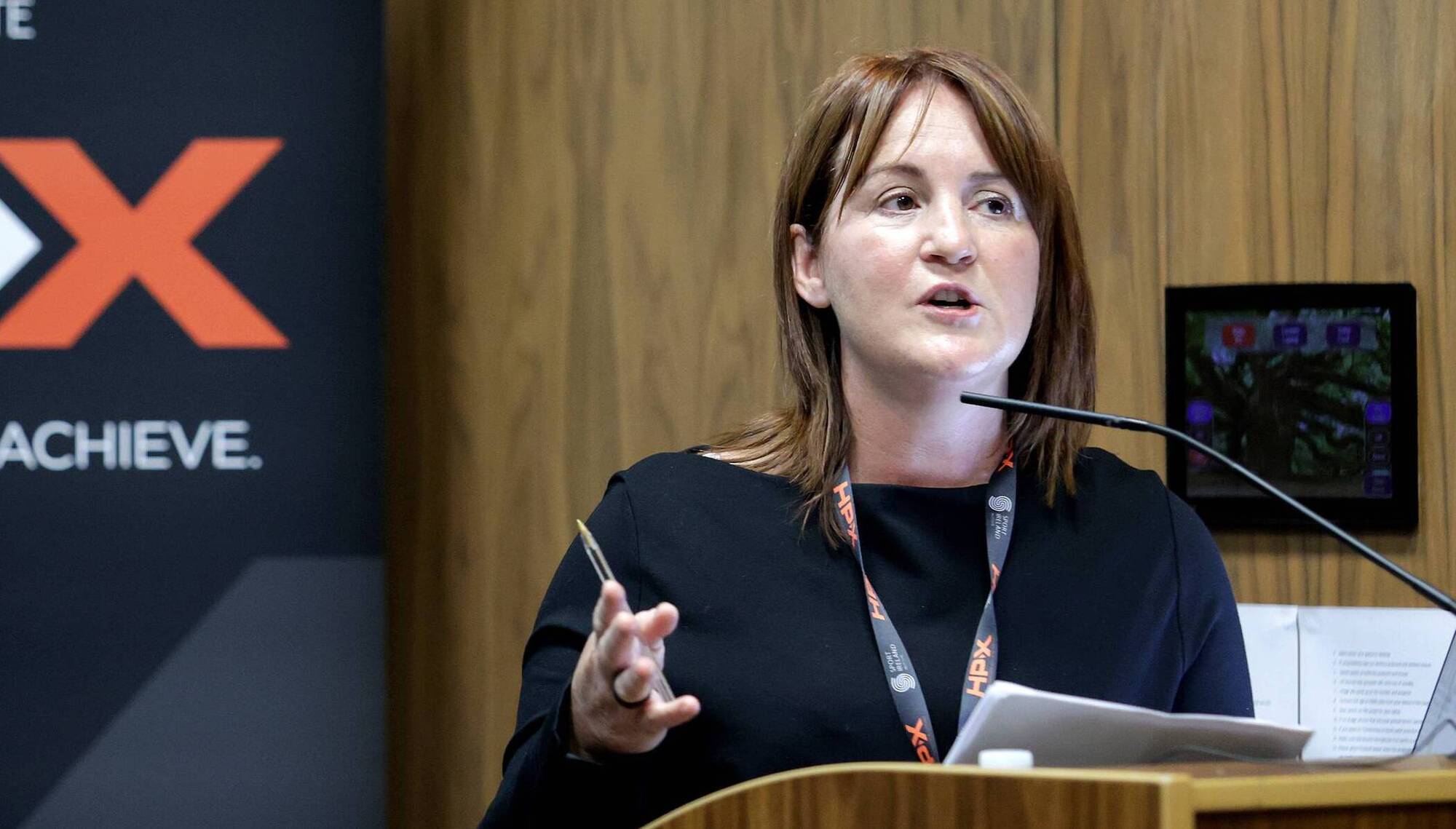
EDUCATION IS KEY: Sharon Madigan, performance nutrition boss with Sport Ireland Institute. Picture: ©INPHO/Laszlo Geczo
There is no epicentre to the Sport Ireland Campus that spreads across 500 acres out on the fringes of Dublin’s western boundary.
A bird’s-eye, or a drone’s, view would present a patchwork of buildings big and small, pitches and tracks that have been sown onto the overall quilt over a period of 20-plus years, and the project isn’t nearly done.
A national velodrome is emerging from the ground even now.
Still, if there is a beating heart to the place then it might be found in the kitchen of the Sport Ireland Institute building that sits somewhere close to what is also the geographic middle of this sprawling sporting estate.
The Institute is the scaffolding that supports the country’s elite athletes with all manner of support services. Its HQ serves as a magnet for athletes of all dispensations who meet and mingle over a bench press in the gym and a healthy smoothie in the lounge.
It’s the sort of place that makes ordinary mortals suck in our stomachs and make quiet, embarrassed promises to rescue the old runners from the bottom of the wardrobe, but these aren’t superhumans either. They can be as fallible as the rest of us.
Put it to Sharon Madigan, head of performance nutrition with the Institute since 2010, that the mantra about healthy eating must be emblazoned in the minds of our fittest and finest by this stage and she soon puts you right.
“Yeah, you would think, wouldn’t you? You tell someone to do something once, but it doesn’t work like that. There are a couple of things. Scenarios and circumstances change at different points so you have to be able to move that to suit what you’ve got in front of you.
“We have younger athletes coming up and we are still finding that the messages are not landing at that age. And then you have to, maybe it’s not the right word but ‘fight’, because you have the social media influencer messages that aren’t often fit for purpose.
“Those messages do permeate with Joe Public, athletes, everybody. None of us are immune to those types of messages so you really do have to sit down with people and make them blinkered to what they do and not listen to the noise that’s out there.”
Madigan has come across influencers whose messages are pretty much on point but it’s a Wild West of information and bad actors out there online and one of her issues is that some actually have significant issues with food themselves.
The other problem is that the web is a black hole of info and athletes, no less than the rest of us, can soon find themselves spiralling deeper into the abyss. That can be more than just counterproductive, it can be draining with it.
Even the simplest of advice or mottos can prove harmful.
Move more, eat less is a maxim that can be all too easily applied to sports where being lighter physically is deemed to be better. Think of your cyclists, your triathletes and your endurance runners. Fine. It may work for a time, but the risk outweighs any reward.
One of the messages written up in the Institute’s kitchen is one on the need to think about bone stress injuries. Ribs for bowlers, boxers and rowers. Leg injuries in athletics. A cyclist coming off their bike and doing a collar bone when they shouldn’t have.
Why? Because their nutrition wasn’t right.
“That bone piece, you can't see them, you can't feel them until there's a problem. Then there is a problem. This is all of the stuff that goes on for years beforehand. Athletes go, ‘but I've been doing this for years. Why is this not working now?’ That's why it's not working.”
The notion that any advances to be made at this stage of the 21st century might be miniscule are refuted time and again. Sometimes in astonishing ways. Take Daniel Wiffen who won gold and bronze in distance swimming at the 2024 Olympics.
Wiffen, who needs to inhale 8,000 calories a day, admitted in the last six months that he had completely neglected nutrition for years. The Olympic Federation of Ireland actually gave him a grant just to address this gap in his preparation a few years ago.
This is one of Ireland greatest ever athletes. Gains are there to be made everywhere.
Education is, and always will be, key to it. Madigan and the other five nutritionists with the Institute work with athletes across the sporting spectrum but commonalities abound in how people underestimate or forget the importance of what they eat and how much.
If an athlete finds themselves flat in a session or across a week then it’s not because they’ve suddenly lost fitness. How could it? It might be that they did two workouts back-to-back and didn’t eat enough before, in between or after to compensate.
The brain might know the difference between a Tuesday night and a Wednesday morning but Madigan tries to explain that the body doesn’t. And if she has a pet hate though it’s the concept of the ‘cheat meal’ or the ‘blowout’.
The very words rub her up the wrong way.
Take the boxers as an example. They will work out on Campus every day from Tuesday to Friday inclusive. They do four sessions in the 24 hours between Thursday morning and Friday morning alone. That, she says, is the night to eat your pizza.
The alternative is the inevitable fade, the equally inevitable slide into bad choices, the guilt and everything else that follows on from it.
“Like, we've frozen yogurt in there today. People go, ‘why have you that’, or there's turkey sausages, or there's whatever. You can't get 8-10,000 calories on rocket and tomatoes. We have to cut our cloth to suit, and I'd love to be able to eat all that, but the context for me is very different.
“But that's where the athletes are falling into that trap that, ‘oh, my friend group, or my family doesn't do this, then why would I?’ Language is key. We set it up straight away whenever we put those words in there. I don't go down that route at all. I go, ‘great, enjoy it. And can I have some?’
"We're not the food police, you know?”

CONNECT WITH US TODAY



Be the first to know the latest news and updates