UCD and Open University researchers discover Earth-like glaciers on Mars
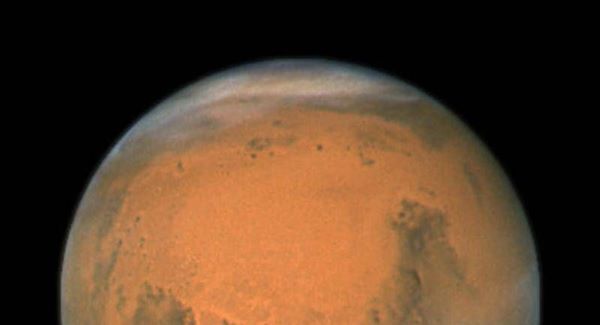
Researchers at University College Dublin (UCD) and The Open University (OU) have found evidence that water once flowed beneath a glacier on Mars.
This discovery suggests that Mars had glaciers more similar to those found on Earth than previously thought.
Dr Colman Gallagher of UCD’s School of Geography and Earth Institute and OU planetary science researcher Dr Matthew Balme, report that they have found direct evidence of melting and significant flows of liquid water beneath a glacier on Mars.
They examined a landform known as an ‘esker’, emerging from a degraded glacier in the Phlegra Montes region of Mars. Eskers are found only in ‘wet-based’ glacial systems – but glaciers on Mars have generally been thought to be ‘dry-based’ with no melt water.
“Finding an esker on Mars means that significant quantities of liquid water flowed beneath this glacier, and that liquid water can persist in the near-surface environment, despite Mars being generally too cold to permit liquid water” said Dr Gallagher.

The eskers are evidence of glacial melting and a wet-based regime, and the melting of the glaciers was due to enhanced geothermal heat flux, not climate warming.
Indirect evidence for eskers on Mars has been reported before, but this research offers the first observation of eskers directly linked to a glacier.
“Eskers have been reported on Mars before,” said Dr Balme, “but they are normally stranded in the landscape with little to associate them with a glacial system. This is the first identification of an esker system on Mars that is still physically associated with its parent glacier.
“Eskers on Mars are important as they indicate melt of glacial ice – and finding another type of environment where liquid water can occur is important in the whole ‘life on Mars’ question, as it provides yet more evidence for habitability in the recent past.”
It comes in the same week that NASA confirms that the "strongest evidence yet that liquid water flows intermittently on present-day Mars" had been discovered, and further fuels the burning question of whether other planets such as Mars can sustain life.
“Our quest on Mars has been to ‘follow the water,’ in our search for life in the universe, and now we have convincing science that validates what we’ve long suspected,” said John Grunsfeld, astronaut and associate administrator of NASA’s Science Mission Directorate in Washington.
“This is a significant development, as it appears to confirm that water - albeit briny - is flowing today on the surface of Mars.”
This image shows dark streaks from flow of briny liquid water on Mars: http://t.co/lp6Der5qbe #MarsAnnouncement pic.twitter.com/4D3isI2zyj
— NASA (@NASA) September 28, 2015
Despite a number of similarities between the climate of Mars and that on Earth, the presence of liquid water has remained one of the key differences between the two planets and an important factor in determining whether the planet could sustain life.