VIDEO: Criticism over sluggish response to Nepal Earthquake
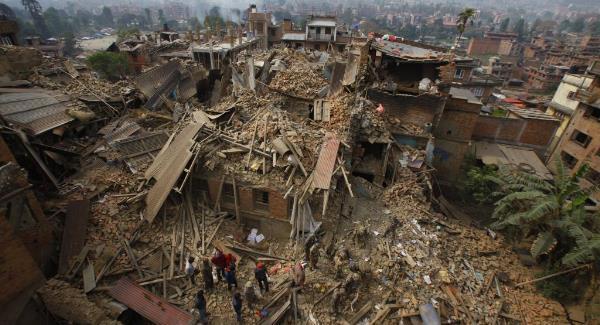
Nepal’s government has drawn early criticism from opposition politicians and some residents for what they say has been a sluggish response to the humanitarian crisis triggered by Saturday’s massive earthquake.

VIDEO: Criticism over sluggish response to Nepal Earthquake

As the body count from the 7.9-magnitude quake in Nepal rose, aid had begun to arrive in the country, but disbursement in many areas was slow.

The country’s mountainous terrain, poor infrastructure, and lack of equipment has complicated the task of assessing the damage and saving lives.

However, even in the capital, Kathmandu, people frustrated at waiting for search and rescue teams have been picking through rubble of collapsed buildings with their bare hands to look for loved ones buried underneath.

The opposition Unified Communist Party said it was cranking up its large volunteer network to extend relief, accusing the government of moving too slowly.

“The government’s response has not been good. They have not been able to carry out rescue and relief operations well,” said Shiva Khakurel, aide to former prime minister Pushpa Kamal Dahal, the former communist revolutionary who is better known as Prachanda.

“They seem to be directionless.”

The Himalayan nation’s government was almost invisible in the quake’s immediate aftermath, critics said, although it had stepped up its response by Monday, when home minister Bam Dev Gautam personally supervised aid delivery at the country’s main airport.

Khakurel said Prachanda will meet prime minister Sushil Koirala to draw his attention to the government’s shortcomings and offer help in distributing relief material in remote areas of the country.

Koirala said he was ordering intensified rescue efforts. “The government is doing all it can for rescue and relief on a war footing,” he said. “It is a challenge and a very difficult hour for Nepal.”

George Varughese, Nepal representative for San Francisco-based Asia Foundation, said years of political instability had distracted the administration and left it under-prepared to deal with humanitarian crises in the disaster-prone country.

“Disaster management has dropped in the priority list to secondary and tertiary level of importance,” he said.

“It is a fragile system there, but it does show that such a disaster has political consequences as well, in the sense that the government is not seen to be able to take charge,” Rahul Roy-Chaudhury, senior fellow for South Asia at the International Institute for Strategic Studies in London, said of Nepal.

However, he added that he hoped the political leadership would step up to assuage their citizens’ concerns in the next 48 to 72 hours.

DISCOVER MORE CONTENT LIKE THIS

More in this section

Cookie Policy Privacy Policy Brand Safety FAQ Help Contact Us Terms and Conditions

© Examiner Echo Group Limited