Three men get first bionic thought-controlled hands
All had suffered nerve damage from accidental climbing and motorcycle injuries that left them with little control over their ârealâ hands and in pain.
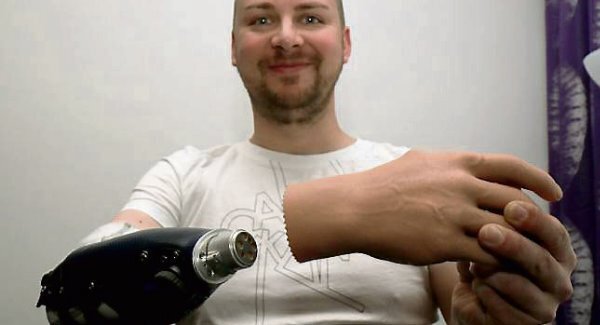
The Austrian trio underwent a new technique called âbionic reconstructionâ that involved amputating the hand and substituting it with an advanced robotic prosthesis.
Three months later, all three have for the first time since their accidents been able to accomplish everyday tasks such as picking up a ball, pouring water from a jug, using a key, cutting food with a knife, and undoing buttons. They are also said to be in less pain.
The bionic hand responds to âthought-controlledâ electrical impulses from attached muscles.
Professor Oska Aszmann, director of the Christian Doppler Laboratory for Restoration of Extremity Function at the Medical University of Vienna, who developed the technique, said the âbrachial plexus avulsionâ nerve injuries suffered by the men in effect amounted to âan inner amputationâ.
He said: âThe scientific advance here was that we were able to create and extract new neural signals via nerve transfers amplified by muscle transplantation. These signals were then translated into solid mechatronic hand function.â
Before amputation, all three patients spent an average of nine months undergoing mental training to learn how to control a computer-generated âvirtualâ hand.
Details of the procedure are published in The Lancet medical journal.