Nobel trio win for lighting up our world in blue LED
It is a breakthrough that has spurred the development of LED technology to light up homes, computer screens, and smartphones worldwide.
Isamu Akasaki, Hiroshi Amano, and naturalised US citizen Shuji Nakamura revolutionised lighting technology two decades ago when they came up with a long-elusive component for white LED lights.
In countless applications today, they have replaced less efficient incandescent and fluorescent lights.
“They succeeded where everyone else had failed,” the Nobel committee said of the trio yesterday. “Incandescent light bulbs lit the 20th century; the 21st century will be lit by LED lamps.”
Red and green light-emitting diodes have been around since the mid-19th century and have been used in applications such as watches and calculators. However, scientists had struggled for decades to produce the shorter-wavelength blue LED needed in combination with the others to produce white light when the three laureates made their breakthroughs in the early 1990s.
Their work enabled LED lights — more efficient and long-lasting than previous light sources — to be used in a range of applications, including street lights, televisions, and computers.
“It is very satisfying to see that my dream of LED lighting has become a reality,” Nakamura, 60, said in a statement released by the University of California, Santa Barbara.
“I hope that energy-efficient LED light bulbs will help reduce energy use and lower the cost of lighting worldwide,” he said.
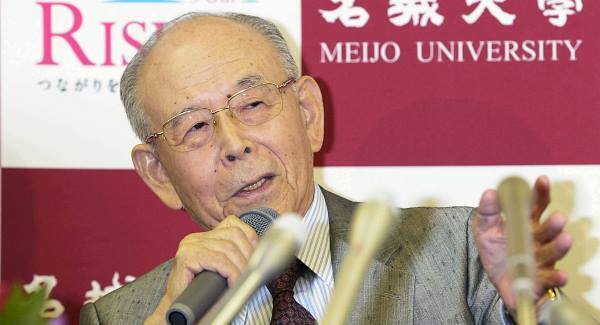
Akasaki, an 85-year-old working at Meijo University and Nagoya University, said he had often been told that his research would not bear fruit within the 20th century.
He and Amano, 54, made their inventions while working at Nagoya University, while Nakamura was working separately at Japanese company Nichia Chemicals.

CONNECT WITH US TODAY



Be the first to know the latest news and updates