Brussels Briefing

Europe correspondent, Ann Cahill, delivers her weekly briefing on Euro affairs from the European Parliament.

Brussels Briefing

While MEPs are campaigning for votes, one Irish woman is pushing ahead with her job — ombudsman Emily O’Reilly. She has seized her role with both hands and is busily expanding its weight, no longer waiting for complaints from citizens about being hard-done by the EU institutions.

She has undertaken investigations on her own initiative of the expert groups set up by the Commission to advise them on draft legislation, with a specific investigation into 14 “civil dialogue groups” to advise on agricultural policy. Many of these groups have been shown to be top heavy with business interests with barely a nod to civil society. This should also open up the lobbying area and the need for greater transparency on who is influencing whom an area which some MEPs might like to resist.

250 protesters held

While business leaders debated business and politicians debated trust in Brussels, police arrested more than 250 citizens protesting silently against what they saw as actions against their interests.

Business Europe held their annual conference in the beautiful Palace Egmont discussing issues such as the new trade agreement with the US, the weak economy and competition from abroad.

But someone gave the order to clear the protesters seated on the ground near the Palace, and the result was distinctly anti-business and anti-EU.

EU gas supplies

With all the emphasis on EU countries being so dependent on Russian gas, the US Energy Information Administration points out that Norway is the world’s third-largest natural gas exporter, after Russia and Qatar.

They supplied 21% of total European natural gas needs last year, mainly through its extensive export pipeline infrastructure while a small fraction is exported as liquefied natural gas (LNG) by tanker.

The largest recipients were Britain, Germany, France, the Netherlands, and Belgium. The EU is hoping US shale gas as LNG will help replace Russian supplies in the future.

Danes mystified over cartoon withdrawal

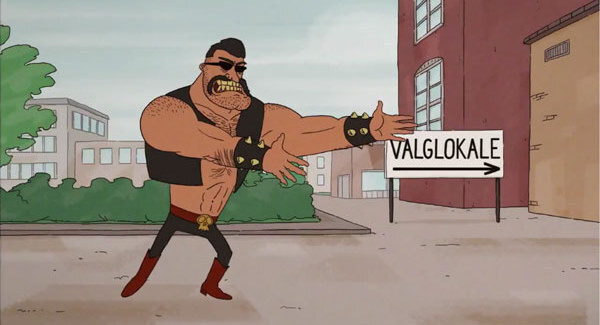
The Danes — known like the Dutch for their rather basic sense of humour — are mystified about why they had to withdraw a video cartoon urging people to vote in the European Parliament elections.

Featuring a hairy, muscular, cave-type man, the cartoon opens with him surrounded by naked svelte maidens pampering him on a bed. Suddenly he hears the call, hurls them aside and takes to the skies.

He alights on a range of people, punching and abusing most of them to insist they vote — explaining his actions in a flashback to his youth when he realised he had no say in EU issues because of his failure to vote.

Complaints about its misogyny and violence perplexed many Danes, who explained it was designed to appeal to youth and not the old fogies who forced its withdrawal — but not before it went viral.

Cutting the supply of commercial data

German media reports that the federal government is to ban state contracts going to private companies that are suspected of handing sensitive commercial information to the US.

However, they have apparently excluded the US giant IT company, Computer Sciences Corporation. One of their subsidiaries was involved in abducting a German citizen who was handed to the CIA and tortured before they finally admitted he was innocent.

They also got the contract for a system to collect vast amounts of data, similar to the NSA’s spy programmes, and contracts involving the flow of information between German government ministries and bodies.

CSC say they can be considered safe, as business with the US is done by a separate, independent business arm — although all company emails do go through the same company server! What do they have on the German government?

Better control of insurance sector

With the EU stressing the need to regulate banks a bit better than in the past, the next step looks likely to be greater controls over insurance companies.

Controlling vast sums of public and private funds, and despite operating EU-wide they can still behave as though national borders still exist.

This was highlighted by Fine Gael MEP Jim Higgins who pointed out that the collapse of Setanta Insurance left 75,000 uninsured and needing to pay out for cover a second time.

They were licensed in Malta and the Maltese regulator was supposed to be in charge — but the Irish State is left with the job of helping out its Irish customers.

Cuts to small countries’ MEPs mooted

Germany’s constitutional court regularly bemoans the fact that its citizens have only one MEP for every 800,000 citizens, while for smaller countries like Ireland there is one MEP for around 400,000 citizens, and going down to one per 80,000 in Malta.

This is because of regressive proportionality to ensure smaller countries are not completely overpowered by those with bigger populations.

Now academic Nicolas Veron of the Bruegel think-tank has quantified the deficiency — and comes up with a figure for the imbalance of 28%. He points out that 11 countries he investigated, including Germany, have similar imbalances, though not as large.

The way to overcome this is to cut the minimum number of MEPs per country from 6 to 3. This would mean another cut in Ireland’s MEPs, possibly to 6.

More in this section

Cookie Policy Privacy Policy Brand Safety FAQ Help Contact Us Terms and Conditions

© Examiner Echo Group Limited










