Cherry tree’s early flowering a cosmic mystery
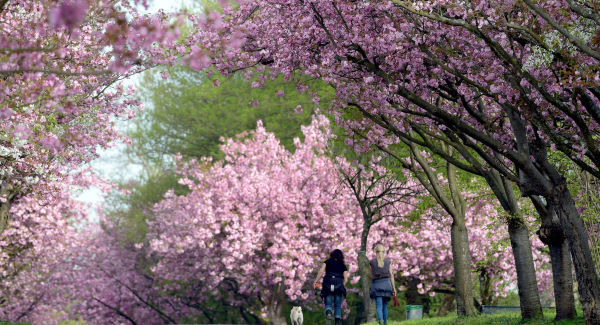
The four-year-old sapling — grown from a cherry stone that spent time aboard the International Space Station (ISS) — burst into blossom on April 1, six years ahead of Mother Nature’s normal schedule.
Its early blooming baffled Buddhist brothers at the ancient temple in central Japan where the tree is growing. “We are amazed to see how fast it has grown,” said Masahiro Kajita, chief priest at the Ganjoji temple in Gifu.
“A stone from the original tree had never sprouted before. We are very happy because it will succeed the old tree, which is said to be 1,250 years old.”
The wonder pip was among 265 harvested from the celebrated Chujo-hime-seigan-zakura tree, selected as part of a project to gather seeds from different kinds of cherry trees at 14 locations across Japan.
The stones were sent to the ISS in November 2008 and came back to Earth in July 2009 with Japanese astronaut Koichi Wakata, after circling the globe 4,100 times.
Some were sent for lab tests, but most were ferried back to their places of origin, and a selection were planted at nurseries near the Ganjoji temple.
By April this year, the “space cherry tree” had grown to around 4m tall, and suddenly produced nine flowers — each with just five petals, compared with about 30 on flowers of the parent tree.
It normally takes about 10 years for a cherry tree of the similar variety to bear its first buds.
The Ganjoji temple sapling is not the only early flowering space cherry tree. Of the 14 locations in which the pits were replanted, blossoms have been spotted at four.
Two years ago, a young tree bore 11 flowers in Hokuto, a mountain region 115km west of Tokyo, around two years after it was planted.
It was of a variety that normally only comes into flower at the age of eight.
Kaori Tomita-Yokotani, a researcher at the University of Tsukuba, took part in the project and said: “We still cannot rule out the possibility that it has been somewhat influenced by its exposure to the space environment.”