Super typhoon leave at least 4 dead in Philippines
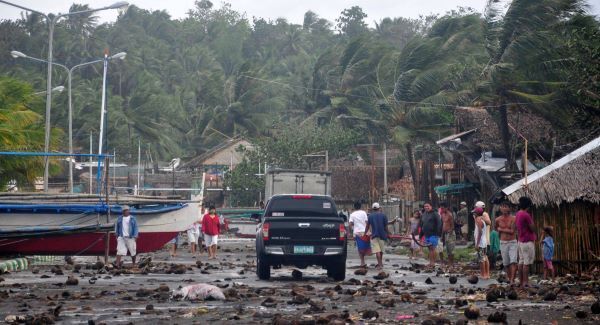
Typhoon Haiyan raced across a string of islands from east to west — Samar, Leyte, Cebu and Panay— and lashed beach communities with over 200 kilometre (125 mile) per hour winds. Nearly 720,000 people were forced to evacuate their homes.
NEW PHOTO: High waves pounding the sea wall amidst strong winds as Typhoon #Haiyan hit the city of Legaspi @KGWNews pic.twitter.com/vzGOz6yQfN
— NewsBreaker (@NewsBreaker) November 8, 2013
At least two people were electrocuted in storm-related accidents, one person was killed by a fallen tree and another was struck by lightning, official reports said.
Southern Leyte governor Roger Mercado said the typhoon triggered landslides that blocked roads, uprooted trees and ripped roofs off houses around his residence.
The dense clouds and heavy rains made the day seem almost as dark as night, he said.
“When you’re faced with such a scenario, you can only pray, and pray and pray,” Mercado told The Associated Press by telephone, adding that mayors in the province had not called in to report any major damage.
“I hope that means they were spared and not the other way around,” he said. “My worst fear is there will be massive loss of lives and property.”
The latest look at Super Typhoon #Haiyan. It’s among the strongest typhoons ever recorded anywhere on earth. pic.twitter.com/KsbxSxZjFS
— CNN Weather (@CNNweather) November 8, 2013
Weather officials said Haiyan had sustained winds of 235 kph (147 mph) with gusts of 275 kph (170 mph) when it made landfall. That makes it the strongest typhoon this year, said Aldczar Aurelio of the government’s weather bureau.
Eduardo del Rosario, head of the disaster response agency, said a typhoon of similar strength that hit the Philippines in 1990 killed 508 people and left 246 missing.
CONNECT WITH US TODAY



Be the first to know the latest news and updates