50,000 dogs run riot through Detroit wasteland
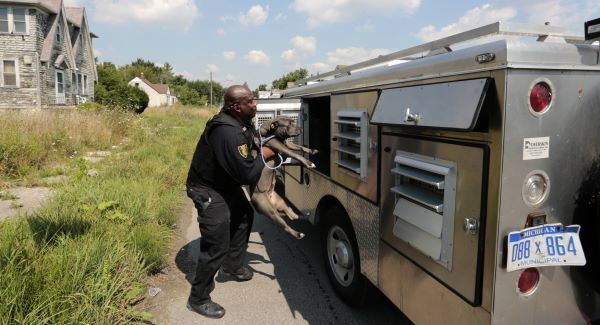
As many as 20 canines have been found making dens in boarded-up homes in the community of about 700,000 that once pulsed with 1.8 million people.
One officer in the Police Department’s skeleton animal-control unit recalled a pack splashing away in a basement that flooded when thieves ripped out water pipes.
“The dogs were having a pool party,” said Lapez Moore, 30. “We went in and fished them out.”
Poverty roils the Motor City and many dogs have been left to fend for themselves, abandoned by owners who are financially stressed or unaware of proper care.
Strays have killed pets, bitten mail carriers and clogged the animal shelter, where more than 70% of them are euthanised.
There are as many as 50,000 of them roaming the city, said Harry Ward, head of animal control. “With these large open expanses with vacant homes, it’s as if you designed a situation that causes dog problems,” he said.
The number of strays signals a humanitarian crisis, said Amanda Arrington of the Humane Society of the United States, based in Washington. She heads a programme that donated $50,000 (€37,330) each to organisations in Detroit and nine other US cities to get pets vaccinated, fed, spayed, and neutered.
Ms Arrington said when she visited Detroit in October, “It was almost post-apocalyptic, where there are no businesses, nothing except people in houses and dogs running around.”
“The suffering of animals goes hand in hand with the suffering of people,” she added.
She said pet owners who move leave behind dogs, hoping neighbours will care for them but unfortunately this does not happen. Those dogs take to the streets and reproduce.
Compounding that are the estimated 70,000 vacant buildings that provide shelter for dogs, or where some are chained without care to ward off thieves, Mr Ward said.
Most strays are pets that roam, often in packs that form around a female in heat, he said. Few are true feral dogs which have had no human contact.
Packs of wild, abandoned dogs are roaming the streets of Detroithttp://t.co/LsMC6YVh39 pic.twitter.com/vDmxMitWTI
— The Texas Daily (@TheTexasDaily) August 22, 2013
Mr Ward said Detroit’s three shelters — his and two non- profit facilities — take in 15,000 animals a year, including strays and pets that are seized or given up by owners.
They are among the victims of a historic financial and political collapse.
Detroit — a former auto manufacturing powerhouse, declared the largest US municipal bankruptcy on Jul 18 after years of decline. The city has more than $18bn in long-term debt and had piled up an operating deficit of close to $400m. Falling revenue forced cutbacks in police, fire-fighting — and dog control.
With an annual budget of $1.6m, Mr Ward has four officers to cover the 139sq m (360sq km) city seven days a week, 11 fewer than when he took command in 2008.
He has one dog-bite investigator, down from three.
“We are really suffering from fatigue, short staffed and work too much overtime,” he said. The officers, who wear bulletproof vests to protect themselves from irate owners, are bringing in about half the number of animals that crews did in 2008, Mr Ward said.
In July, the pound stopped accepting more animals for a month because the city hadn’t paid a service that hauls away euthanised animals for cremation at a cost of about $20,000 a year.
The freezers were packed with carcasses, and pens were full of live animals until the bill was paid.
Pit bulls and breeds mixed with them dominate Detroit’s stray population because of widespread dog fighting, said Mr Ward. Males are aggressive in mating, so they proliferate, he added.
One type of fighting pit bull has become known as far as Los Angeles as the “Highland Park red,” named after a city within Detroit’s borders, Mr Ward said.
Their prevalence was clear as Mr Ward and officers Ms Moore and Malachi Jackson answered calls. On a block where vacant houses and lots outnumbered occupied ones, they found four dogs in an abandoned house — a male and three females, including a pregnant pit bull with a prized blue-gray coat.
Mr Ward said it appeared the dogs were fed by someone who used the house to hide stolen items.
Aggressive dogs force the US Postal Service to temporarily halt mail delivery in some neighbourhoods, said Ed Moore, a Detroit- area spokesman. He said there were 25 reports of mail carriers bitten by dogs in Detroit from October through to July. Though most are by pets at homes, strays have also attacked, he said.
“It’s been a persistent problem,” he said.
Mail carrier Catherine Guzik told of using pepper spray on swarms of tiny, ferocious dogs in one neighbourhood. “It’s like Chihuahuaville.”
At two nearby homes, one pet dog was killed recently and another injured by two stray pit bulls that jumped fences into yards, neighbour Debora Mattie said. Last year, there were 903 dog bites in Detroit, according to Mr Ward, adding that most go unreported to police. He said 90% are by dogs whose owners are known.