Libyan rebels reject Gaddafi’s negotiation offer
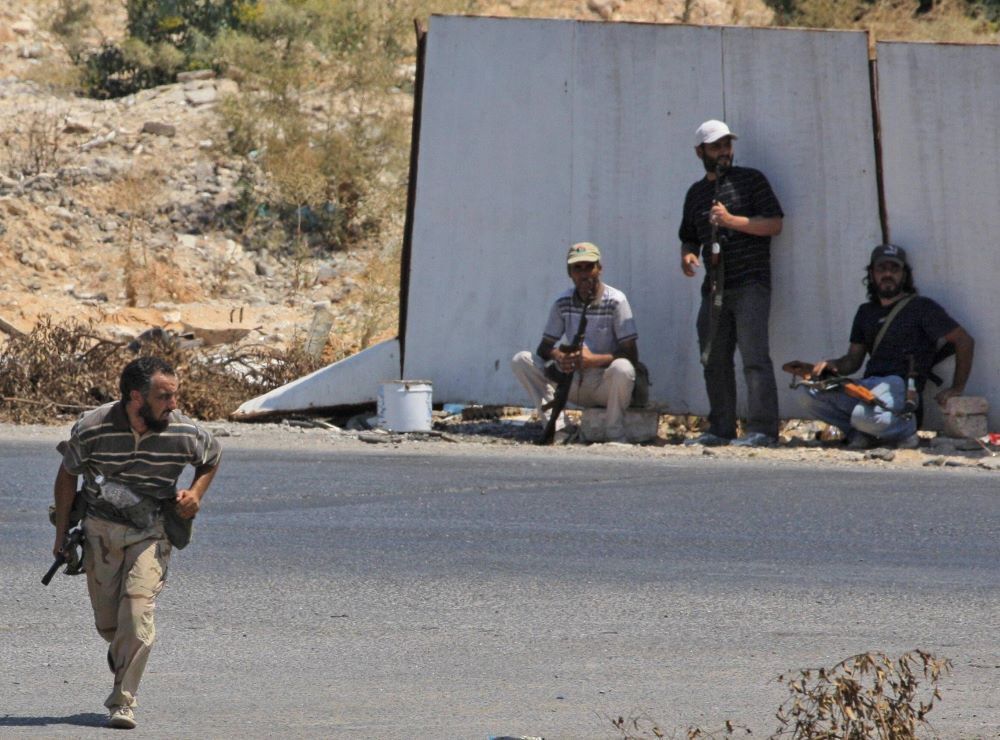
LIBYAN rebels have rejected an offer by Colonel Muammar Gaddafi to negotiate and said they have captured the eastern town of Bin Jawwad, forcing regime loyalists to flee after days of fighting.

Libyan rebels reject Gaddafi’s negotiation offer

With his regime crumbling, Gaddafi is on the run, but his chief spokesman Moussa Ibrahim said the deposed leader is still in Libya.

As the call for negotiations came, new signs emerged of arbitrary killings of detainees and civilians by Gaddafi forces during the rebels’ push into Tripoli earlier this week, including some 50 charred corpses at a regime lockup.

The rebels dismissed Gaddafi’s proposal, relayed by Ibrahim by phone, to have his son al-Saadi lead talks on a transitional government as delusional.

“I would like to state very clearly, we don’t recognise them. We are looking at them as criminals. We are going to arrest them very soon,” Mahmoud Shammam, the information minister in the rebels’ transitional government, told a news conference. “Talking about negotiations is a daydream for what remains of the dictatorship.”

The opposition fighters have threatened to advance westward on the coastal road toward Gaddafi’s home town of Sirte if tribal leaders there don’t agree to surrender.

The fighting in the east comes as the rebels consolidated their hold on Tripoli, some 350 miles to the west of Bin Jawwad.

Mohammed al-Rajali, a spokesman for the rebels on the eastern frontlines, said they captured Bin Jawwad and deployed forces in the city after days of fighting.

He said Gaddafi’s forces fled westward and were likely to join regime forces in Sirte, the headquarters of Gaddafi’s tribe and his last major bastion of support.

The opposition has threatened to assault the city, which has been heavily targeted by Nato airstrikes, if tribal leaders there refuse a peaceful surrender.

With Gaddafi on the run, his spokesman Moussa Ibrahim called The Associated Press to say Gaddafi is still in Libya and offering to have his son, al-Saadi, lead talks with the rebels on forming a transitional government. In the past, Gaddafi referred to the rebels as “thugs” and “rats”.

Ibrahim said he saw Gaddafi on Friday in Libya.

Signs emerged of killings of detainees and civilians by Libyan forces, including the 50 charred corpses found in a makeshift lock-up near a military base that had been run by the Khamis Brigade, an elite unit commanded by Gaddafi’s son, Khamis.

Mabrouk Abdullah, who said he survived a massacre by Gaddafi’s forces, also said that guards opened fired at some 130 civilian detainees in a hangar near the military base, and fired again when prisoners tried to flee.

Abdullah, who was at the site yesterday, said he and other prisoners were told by a guard they would be released on Tuesday. Instead, they threw grenades and fired at detainees huddling in a hangar.

Abdullah said he had been crouching along a wall and was shot in his side, lifting his shirt to show his injury. As survivors of the initial attack tried to flee, they came under fire again.

The killings by Gaddafi troops appeared to have taken place in the past week, as rebel fighters gradually took control of Tripoli, according to a witness and international rights groups.

New York-based Human Rights Watch said yesterday it has evidence indicating that Gaddafi loyalists killed at least 17 detainees and arbitrarily executed dozens of civilians as rebels moved into Tripoli.

Reporters touring Tripoli have found clusters of decomposing corpses in several areas of the capital.

“The evidence we have been able to gather so far strongly suggests that Gaddafi government forces went on a spate of arbitrary killing as Tripoli was falling,” said Sarah Leah Witson of Human Rights Watch.

The rebels control most of Libya but are struggling to alleviate shortages of water, fuel and electricity. Usama el-Abed, the deputy leader of the new city council, said up to 70% of residents don’t have enough water, but that the shortages are due to technical problems.

The UN is preparing to ship in baby food, bottled water and medicine. World Health Organisation officials are on Malta, some 350 kilometres north of Tripoli, to prepare the aid shipments, which are expected to leave for Libya in the next few days.

More in this section

Cookie Policy Privacy Policy Brand Safety FAQ Help Contact Us Terms and Conditions

© Examiner Echo Group Limited