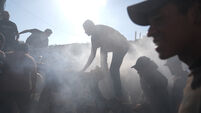
Friends and families gather to mourn miners in private
Paying their respects, a group of emergency workers wore black patches on their uniforms with yellow lettering that read: “In memory of our fallen Sago miners.”
Grove was one of 12 miners killed last Monday in the Sago Mine explosion. Friends and families of the victims began grieving on Saturday in private visitations, with funerals scheduled from yesterday through to tomorrow.
Meanwhile, doctors treating the critically injured sole survivor planned to ease Randal McCloy Jnr’s sedation last night, a day after he returned from treatment at a Pittsburgh hospital.
“It has been very difficult to allow him to awake, although that is our hope today,” said Dr Larry Roberts, the head of Mr McCloy’s treatment team at West Virginia University’s Ruby Memorial Hospital.
Doctors have placed Mr McCloy, 26, in a medically induced coma to allow his brain time to heal.
In recent days, Mr McCloy’s eyes flickered and he bit down on his breathing tube when the medication was eased, said Dr Richard Shannon, who treated Mr McCloy at Allegheny General Hospital in Pittsburgh.
Back at the mine, 12 black bows were tied around the entrance’s fence, and residents spent the day shuttling back and forth to the miners’ wakes.
After their wrenching vigil of raised and shattered hopes during the recovery effort was played out in front of television cameras, the families took pains to carry out their grieving in private.
Police cars lined up to keep television trucks, reporters and others away from the visitation for 28-year-old David Lewis in Philippi.
In Buckhannon, two state troopers guarded the entrance to a funeral home where the visitation for 51-year-old Alva Bennett was held.
Governor Joe Manchin spent about an hour at a funeral home with the family of Groves, 56. He presented relatives with a memorial proclamation from the state and hugged Groves’s mother Wanda.
Family members also learned that one miner was alive at least 10 hours after the explosion. Shuttle car operator Jim Bennett, 61, had scrawled a timeline while he was trapped, his daughter said.
“Each time he documented, you could tell it was getting worse,” Ann Merideth said.
“Later on down the note, he said that it was getting dark. It was getting smoky. They were losing air.”
If he was lucid enough to be writing 10 hours after the blast, he could have been saved - but the rescue operation didn’t move fast enough, Ms Merideth said.
The first rescuers didn’t go into the mine until 11 hours after the blast, a lag officials said was necessary to clear the mine of high concentrations of poisonous gases. The miners were brought out more than 40 hours after the explosion.